José Rivera, References to Salvador Dalí Make Me Hot, directed by Gigi Guizado, A Public Fit Theatre Company, April 4 to April 22, 2025.
The heat is on for the Las Vegas theatre scene. A January New York Times article by the drama critic Elisabeth Vincentelli drew attention to the city’s stage production outfits, including Majestic Repertory Theatre, A Public Fit Theatre Company, and Vegas Theatre Company (formerly Cockroach Theatre Company). With access to a “wild pool of talent,” in the midst of a growing American metropole, local productions, wrote Vincentelli, should be attracting more and more patrons—not only from the community but from across the country. Just as visitors to the Big Apple often venture off-Broadway, Vegas tourists might increasingly head off-Strip for theatrical entertainment.
A Public Fit has grown, over the past eleven years, to become one of the most significant contributors to the city’s expanding arts and culture networks, bringing esteemed plays to local theatergoers. Their season this year included mainstage productions of Tracy Letts’s The Minutes (2017), Sam Shepard’s True West (1980), and José Rivera’s References to Salvador Dalí Make Me Hot (2000).
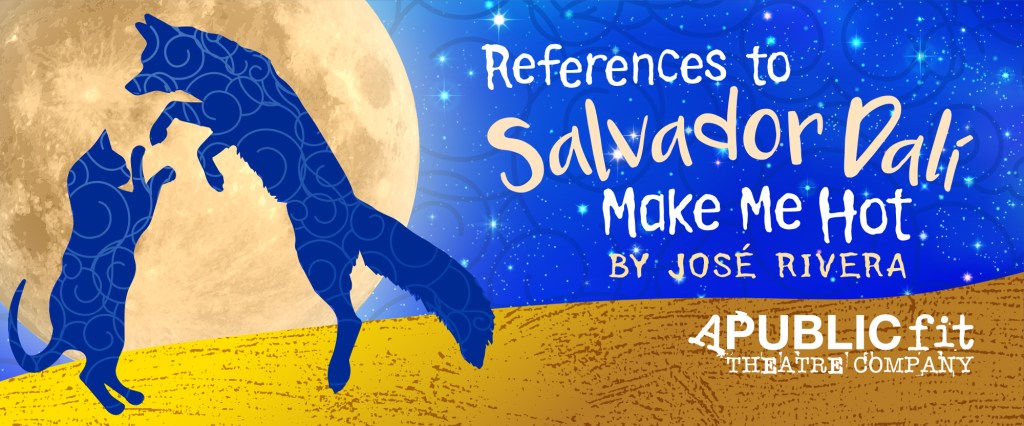
The last production was staged in the Jeanne Roberts Theater at the Charleston Heights Arts Center, a wonderful venue with plenty of parking. Rivera, a Puerto Rican playwright, is perhaps best known for writing the screenplay for the 2004 film The Motorcycles Diaries, which was nominated for an Academy Award. At the center of References to Salvador Dalí Make Me Hot is Gabriela (Amanda Guardado), a 27-year-old army wife living in Barstow. As she waits for her husband, Benito (Jamey M. Clay), to return from deployment, she starts to lose her grip. The desert beyond her backyard becomes a surreal landscape—a place of furtive movements and jarring sounds, where time is irregular and the cacti are closing in.
A tremendous fount of desire fuels this play. At the outset, a Coyote (José Anthony) tries to seduce Gabriela’s Cat (Aurora Watts-Esquibel), a domesticated pet nevertheless drawn to the wildness outside her house. The sexy and playful banter between these two predators elicited squeals from the Vegas audience. The lonely Gabriela, meanwhile, sleeps outdoors and fantasizes about making love with the moon—a masculine Moon, personified onstage as a sensual musician. (In A Public Fit’s production, two actors portray the Moon—one, Agustín Ballesteros-Martinez, to deliver the dialogue and another, Arturo Hernandez, to play the violin.)
A tremendous fount of desire fuels this play.
Benito’s return should bring everything back to order, but it doesn’t. It turns out that he has been facing his own demons, and he can’t simply repair his marriage with a smile and a kiss. Like the hunks in Salvador Dalí’s 1940 painting Two Pieces of Bread Expressing the Sentiment of Love, Benito and Gabriela are caught crumbling in the desert.

The great Spanish poet and playwright Federico García Lorca (who was friends with Dalí) famously promoted the hard-to-define concept of duende, a dark heaviness responsible for the struggle at the heart of all great art. (Rivera’s script begins with an epigraph from García Lorca’s Blood Wedding, a 1933 tragedy that also features a personified Moon: “And I’ll sleep at your feet, / to watch over your dreams.”) In References to Salvador Dalí Make Me Hot, the duende takes the form of trauma—Benito’s struggle to compartmentalize work (as a soldier) and play (as a husband) but also Gabriela’s loneliness, most apparent through her thwarted intellectual and libidinal aspirations.
A Public Fit’s production brought a lot of energy to Rivera’s play. Jamey M. Clay, who portrayed Benito (and who was terrific in Vegas Theatre Company’s production of Suzan-Lori Parks’s Topdog/Underdog last year), imbued his character with vitality and intensity; he often seemed to be vibrating on stage. Director Gigi Guizado’s program notes suggest that References to Salvador Dalí Make Me Hot might be understood as a work of surrealism or magical realism rather than one of strict realism, but these strands seem somewhat bifurcated. During the daytime, we get a conventional drama about a married couple torn apart by the husband’s physically and emotionally demanding military career and the wife’s debilitating isolation; at night, the moon comes alive, and the animals speak in flirtatious banter. These nocturnal surreal elements of the play were generally less predictable and more entertaining than the marital arguments.
“Don’t be a puritan,” Rivera has told his playwrighting students. “Be sexy. Be violent. Be irrational. Be sloppy. Be frightening. Be loud. Be stupid. Be colorful.” Be free, he might have said. References to Salvador Dalí Make Me Hot is a sad play, but it is also a liberating one. It pushes back gently upon some of the conventions for modern drama and captures a hint of the magic of the Mojave Desert, raising the temperature for the Vegas theatre scene.
 Las Vegas Review of Books