Anne Washburn, Mr. Burns, A Post-Electric Play, directed by Kirsten Brandt, Nevada Conservatory Theatre, September 12 to September 21, 2024.
Anne Washburn’s Mr. Burns, a Post-Electric Play (2012) is one of the most popular and significant American theatrical works of the past twenty years. Divided into three acts, it offers a postapocalyptic account of survivors cobbling together the shards of their shared cultural history. Following an unspecified disaster, the grid has gone down permanently—and, without electricity, the nation’s abandoned nuclear power plants become unstable meltdown hazards, worsening the situation considerably.
In the first act, in the immediate post-electric aftermath, frightened and bewildered stragglers sit around a campfire and, to pass the time, try to recall the lines of a particular episode of The Simpsons—the “Cape Feare” episode, in which Sideshow Bob escapes from prison and attempts to murder Bart Simpson. The second act takes place seven years later, with the campfire gang having become a theater troupe that performs old television shows, pop songs, and even commercial advertisements for crowds eager to recall the simple pleasures of the bygone past.
But the third and final act is the showstopper. Set seventy-five years further into the future—a future in which, one presumes, barely anyone could personally recall the pre-apocalyptic past—this act is essentially a musical: part Grek tragedy, part modern opera, and part Noh theater, an amalgamation of distorted cultural memories that effectively creates a new mythology for a post-electric world. (It also perhaps owes something to Russell Hoban’s postapocalyptic classic Riddley Walker.)
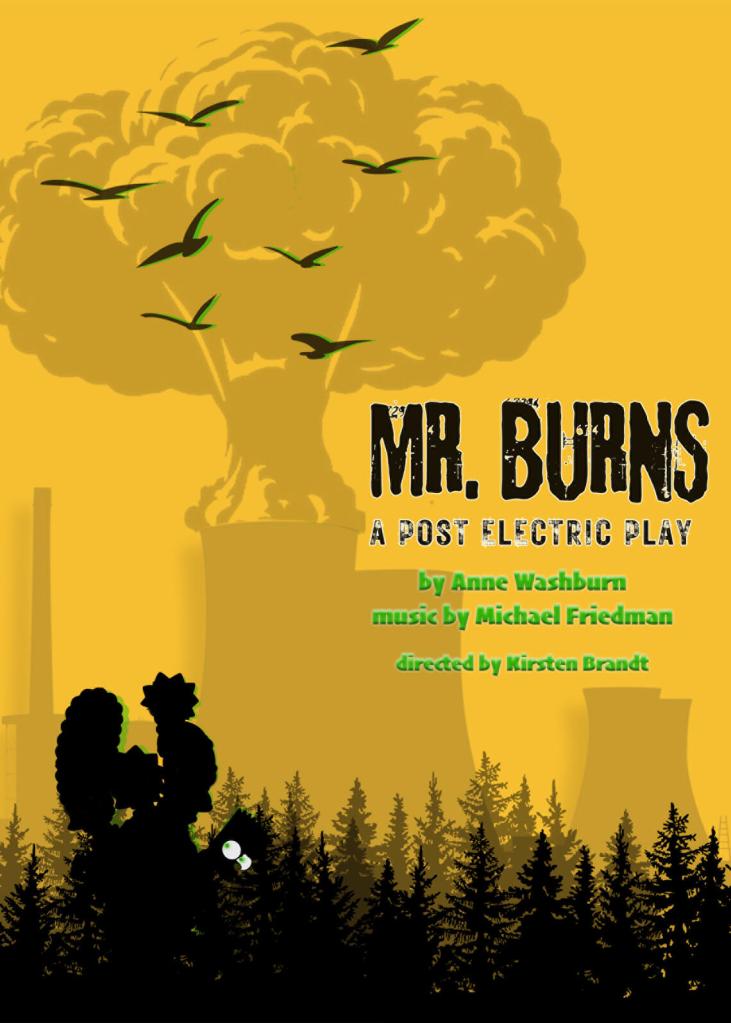
Needless to say, “this play is a beast, for sure,” as Kirsten Brandt observed in a recent interview. Brandt, the executive director of the Nevada Conservatory Theatre, directed the production of Mr. Burns staged at UNLV from September 12th to the 21st. One marker of the play’s popularity is that this was not the work’s Las Vegas premiere; the Cockroach Theatre Company staged an outstanding production of Mr. Burns in Las Vegas in 2015, just two years after the play’s New York debut.
In fact, the status of Mr. Burns has grown steadily over time. By 2018, theater critics Ben Brantley and Jesse Green ranked it as the fourth best American play to appear in the twenty-five years since Tony Kushner’s Angels in America (1993). And then, just a bit later, the COVID pandemic made Washburn’s play seem more relevant than ever. Reviewing a 2022 production of the play, New York Times critic Alexis Soloski wrote, “In its invention, its cool ruthlessness, its interrogation of why and how we use narrative, it has not aged at all.”
These issues of aging and relevance, pertinent to any work of art, are especially called to the fore by Washburn’s play. A major part of Mr. Burns’s appeal is a kind of silent audience participation—just as the characters try to recall specific lines from The Simpsons onstage, you do so as well in your seat, and, in your head, you can see and hear Sideshow Bob (voiced by Kelsey Grammer) in the “Cape Feare” episode, which originally aired on Fox in 1993. Patrons unfamiliar with The Simpsons can still enjoy the play but will doubtless miss out on many of the references. And as that particular Simpsons episode becomes older and older, it’s less and less likely that audiences will feel the same connection to it that the characters onstage do. In this sense, the play is destined—eventually—to fade into obsolescence.
Issues of aging and relevance, pertinent to any work of art, are especially called to the fore by Washburn’s play.
However, several factors have worked to keep Mr. Burns relevant. First is the massive popularity of The Simpsons; this isn’t just a random television show from the 1990s. As Washburn herself has said, “if any show has the bones for post-apocalyptic survival, it’s The Simpsons.” The characters are “durable archetypes”—Bart the Trickster, Homer the Holy Fool—that thus offer qualities and dynamics that transcend mere generational vibes. In a 2023 interview, reflecting on the 10-year anniversary of the play’s New York opening, Washburn further noted that The Simpsons was more significant than other huge TV shows of the era—Cheers, Seinfeld, Friends—because The Simpsons, unlike the others, is ultimately about family and community. It might therefore provide more postapocalyptic comfort.
And as UNLV English Professor Jessica Teague has written, Washburn’s use of the television show is especially apt because The Simpsons is itself “a kind of warehouse of cultural artifacts.” The “Cape Feare” episode prominently references not only the two Cape Fear films (1962 and 1991) but also the 1955 film Night of the Hunter and the 1878 Gilbert and Sullivan musical HMS Pinafore. A society looking to rebuild some semblance of cultural history could do worse than The Simpsons, with its Harvard-heavy writer’s room drawing on a host of touchstones both notable and obscure. Its viewers have often been implicitly urged to learn more about cultural references first encountered through bits and scenes on the screen.
Recognizing that both The Simpsons and Mr. Burns are filled with such references that might fly over the heads of a contemporary audience, UNLV actress Kate Critchfield (who appears in the production) created a “Know Before You Go” study guide for patrons. While not strictly necessary, the mere availability of the guide suggests that the play offers a richer set of materials than the average campus production.
One interesting choice here was the Nevada Conservatory Theatre’s use of Michael Friedman’s original musical composition of 2012, which includes a mashup of pop hits from the late 1990s and early 2000s (such as Ricky Martin’s “Livin’ la Vida Loca” and Britney Spears’s “Toxic”). Washburn’s script suggests that this medley might be updated over time to include songs from a period about ten years prior to whenever the play is being performed, but the NCT stuck with what would seem to be an original “dating” of the play to around the year 2012.
Similarly, the third act’s typical use of masks (which allow the actors to reappear onstage in roles distinct from the characters they played in the first two acts) suggests a new valence in our post-pandemic moment—and one figure in the chorus did sport an N95 mask—but the NCT production opted to show more of the actors’ faces, encouraging the audience to connect more directly with the cast. And the future here, for the NCT, is promising; the cast of this
Mr. Burns production, consisting primarily of UNLV MFA students, was quite strong, with Joann Birt, Andrew Scott Bullard, and Nick Case standing out. Keeping in line with the subject matter, we might say they embiggened their roles with cromulent performances.
 Las Vegas Review of Books