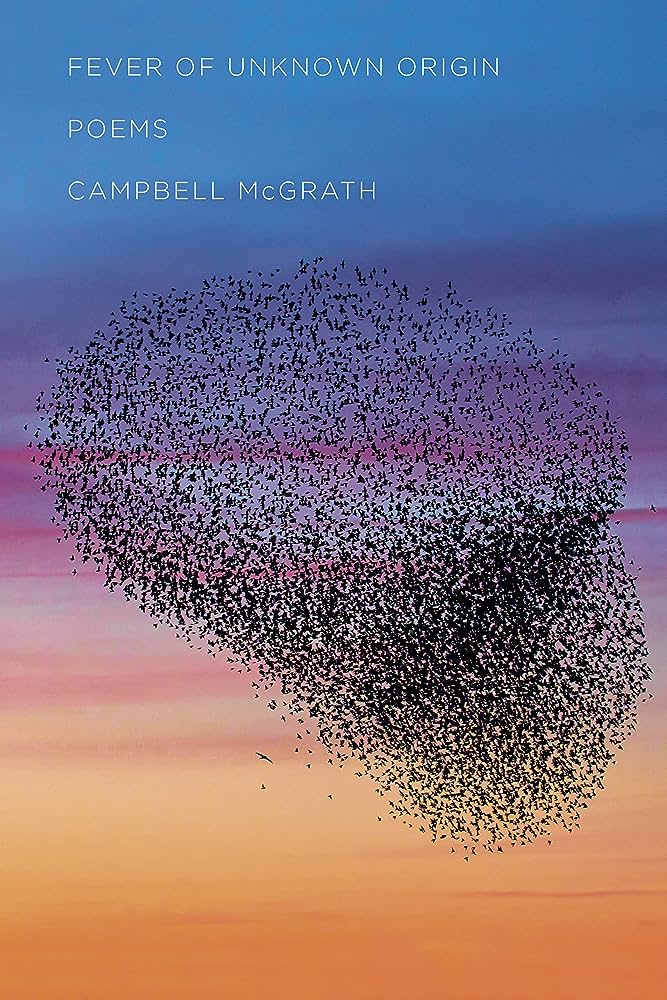
Campbell McGrath, Fever of Unknown Origin (Knopf), 112 pp. Hardback, $29.00.
“At the Ruins of Yankee Stadium,” the second poem in Fever of Unknown Origin, Campbell McGrath’s new collection, is one of the most significant American poems written in the past twenty years. First appearing in the April 20, 2020, issue of The New Yorker magazine, this 163-line masterpiece it is not a lament over baseball games of bygone days but rather a Whitmanian meditation on the indomitable and irrevocable forces of history.
Beginning in the East Village of New York in April (someone once called it the “cruelest month,” but he was no baseball fan), McGrath celebrates “spring at its most deluxe, / pure exuberant fruitfulness run amok.” Behind the buzzing of the bees outside the window, he hears, in the background, the music of the streets, and the poet launches into a litany of the bustling throng. Someone out there is “pub-crawling, speed-dating, pump-shining, ivy-trimming, / tap-dancing, curb-kicking, rat-catching, tale-telling.” People are “getting lost, getting high, getting busted, breaking up, / breaking down, breaking loose, losing faith, / going broke, going green, feeling blue, seeing red.” Everything is alive, in action, and it all sweeps along the streets in rapid riffs of idiomatic American English.
McGrath can here be heard building on his own wonderful 1993 poem “Angels and the Bars of Manhattan” (which can be found in his last collection, the 2019 Nouns & Verbs: New and Selected Poems), a paean to the borough’s watering holes, inspired by “the very bums and benches of Broadway.” But while that earlier work and its exuberant decadence (the joys of “shooting tequila and eight-ball”) reverberated with the poetry of Allen Ginsberg, “At the Ruins of Yankee Stadium” strikes a chord with the older Ur-Poet for McGrath: “Walt Whitman is ever my companion in New York,” he declares.
McGrath’s magniloquence is electromagnetic, illuminating a city filled to the brim with the crème de la crème and the dregs of humanity—an imperial, imperious city, “tyrannical, democratic, demagogic, dynastic, anarchic, / hypertrophic, hyperreal. An empire of rags and photons.” The poet’s democratic vista is a field of dreams, a “congregation of apparitions,” assembling through the storm of time. (The poem’s original 2020 version had a “gathering of apparitions”; McGrath’s revision here in the book is an improvement.) His childhood days in Washington Heights are long gone—or, almost long gone, remaining now in the rosy afterglow of reminiscence. Sic transit gloria. One cannot help but imagine, claims the poem, an ever-changing future, the Edenic Big Apple of memory eventually inundated by a Great Flood, the people going west and singing dirges in the dark about the “Ruins of Yankee Stadium.” But, ironically, those chanters-to-come will remember and portray us not as Yankees but as Giants, “as cartoonishly gargantuan as the past” (as enormous, perhaps, as the distance to the center field fence at the old Polo Grounds).
This poem alone is worth the book’s $29 cover price. That’s not to slight the other poems in the collection, some of which are quite strong. Fever of Unknown Origin is broken into five sections, and the first is all about time and history. McGrath, a MacArthur “Genius” now over 60 years old, is writing an older man’s poems—poems of memory, of nostalgia, and of illness and death. “The past / is paper,” he observes in “Ode to History”—“and the present a match.” Our apocalyptic wildfires are consuming our history, and the poet must shore up the fragments against the ruins.
The collection takes its title from the second section, a long, multi-part poem (“Fever of Unknown Origin”), which is also a triumph. It first appeared in The Paris Review in 2021 and is substantially unchanged here (though for some reason “Toyotathon” has been revised to “Toyota Sellathon,” an unfortunate editorial choice). One might suppose that this poem is about COVID, but it’s not—the unknown cause of fever turns out to be the Coxsackie B enterovirus. Nevertheless, the poet, in his illness, contemplates our “virulent commonwealth,” the way the bugs and bacteria ultimately link us all together. As much as disease can reinforce our feelings of individual corporality, a virus is a communal event. “Every atom belonging to me as good belongs to you,” as Whitman would say. McGrath, for what it’s worth, will not go gentle into that good grass: “I want my heart to shake its defiant fist at the sky forever.”
McGrath’s magniloquence is electromagnetic.
Not all the verses can maintain the power and depth of “Fever” and “At the Ruins.” Short chuckles of poems are interspersed throughout the collection. A longer effort titled “Triumph of the Goblin,” a topical shuddering at the current American nightmare and its “jamboree of grotesques” (McGrath’s version, perhaps, of a “basket of deplorables”), has moments of sparkle—as in its observation that the new routine is “war all the time, / on earth as in heaven, / 9/11 24/7”—but lacks the gravity necessary for a deeper impression. It is eclipsed, just a couple pages later, by “The Teacup,” a wonderful sonnet that grasps “the sweeping / epic of humanity” in one hand and imagines the porcelain shards of apocalyptic destruction that might result from “a touch of the future’s careless elbow.”
McGrath’s powers of observation have only grown with time, and he is now, without doubt, an American poet to be reckoned with. He is equally at home in his Florida backyard at night (where “the fireflies / challenged the planets for supremacy”), at the California coast at sunset (where the horizon waters rippled “as if ants were crawling everywhere across it”), or in the confines of an MRI tube (into which he was inserted “as into a Neanderthal burial pit”). His poems, taken all together, are strikingly national, containing few references to international locales and many reflections on the spaces across the United States, from the Redwood Forest to the Gulf Stream waters. In an earlier poem, McGrath claimed that he found America when he drove through the Mojave Desert.
Fever of Unknown Origin is a welcome addition—not only to an increasingly impressive career but to the rising edifice of twenty-first-century American poetry.
 Las Vegas Review of Books