José Felipe Alvergue, en el norte / soy del sur (Omnidawn), 110 pp. Paperback, $19.95.
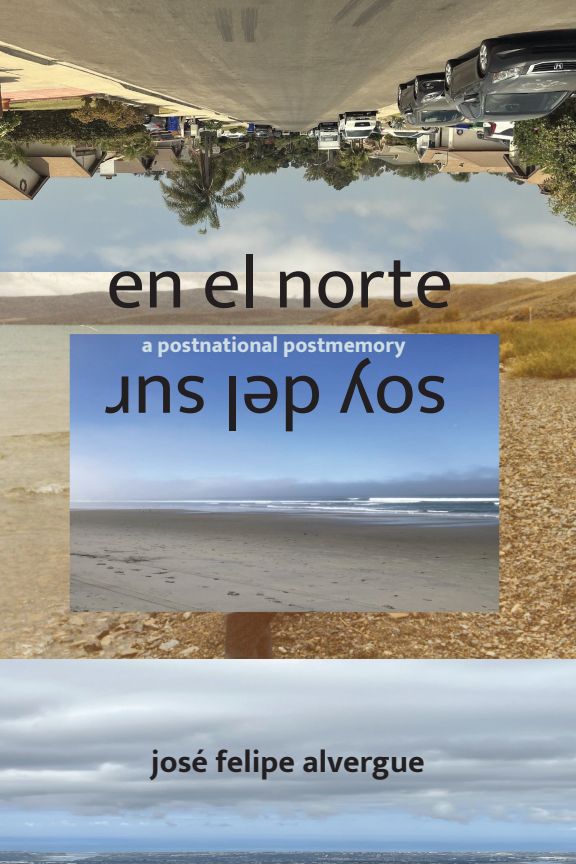
The title of José Felipe Alvergue’s new book of poetry roughly translates to “in the North, I am from the South.” And the cover, with flipped and juxtaposed photographs, suggests an “upside down” aesthetic, a reorientation in which everything falls down. Alvergue, whose family left El Salvador in 1979 at the outbreak of civil war, encapsulates this process in a few lines about his mother getting harassed while shopping at Costco: “She landed trusting / she would be American only to find herself / a woman of color in America.”
The word “landed” here is significant. Alvergue employs as an epigraph some lyrics from Tito Rodríguez’s 1955 song “Los Marcianos,” which can be translated as “The Martians.” The song turns on a pun: the Martians exclaim “ricacha,” a derogatory Spanish slang term for a wealthy woman—but, as Rodríguez explains, ricacha is simply the Martian way of saying cha-cha-cha. The Martians don’t pose a threat to anyone. Alvergue suggests that Rodríguez is a miraculous hero for seeing things right: “he saved earth / from a potentially apocalyptic / misunderstanding with / creatures who really just / wanted to dance.”
The point here, of course, is that the marcianos are aliens, and immigrants to the United States can often feel like they are treated not just as inferior but as downright extraterrestrial. But Mars isn’t just another planet; he’s also the Roman god of war. And Alvergue is especially concerned with issues of traumatic violence and international conflict. Drawing on theoretical work by José Esteban Muñoz and Resmaa Menakem, he considers how “a genocide of details” might become encoded as “confounding epigenetic truths” that then get passed down generationally, even to those who never witnessed such violence firsthand.
“Engaging with postmemory work, family systems theory, and somatic abolitionism helped me understand how trauma is imparted onto children prior to consciousness, especially in diaspora communities effected by war,” Alvergue writes on his website. So we might think of the verses in en el norte / soy del sur as attempts at processing ancestral pain. These ideas were very much at the forefront of Alvergue’s last book, Purplish (University of Iowa Press, 2025), a critical examination of anger in American poetry. As he observes there, “Poetry is an archive of somatic and linguistic adaptations to the challenges of living on earth.”
The sonnets here are practically flying off the page.
This may help to explain why the subtitle of en el norte / soy del sur is “A Postnational Postmemory.” Alvergue wants to use poetry to investigate and articulate how the trauma endured by his parents and grandparents has become an ineradicable component of his own life. Even if not accessible in his own personal memory, events and experiences in El Salvador in the 1970s have nevertheless carried over, across borders and generations, to shape the poet’s life profoundly.
The vehicle for expression here is the sonnet—the fourteen-line mainstay of Western poetry for the past several centuries. Alvergue declares that en el norte / soy del sur consists of four “sonnet essays” (titled “trust,” “fear,” “anxiety,” and “miracles”), each of which is a series of sonnets on a given theme. Most useful for him is the volta, the “turn” or twist that allows a sonnet to begin in one place and end up in another. The very form suggests the movement of a thought—and Alvergue’s verses are very much in motion. This is not the kind of poetry that freezes or crystallizes or detains a notion into a portable object. This is the opposite of detention. The sonnets here are practically flying off the page. Lines sometimes take different angles and move in different directions. Simple linearity cannot be taken for granted. (On some level, the form of the sonnet has always challenged linearity—thus the frequency with which sonnet sequences are labeled “cycles” or “crowns.”) Mobility—the power of “mobile architecture” and “mobile nation”—is key to the energy of these poems.
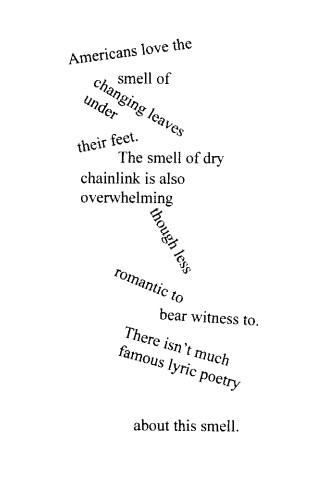
In the example above, from “anxiety,” the rigidity and symmetry of the traditional sonnet falls apart, just as the “changing leaves” of autumn might fall to the ground and get trampled underfoot, releasing an invisible aroma that might similarly drift across space in a non-linear fashion. But the turn to the overwhelming “smell of dry chainlink” indicates a much less “romantic” sense of being trampled underfoot. Lyric poetry, Alvergue suggests, is much more associated with fall colors than with children kept in cages. But what is a sonnet if not a cage—a metrical form for containing meaning? The poet does what he can to write such cages apart, to explode the form that would otherwise confine. Or, as Rebecca Morgan Frank has observed in a review, Alvergue’s sonnets are “fourteen-liners that need not align with borders.” Post-border, one could say.
The visual component of Alvergue’s poetry is thus absolutely essential. Family photographs are interspersed throughout some of the verses, sometimes turned upside down; other pages feature scribbles, doodles, and alternative fonts. Most memorable here is the way that the first sonnet essay, “trust,” keeps returning to an image of the poet’s mother riding in a teacup at Disneyland. (An earlier version of this poem was published in 2023.) The blurred trees in the background signal the motion of the teacup, but his mother’s face is in focus. In other words, she is seated, relatively still, while the teacup dances her through the ride. “You don’t see a lot of photos / of diaspora sitting in cups like this,” notes Alvergue.
This is a nice moment, though the verses also recall traumatic violence. Alvergue’s grandparents were killed in San Salvador in 1978 in a hit and run, while they were walking home from a restaurant, for which no official police paperwork exists. A year later, the poet, then a baby, would leave El Salvador with his parents for the United States. While he cannot remember witnessing violence in his native country, he repeatedly turns to biochemical metaphors of “tissue panic” and “snapping hormones” to explain the somatic, epigenetic, and psychological effects of such trauma—that which “lingers / in a residue of once-/believed-in ideas.” “The archive is / in our bodies,” he insists, “in the hormones coursing through kids.” “We are epidemiological paradoxes,” he adds. Put more bluntly (and viscerally): “It matters little / if my infant eyes ever saw the human / tissue being power washed / from walls and sidewalks.” It’s a chilling image, but it speaks to the gravity of these mobile verses.

