Wisława Szymborska, The Acrobat: Essential Poems, translated by Clare Cavanagh and Stanisław Barańczak (Ecco), 96 pp. Paperback, $18.00.
Paul Valéry once observed that if prose is like walking, then poetry is like dancing. But of course, there are so many different ways to dance! Some poets perform a stiff waltz, while others prefer a funky shuffle; some a sensual tango, and some a violent mosh. Nobel Prize winner Wisława Szymborska would have been at home in a Cirque du Soleil show. Her short poems consist of concentrated bursts of taut and precise acrobatics.
“The Acrobat” is a terrific introduction to the work of an eminent twentieth-century poet.
So it’s no surprise that one of her best verses, from 1967, is “The Acrobat”—which is also the title of a new, slim volume of Szymborska’s “essential poems,” translated by Clare Cavanagh and Stanisław Barańczak. As Cavanagh notes in her introduction (Barańczak died in 2014), “Szymborska’s wordplay is the verbal equivalent of the trapeze artist’s gymnastics.” In the title poem, repetition catches the reader’s breath as the performer sways through the “startled air,” line by line, each time narrowly avoiding a fatal slip:
From trapeze to
to trapeze, in the hush that
that follows the drum roll’s sudden pause, through
through the startled air, more swiftly than
than his body’s weight, which once again
again is late for its own fall.
In many ways, this poem encapsulates Szymborska’s style. Her focused attention on the integrity of the line, combined with her willingness to flirt with disaster, results in the kind of professional playfulness that led to her Nobel laurels in 1996.
Cavanagh and Barańczak deserve a lot of credit for rendering Szymborska’s original Polish into a bouncy and flexible English that pops and resonates and often rhymes without ever sounding trite. We get, for example, not quite an acrobat but a rippling hulk in “Bodybuilders’ Contest” (1962): “From scalp to sole, all muscles in slow motion. / The ocean of his torso drips with lotion.” Or, in “Birthday” (1972), a deceptively simple description of a flower blooming: “so aloofly precise and so fragilely proud.”
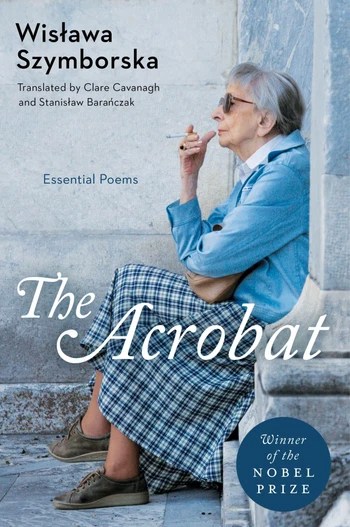
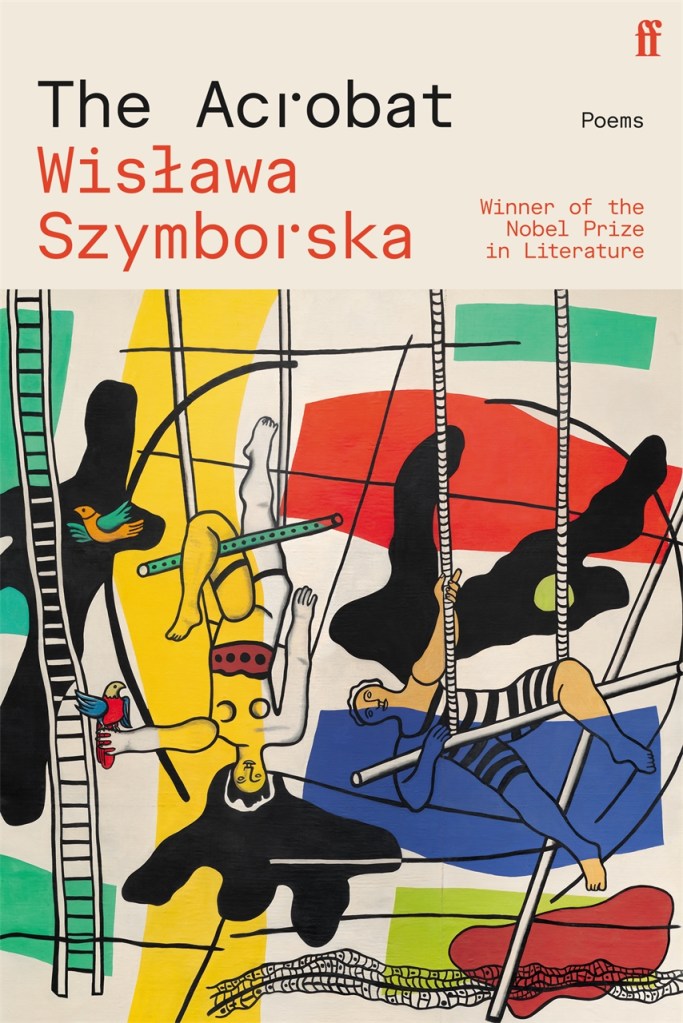
The Acrobat contains just 32 poems, spread across about 50 pages. They’re short. And they’re followed by Szymborska’s eight-page Nobel Lecture, “The Poet and the World,” which defends the oddity of the professional lyricist in a global society that often rewards conformity: “In the language of poetry, where every word is weighed, nothing is usual or normal.” The book serves as a great brief introduction to Szymborska’s work. Though it should be noted that, as cool as the poet appears on the cover (shades and cigarette, head cocked in profile), the British edition, published by Faber, features a much more appealing image of the circus performers indicated by the title.
Those wishing for more could consult the 253 poems appearing in Map: Collected and Last Poems (Houghton Mifflin, 2015), also translated by Barańczak and Cavanagh, which is essentially a complete collection (with the exception of some untranslatable verses) of Szymborska’s published poetry. (She died in 2012.) Certainly there are plenty of gems that didn’t make it into The Acrobat. “A Word on Statistics” (2002), for example, is a very good poem available online; so is “Life While-You-Wait” (1976).
But the verses here are excellent. “The Onion” (1976) offers a curious meditation on a vegetable that just becomes a smaller version of itself as you peel off its many layers: “Its innards don’t exist. / Nothing but pure onionhood / fills this devout onionist.” Perhaps gesturing to the idea that the onion might be in fact a masturbatory onanist, entirely content with itself, the verses suggest that—not unlike a self-contained poem—the onion has achieved a balanced, self-reliant “onionoid” perfection. It is “internally at rest,” uncorrupted by all that is not onion.
One of Szymborska’s oldest poems, “Nic dwa razy” (1955), translated here as “Nothing Twice,” is also one of her best. “Nothing can ever happen twice,” it begins. “In consequence, the sorry fact is / that we arrive here improvised / and leave without the chance to practice.” It would be nice to get a do-over. But everybody only goes once.
For a sense of Barańczak and Cavanagh’s gifts as translators, we might take Szymborska’s 1993 poem “The End and the Beginning” (“Koniec i początek”), which describes the aftermath of war. The second stanza of the poem, in the original Polish, reads:
Ktoś musi zepchnąć gruzy
na pobocza dróg,
żeby mogły przejechać
wozy pełne trupów.
In a 2001 English translation, Joanna Trzeciak renders this stanza thus:
Someone has to push the rubble
to the side of the road,
so the corpse-filled wagons
can pass.
Trzeciak’s is a good literal translation, but Barańczak and Cavanagh’s offers a better sense of Szymborska’s deft wordplay and taste for alliteration. Their translation is as follows:
Someone has to shove
the rubble to the roadsides
so the carts loaded with corpses
can get by.
The alliterative symmetry of rubble/roadsides and carts/corpses draws attention to the poet’s diction, and even the choice of the verb shove (over push) assonates better with rubble while arresting the reader to convey the inconvenient labor all too easily overlooked in the horrors of war.
In short, it’s an impressive translation that goes a long way to bring the best qualities of Szymborska’s verses to English-language readers. The Acrobat is a terrific introduction to the work of an eminent twentieth-century poet.

