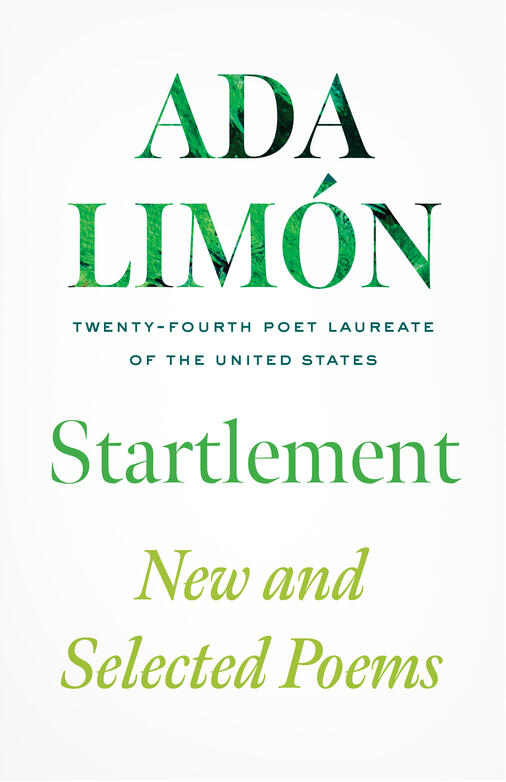
Ada Limón, Startlement: New and Selected Poems (Milkweed), 232 pp. Hardback, $28.00.
Ada Limón’s lines grab you by the lapels. In “First Lunch with Relative Stranger Mister You,” a poem from her first collection, Lucky Wreck (2006), she insists that she wants to start every sentence with “Let me tell you something, Mister.” Listen up, and listen good.
Limón is a slightly older poet now, though still impressively young for the sort of career retrospective contained in Startlement: New and Selected Poems. She’s hardly past her prime; her last two collections, The Carrying (Milkweed, 2018) and The Hurting Kind (Milkweed, 2022), were heavy hitters, and the new poems in Startlement are as strong as the selected older works. (The volume offers 102 poems from Limón’s six earlier collections plus 21 new ones.)
For those unfamiliar with Limón’s work, this collection is essential. It offers some of the best examples of her terrific style, a wonderful balance of verbal playfulness and blunt declaration—very accessible but never trite. The earliest poems often crackle with an electric charge and convey the thrum of physical desire. They’re also remarkably American, alive with a Western punch and shuffle and illuminated by the golden sunlight of Limón’s native Sonoma Valley. “Miles per Hour,” for example, captures the awkward excitement of that all-American activity, having sex in a car: “not knowing / whether or not to hold onto the handle / or the stick shift or to shove my foot / on the dashboard.”
In another early one, “Centerfold,” the poet recalls a moment from her youth when she was looking at adult magazines in a barn, sitting around a “cedar chest splayed” with pages of pornography. Winking at “chest splayed,” Limón expresses not discomfort but aspiration, as she focuses on a nude ballerina immodestly spread out for the reader. “I thought how lovely it would be to / be her, to be naked all the time, / and dancing.”
Her newer works suggest some restraint over her youthful energy without any loss of exuberance. In “Field”—which the poet Forrest Gander calls “a magical horsey love poem for the poet’s husband”—Limón reflects upon her own equine attributes, her sense that she, too, is all “bravado and bristle,” a perfect critical crystallization of her enduring style.
The new poems here represent her output from her time as the U.S. Poet Laureate, a title she held from 2022 to 2025. They include, for example, “In Praise of Mystery: A Poem for Europa,” which is engraved into the side of a NASA spacecraft that will probe a moon of Jupiter for signs of extraterrestrial life. Channeling Carl Sagan, Limón sends out a missive through the cosmos that offers a simple accounting of our humble humanity: “We are creatures of constant awe.”
Of the new poems, the best is a sonnet, “While Everything Else Was Falling Apart” (first published in the December 2024 issue of Poetry). Here the poet recollects feeling bleak and forlorn while waiting for a subway train, only to find inspiration from a happy snacker learning to pronounce the word “churro” from a vendor. Again, it’s humanity in a nutshell: “someone giving someone comfort / and someone memorizing hard how to ask for it again.”
Ada Limón’s lines grab you by the lapels.
Of the many shared and prominent themes evident in Startlement, the most appealing is Limón’s deep and recurring appreciation for the way that love is shaped by time, that it can only be lived through our temporary experiences. “The Conditional,” a poem from Bright Dead Things (Milkweed, 2015), initially seems like it might be a dorky grammar game, an opportunity for subjunctive soliloquy by playing on the verb “say”: “Say we never get to see it.” It could be an imperative command, a direction to a lover to repeat the following, but it seems instead to be the “say” of “what if.” For Limón, this is no dry parsing of language; this is where everything happens. We might never get to see that “bright / future, stuck like a bum star, never / coming close, never dazzling.” The dazzle is now. Let me tell you something, Mister. Forget that bum star and look at what you’ve got.
If there’s a problem with Startlement, it’s that it leaves too much out; Limón has so many amazing poems that this “selection” is simply unfair. Why not, for example, “Drowning Creek,” from The Hurting Kind, with its masterful movements and stirring conclusion? “Drowning Creek” especially displays the strengths of The Hurting Kind as a whole, in which the poet learns the names of birds and trees (“Calling Things What They Are”) and sharpens her verses toward piercing, unforgettable endings, as in the wonderful poems “Joint Custody” and “The End of Poetry.”
And Limón’s earlier 2018 collection The Carrying is itself so strong—truly a modern masterpiece—that the poems selected from it may as well have been chosen at random. To be sure, those printed here are incredible. “The Leash” and “Dandelion Insomnia” are perfect brief meditations, and “The Contract Says: We’d Like the Conversation to Be Bilingual” may soon be a classroom staple. (“Will you tell us the stories that make / us uncomfortable, but not complicit?”) “The Raincoat” is stunning, an instant classic; if you’re not familiar, just click on the link and read it now. You won’t regret it. Bangers from The Carrying not included in Startlement—such as “Almost Forty,” “Late Summer after a Panic Attack,” and “Wife”—are also well worth your time.
In short, treat Startlement not as a career-defining collection but rather as an introduction to the verses of one of America’s best working poets. It can then lead you to further toward the uncollected gems.
Just before she became the U.S. Poet Laureate, Limón hosted the poem-a-day podcast The Slowdown in 2021 and 2022. In one episode (#601, from February 1, 2022), she reads a very short poem that she penned when she was in her late twenties and working for a brides’ magazine in New York City:
They say, All you need is love.
But what we really need is health insurance.
And then love can come along and make us really, really sick.
It’s a little jokey—maybe just some throwaway lines—but the essence is quite Limónian. The punchline quickly becomes an ambiguous declaration (good sick or bad sick?), an articulation of the desires at the core of our fallible humanity. A profound truth expressed with terse directness. Let me tell you something, Mister.
 Las Vegas Review of Books