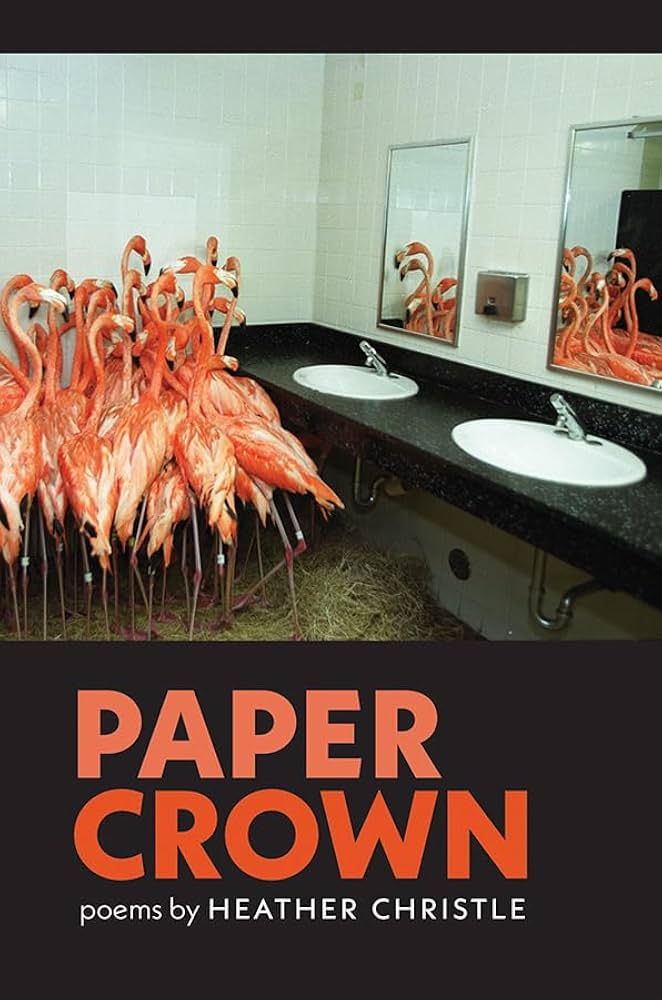
Heather Christle, Paper Crown (Wesleyan University Press), 80 pp. Paperback, $16.95.
Heather Christle’s “Perfect Song” is an absolute banger. First published in Narrative in 2019, and now included, without revisions (none needed), in her new collection, Paper Crown, the 16-line poem begins with the phrase “I remember” and takes us back to an ordinary moment of unusual liveliness. The poet recalls a cold morning walk, following “a night of heavy snow and drink” (a beautiful example of zeugma, the artful device that allows the descriptor heavy to do double duty). Despite feeling hungover, she is radiant—“as clean as a piano” (much more impressive than a whistle!), resounding with unbridled confidence and unlimited potential. At any moment, she feels, “someone might fall in love with me.”
She was wearing headphones and cutting through the dawn, “woven into the electric / cold bright air,” looking up as “the most perfect song” plays an anthem to her apotheosis. The poem then turns, in a kind of volta, as she later tries to recapture this evanescent moment. For weeks following this magic morning, she replays the music album, searching for that top-tier tune but never finding it. Only “later much later” does she realize “that what I had taken to be the song / was in fact the joyous concordance of / a moment that would not come again.”
This frustrated Proustian effort nevertheless captures something terribly appealing—that tingling electrical aftermath of a sublime thunderstorm. What, after all, is a perfect poem, a perfect work of art, but a “joyous concordance”? It might be worth chasing for years. The most important recollections are the living ones, the ones that cannot be decisively rendered in either past or present tense. And that final line of Christle’s poem—“a moment that would not come again”—suggests, with its fall into the minor key, the ambivalent mix of the best rememberings. It may be dark and foreboding, signaling a life that never again experiences the pleasures or fulfills the potentials of youth. But it may also simply affirm the artistic need to keep moving. A joyous concordance cannot be frozen and commodified. The poet must keep looking ahead.
The other poems in Paper Crown manifest Christle’s enthusiasm and dexterity, but none quite attain the power of “Perfect Song.” Like the elusive lingerings of a passing melody, the echoes or traces of an erstwhile earworm, Christle’s verses dart and digress, refusing to stand still and stay in one place. The effect throughout the book as a whole is pleasing, a kind of bardic bar-hopping, but makes it more difficult to pin down any single poem. Nail clippers shift to pregnant deer; a milkshake leads to a doorway; a town mayor turns to a broken toe. The attention drifts and flits. The poems are marked by a paratactic absence of transitions.
“In Order of Appearance” admirably elucidates this method. Here a child refers to a “swimming mountain,” and in her effort to retain this image (and not let it disappear into nonsense), the poet aggressively tries to think of other things: “instead I thought about weasels, / handbags, the future.” Much of the poem consists in such random appearances of idle notions as part of a struggle to preserve that mountain in a pure state, untouched by cerebral consideration. Christle conjures up thoughts of playing bridge, of watching The Man Who Knew Too Much, of hating people who greet each other “at volumes exceeding / their actual degree of enthusiasm.” This wonderful poem, in short, offers a winning combination of the humorous observations of the poet’s wandering mind (“how I would love to milk a cow / but not to drink the milk”) and the agonizing desire to hold onto feelings and sensations bound to vanish. If the fanciful mountain must disappear, the poet will not be devastated by grief: “I will not sense its loss, my mind will be elsewhere.”
What, after all, is a perfect poem, a perfect work of art, but a “joyous concordance”? It might be worth chasing for years.
Christle’s wanderings occasionally result in moments that pop out and strike the reader forcefully. For example, the book’s title poem (it’s not a crown of sonnets) alludes to “A Venn diagram I will never draw: the circle / of physical lovers and its slim overlap // with the circle of lovers in dreams.” And the wordplay of Paper Crown provides some amusing puns. In “Shelter in Place,” the poet announces, “Every time I turn on the blender I am afraid / the blade will spin out through the glass / and on through my stomach.” In addition to the consonant layering of blender and blade, we get the wry fear that use of a blender will be a dangerous blunder.
The poem “Eff” especially stands out for its attention to language. At first glance, the title seems as if it might be an expletive—as in, “Eff that noise.” But it’s rather a meditation on the meaning of the term ineffable, that quality that is so impossible to describe. As Christle notes, ineffable and unspeakable etymologically mean the same thing. But the former is airy and the latter is earthy; “ineffable / summons inarticulate joy, while / unspeakable’s covered in blood.” The right word can make all the difference. Some vanishings are devastating, evoking our unspeakable horror at what we know we cannot retain or return. But certain transient experiences, such as a thrilling strut of ebullience accompanied by the perfect song, give us that ineffable, inarticulate, joyous concordance that reinforce our need for beautiful poetry.
 Las Vegas Review of Books