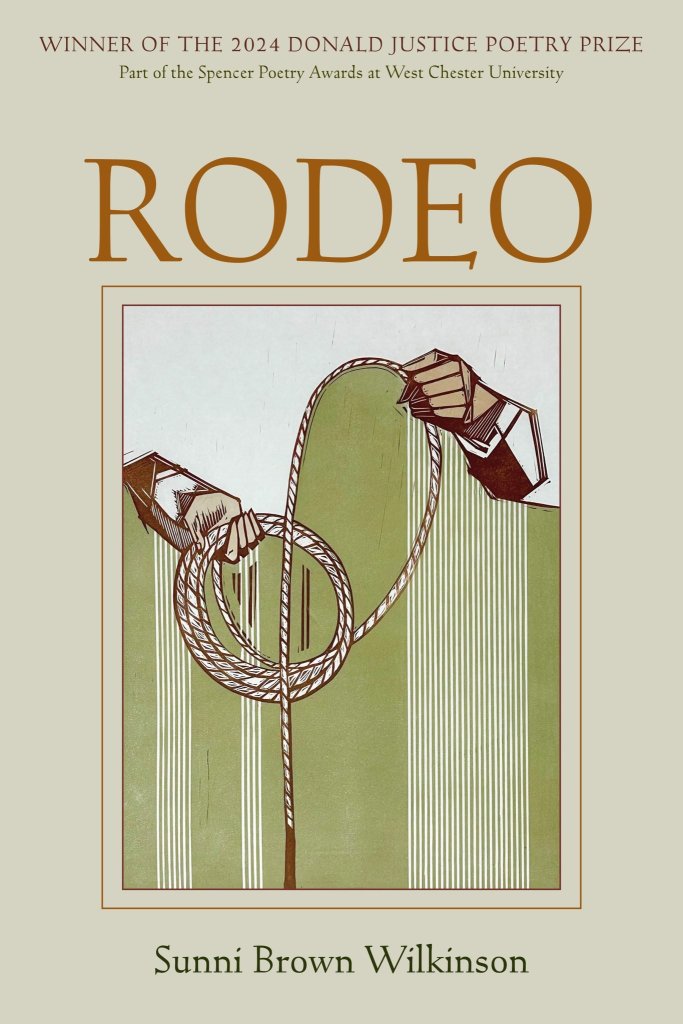
Sunni Brown Wilkinson, Rodeo (Autumn House), 88 pp. Paperback, $17.95.
The title poem of Rodeo, Utah poet and Weber State University professor Sunni Brown Wilkinson’s newest book, is also the strongest of the collection. The evening event, part of the annual week-long Ogden Pioneer Days Rodeo, is an attempt to corral chaos, to hold the elements in their proper places, to tie them down securely. A poem does this too, imposing order on language—however briefly. But nature can be unruly. The rodeo announcer’s bullhorn exclamations carry miles through the air to suburban backyards; the sky “bleed[s] itself out over the train tracks / and the abandoned brick factories”; the homeless spill out of a shelter downtown. An illuminated sign at a carpet store has its T burned out, shining CARPE to passersby, though perhaps only a “hapless moose” wandering into a schoolyard truly seizes the day.
The poet thinks of the “grace” of the bull rider, “one hand on the saddle / and the other a flag waving violently / above him—a wild show of surrender.” The posture here is reminiscent of Bob Dylan’s picture of gleeful abandon in “Mr. Tambourine Man”: “to dance beneath the diamond sky / with one hand waving free.” But for Wilkinson, the figure of the bull rider is more fearsome: “Some days it’s like this: one part / anchored while the other begs for mercy.”
It’s a great image—holding on tight to what counts and calling for help at the same time. The violently waving flag alternately and ambiguously connotes victory and surrender. It does a lot to introduce the two major recurring themes that work together in this book. The first is the ongoing grief stemming from the loss of the poet’s baby boy, who died at birth. The second is the beauty of small-town life in Utah. Wilkinson, a mother of three now in her late 40s, honors her family and her faith. She tries to see the good in the world.
She may or may not have had Bob Dylan in mind, but Wilkinson was certainly thinking of Judy Collins, whose 1968 song “Someday Soon” (written by Ian Tyson) is the title of another strong poem in the collection. Wilkinson notes that she grew up listening to this song and that Collins “has had a profound influence on [her] life and art.” Collins sings about a cowboy who “loves his damned old rodeo as much as he loves me.” Wilkinson, when a girl, similarly imagines herself running away from Utah with a cowboy and leaving everything else behind—“someday soon.” The wry irony here is that Wilkinson hasn’t really left; born and raised in Logan, Utah, she now lives in Pleasant View, a mere 40 miles away.
And indeed, there’s something very “Utah” about Rodeo. One poem, an ode, is a “Valentine for the Great Salt Lake.” Another is a “Letter to Josie Bassett Morris,” a female cattle rustler and rancher who associated with Butch Cassidy and might be considered the “Wonder Woman of the West.” Perhaps most memorably, another poem (“Don’t Feed the Coyotes”) focuses on a biker tossing hot dogs to a hungry coyote at a gas station. (Technically that one takes place in Arizona.)
The poems often seem on the verge of leaping into song.
The poems in Rodeo often turn to quiet reflections upon natural observations (some readers may be reminded of Mary Oliver’s work), but the human desires to tame this natural world are key for Wilkinson. These forces are always a little at odds. “The house is for sale but the garden / doesn’t know it,” she remarks with epigrammatic power. A religious element can sometimes transform the landscape—finding, for example, a “monastic space” in “Jenny’s Slot Canyon, Evening, Late November.” This same element occasionally brings down apocalyptic overtones: “The Bible says one day the earth will be fire, and we’ll all be born again—to singing or to silence.” Something, in other words, must be heard here in Rodeo. The poems—as with “Someday Soon”—often seem on the verge of leaping into song.
The other real standout here is “I Drive Past the Cemetery.” Listening to Van Morrison’s “Sweet Thing” on her car stereo, the poet looks out the window to the plot where her baby was buried, after surviving mere minutes in the world (“a body we held briefly and let go,” she writes in another poem). She speaks to him about the world he was destined not to experience. Her drive is “riddled / with appointments, bad radio, roadkill,” but somewhere in the trees he waits for her, bodiless, an invisible, electrical presence: “your kingdom of quiet, my whole life aflutter / with color and noise and smells, your world / this mystery I lean into for a moment.” She must be satisfied not to read in between the lines.
 Las Vegas Review of Books