Ariana Reines, The Rose (Graywolf), 96 pp. Paperback, $17.00.
In Ariana Reines’s absolutely stunning poem “Eye of Death,” dedicated to Vegas writer Amanda Fortini, the poet and Amanda walk through a casino one night after watching a magic show. As they pass the poker table, a sharp dressed man looks up from his cards and stares at Reines—a look that knocks her into next week: “He held my gaze / Til I couldn’t take it anymore.” She needs to walk away and catch her breath, steady herself against her friend. It’s an incredibly powerful erotic moment. This gambler has laid his “gorgonic eye” upon her and blasted her into a mythic mindset. “What if one look is all you get / Century to century?”
The poem isn’t simply erotic or flirtatious. It attributes far more sophistication and maturity to Vegas casino culture than do most literary texts. “Eye of Death” seemingly begins with the lowbrow, with David Blaine illusions and Brazilian butt lifts, but it insists upon the Strip as a place of intellectual vitality. “There’s dignity / In pleasure,” Reines insists. Casino design and event production are the results of “good quality intelligence” aimed at making even maudlin misanthropes feel happy. And the poker table pulses with “cerebral energy”; the calculative players are “Poring over their cards like nuclear / Physicists on deadline.”
When a man in gray looks up at Reines and fixes his gaze, it’s not just raw animal physicality; it’s about “Strange electric brain / Power,” high voltage intensity. The man in the poem has no body to describe; he is all sightline. And Reines’s rendering is formally arresting. The poem, in couplets, halts at the instant the man stares
At me—long & hard. A lock
Of combed hair dropped
Over his brow.
“Lock” is perfectly placed; the enjambment here (“lock / Of combed hair”) suggests that the two have locked eyes and that everything has halted indefinitely, frozen in place. Even the description of errant strands of hair is indented, displaced from the rest of the poem, set apart as if outside of time.
Reines’s attempt to compose herself employs a stuttering vocabulary (“steadied,” “steering,” “stalling”) and an apocalyptic reorientation (“I understand Dante now”). The poem regains its order, but the poet is still shaken, flushed, thrilled by a vital force. She concludes by lamenting the decreasingly popularity of the poker tables. Like the starved polar bear on a lonely ice floe, the card shark is a predator “in a growing wasteland devoid of prey.” Still dangerous.
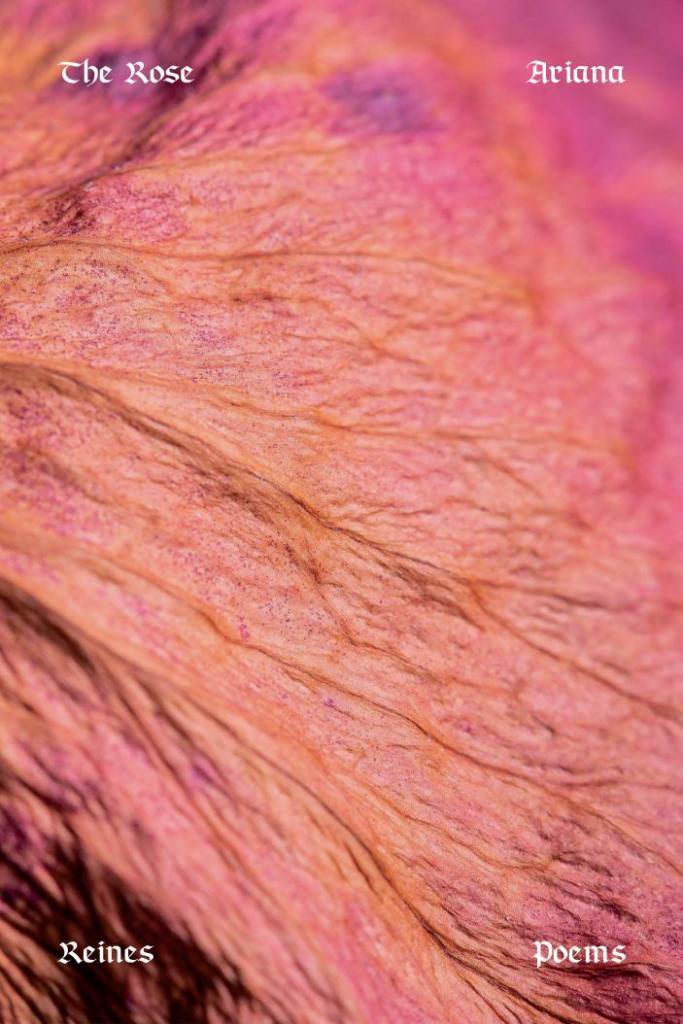
In a recent talk at The Writer’s Block, Reines spoke to Amanda Fortini about her new book of poems, The Rose, in which “Eye of Death” appears. She explained that the book was, in part, inspired by a pandemic romance. Reines had enrolled at the Harvard Divinity School in 2020 but didn’t find what she was looking for. The dating scene in Cambridge was particularly drab, and she ended up seeing a mechanic who served as her male muse. The Rose is, in its own way, a book about love, but it eagerly twists the tawdry expectations that might surround so cliched an emblem.
“The rose is a symbolic figure so rich in meanings that by now it hardly has any meaning left,” wrote Umberto Eco. This semiotic exhaustion has been especially attractive for Reines. The rose is a symbol of love, of sex, of passion, of beauty—but, perhaps most significantly, of secrecy (sub rosa). However obvious its meanings may be, there’s always one more that remains hidden. A prominent vein of esoteric knowledge winds through the poems in The Rose, evoking classical mythology, medieval theology, modern astrology, and—maybe—witchcraft. Reines (who proudly hails from Salem, Massachusetts) announced the publication of the book on Instagram by declaring, “It’s a book about fucking the devil and going to hell.”
“The Rose” is characterized both by a playfulness and by a conviction—a sense that the sensual and the symbolic are still essential.
Most of the 46 poems in this book are short, fragmentary, sapphic expressions of erotic energy. Eight of them are titled “Medea,” after the mythic Greek sorceress. The last of these, a pandemic poem (and one of the strongest in the collection), describes a spat with a lover, screaming, kicking him to the curb, shaking. “Texted that he should stay / Away using two separate / Messaging / Applications.” Reines is a master of ambiguous enjambment—wanting something both ways and generally having it. (In another poem, she observes, “My sorrow it can be extra- / Polated”). Here she conveys both contradictory desires: to beg him to stay and to order him to stay away. The man comes back—“Fucked my brains out / Exactly / The way I wanted.” Exactly.
It would be an oversimplification to say that Reines plays with submission and control, but something of that kind is at work. Her poetic persona never comes across as a victim and rarely seems vulnerable. As Reines herself has said, in an interview with Marissa Zappas, “What I’m best at is to just be completely taken, and overwhelmed, and ravaged.” This artistic self-abnegation—the ability to lose oneself, return, and write about it—is at the heart of her work. And something political, perhaps feminist, is active here. As Hannah Bonner writes, “The Rose offers an alternative narrative wherein femmes of all stripes can find shards of their own reflection: furious, fearful, filthy.”
The Rose follows hot on the heels of Reines’s Wave of Blood (Divided Publishing), which appeared at the end of 2024, a hard-to-categorize work that Audrey Wollen has labeled a “grief memoir.” Reines hints at some of the weighty issues in that earlier book in poems such as “Archilochus,” where she explains her attraction to military men: “I know what it means to give my whole heart / & body to something I know may have no meaning.” But overall, The Rose is characterized both by a playfulness (which can border on silliness: “we fucked a lot & now it hurts to pee … / i had to heal // extraverbally”) and by a conviction—a sense that the sensual and the symbolic are still essential.
 Las Vegas Review of Books