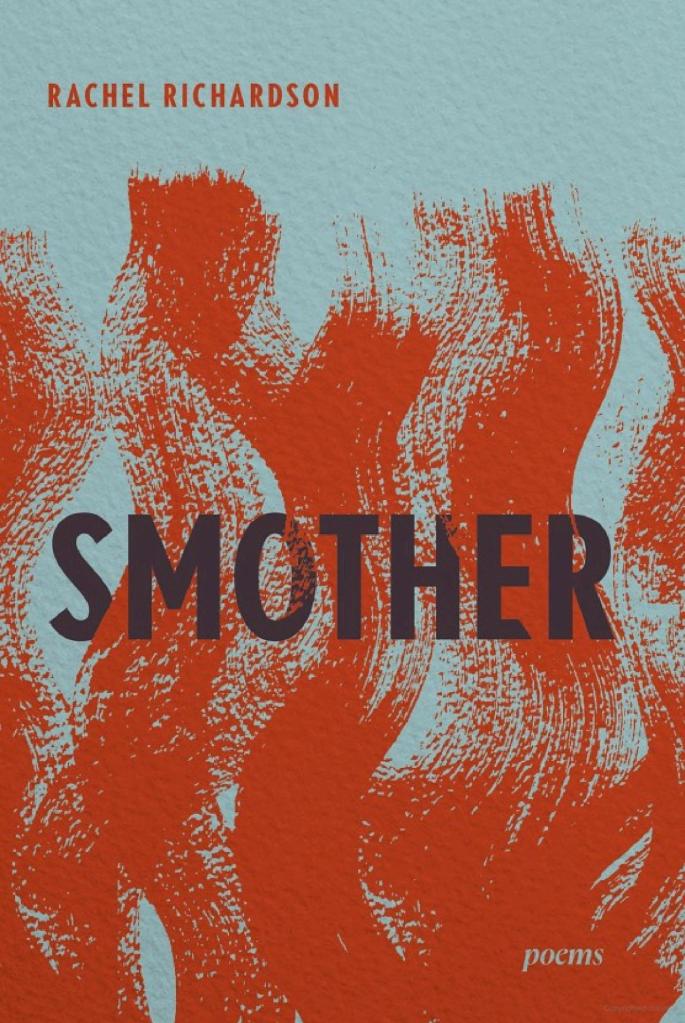
Rachel Richardson, Smother (Norton), 128 pp. Hardback, $25.99.
Smother, Rachel Richardson’s new collection of poetry, isn’t about suffocating anybody. The title is a portmanteau of “smoke” and “mother,” a wry joke that brings together the two major tropes of the book, wildfires and motherhood.
Written between 2017 and 2023, the poems in Smother reflect on the loss of a friend (the poet Nina Riggs), the birth of a daughter, and the devastation and anxiety wrought by the increasingly frequent fires in California. Richardson, who lives in Berkeley (where she also grew up), brings considerable light and heat to the subject of a more and more perilous environment. The smoke in these poems is often quite literal; as she insists in “Tamarack Fire” (in a parenthetical insertion added after the poem’s original publication at Terrain.org), “The fire burning thirty miles away is not a metaphor.”
The fire is not a metaphor, not simply meant to evoke a tense political situation. The crisis is indeed the fire itself. Smother concludes with an appendix detailing the many damaging California wildfires referenced in the poems. And Richardson is serious about what she has called “the long, slow emergency that we’re living in,” the threat posed by ecological mismanagement. Indeed, Richardson has herself recently becomes trained and certified as a wildland firefighter.
The collection profits from being read as a single entity rather than as an assortment of verses.
The smoke in the collection gains power not by analogically suggesting but by thematically abutting the book’s focus on motherhood. It opens with an epigraph from the late J. D. McClatchy, erstwhile editor of the Yale Review: “I automatically reject any poem with the word ‘mother’ in it.” McClatchy reportedly made this remark at the Sewanee Writers’ Conference in 2009. As Richardson notes, this comment gave her “a wall to push against,” an opportunity for a polemical thrust against a patriarchal establishment that would characterize the topic of motherhood as somehow beneath the dignity of poetic art.
The book’s first poem, “Creek Fire,” opens with her daughter’s birthday party. The sky turns dark as flakes of ash as large as crow feathers slowly descend. As many have noted, ecological catastrophe is intimately tied to parenthood. Is it morally irresponsible to bring children into an environment that threatens to become unlivable? What do we owe future generations when it comes to our stewardship of the planet? If we allow the climate to worsen, does that make us bad parents? As Blaise Zerega puts it, Smother is about “raising kids in calamitous circumstances.” How are expectations for parenthood shaped and altered by the risks and dangers of the outside world?
“Poem with Child Crying in the Background,” one of the strongest in the collection, explicitly announces itself as a “Mother Poem.” The child is the poet’s, wailing because of an incident with a Band-Aid—wanting to have it removed but also, simultaneously, not wanting it touched. These conflicting desires may be irreconcilable, but the situation, as the mother-poet knows, is easily resolved: “I reached / down, took her in my talons / and tore the bandage from her arm.” The poet then turns away to write the poem, while the child continues crying. Is Richardson like Alexander the Great, sensibly cutting through the Gordian Knot? Or is she a harpy, torturing her daughter and then turning her tears to verse?
The myth at the center of Smother, however, is that of Daphne—the naiad, chased by the rapacious Apollo, saved only by being transformed into a laurel tree. (Every poet laureate dons the symbol of Daphne.) In “Despite,” Richardson imagines the prospect of self-growth as tree growth. “I’d accept my trunk / like Daphne,” she writes. “I’d learn / to stretch in it, be peeled back // by flame. Smolder.” Rather than punishment or curse, this metamorphosis suggests intriguing arboreal possibilities. Perhaps the woman-become-tree is more powerful than ever before—a being even more resilient and protective. (“If you become bird and fly away from me, I will be a tree that you come home to,” says the mother to her child in Margaret Wise Brown’s The Runaway Bunny.)
Many of the poems in Smother were previously published in other venues, but Richardson has made careful revisions in the process of assembling them into this book. In “Girl Friend Poem: Lyrae,” for example, originally published in Alta Journal in 2022, she reorganizes the opening and alters the first line. This shift—from “I’m thinking of your Jeffrey pines—” to “You haven’t been back”—offers a much more powerful declaration of change and loss. Such revisions create a greater cohesion, and, as a result, the collection profits from being read as a single entity rather than as an assortment of verses.
And there is a productive tension at the heart of the book. As Christopher Kempf notes in his review of Smother for LARB, Richardson turns “from burn-it-down defiance to self-annihilation to an ambivalent archivism of domestic contentment.” On the one hand, burn down the patriarchy—burn it all down! Stick it to McClatchy and his sexist distaste for motherhood. But on the other hand, don’t burn down California. Let us preserve the natural inheritance that we seem to be spending with unchecked profligacy.
Both sentiments exist here. As Richardson wonderfully puts it,
my new philosophy is everything goes in a poem.
Yes, a poem can be a space of wanton abandonment and exhilarating freedom. You can do what you like; there are no rules here. But that not-quite-separated qualifier—in a poem—keeps everything in check. And in the context of the poem in which this line appears, a friend has just asked, “are you going to put this in a poem?” The answer, of course, is yes—it all goes in, every last drop. Birth, death, fire, water, smoke, air, motherhood, artistry, myth, reality, everything goes in a poem.
 Las Vegas Review of Books