Rick Barot, Moving the Bones (Milkweed), 88 pp. Paperback, $16.00.
At the center of Moving the Bones, Rick Barot’s fifth book of poetry, is a long poem titled “During the Pandemic.” It consists of thirty prose parts, each receiving its own page but often using just a few inches at the top for text. Each part anaphorically begins with the phrase “During the pandemic …,” followed by a few brief sentences. These pages don’t glow with lyrical brilliance, but they vividly convey the hollowness of quarantine and the vastness of isolation.
“During the pandemic,” Barot writes, “I fixed on each fear. Each fear was its own fastidiousness.” Masks, gloves, rules, proscriptions—new fixations. “We stood apart in the mandated distance, like the remaining pieces at the end of a game of chess.” The rest of the page is empty white space, eerily emphasizing the inked lines above.
Despite their softness and their quiet demeanor, the poems in “Moving the Bones” are social. They move far beyond the first person.
This snippet offers a good example of Barot’s power. Moving the Bones follows on the heels of his successful 2020 collection The Galleons. That work had reflected upon the historical and structural violences of colonialism (Barot himself was born in the Philippines; he now lived in Tacoma) while resisting the sort of lyricization that might not only aestheticize but anesthetize the subject matter. A key tactical maneuver for Barot was what he has called the “anti-epiphany,” a tendency to end poems not with ethereal revelations but with more mundane crystallizations.
This anti-ephiphanic style is epitomized by “Ode with Interruptions,” the final poem in The Galleons. The ode ends with the following two couplets:
I used to think that to write poems, to make art,
meant trying to transcend the prosaic elements
of the self, to arrive at some essential plane, where
poems were supposed to succeed. I was wrong.
Moving the Bones—which is dedicated to Barot’s father, who passed away in 2023—similarly features poems with killer endings, clincher lines that linger long after the pages have closed. One poem ends with a girl getting off of the train at her stop and “then, like all of us, walking into the day, / into the one thing there’s plenty of: the future.”
Another, “The Lovers” (one of the strongest of the collection), voiced by a wistful poet recalling the boyfriends of his past, finishes by “thinking of all the ice machines on every floor of every hotel / in the world, the sad machines dreaming / of each pure cube of light.” Few writers would find the poetry in those frigid dispensers, but Barot can see pathos and purity where the rest of us can’t. Moments like these are the most valuable parts of the book.
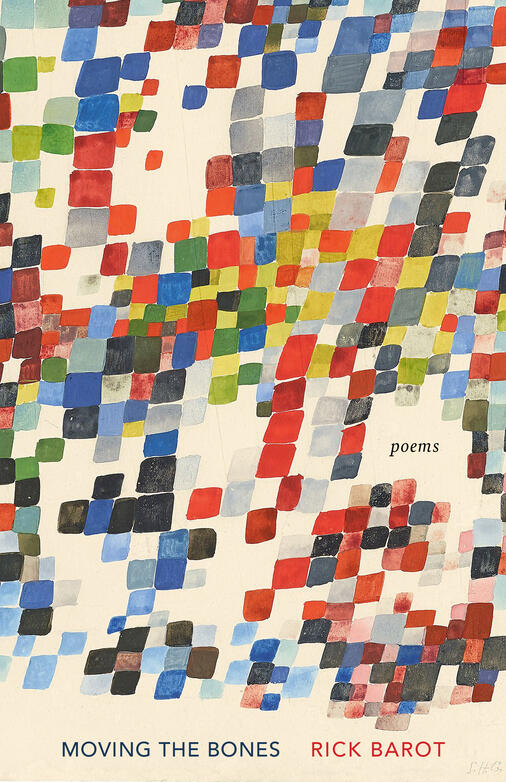
What is initially most striking about Moving the Bones is its cover, which features a beautiful abstract painting by the modernist artist Sophie Taeuber-Arp. Wassily Kandinsky once said that Taeuber-Arp’s works elicited a language “which is often only a whisper,” but a whisper “more expressive, more convincing, more persuasive, than the ‘loud voice’ that here and there lets itself burst out.” This remark could also apply to Barot’s artistry, which is also of the soft-spoken variety. There is little bombast or exclamation in his lines. Instead, we get just the right words—as with a “paperback’s pages yellow as a smoker’s fingers,” or with a “coyote on the street, its pauper’s grandeur.”
This is a world of little, everyday miracles, in which our limitations are primarily perceptual. Here, Barot can express his true anxiety: “the poet’s dread of being / the wrong person in the right world.” “What truth an inadvertence could betray,” he worries elsewhere.
The solution is to avoid the solipsistic navel-gazing so often stereotyped upon artists. Despite their softness and their quiet demeanor, the poems in Moving the Bones are social. They move far beyond the first person. In one delightful moment, Barot expresses his wonder and satisfaction with public transportation: “I thought / of the bus the way I thought of poems, that it / was a civic space and a lyric space at once.” The poet is not just a citizen of the world but also a good citizen.
In “Abundance,” we are told that “far back in its etymology the closet / actually meant a space of intimate privacy // where you might welcome others, not a place / of shame you’re supposed to leave behind.” Barot, in other words, doesn’t want to celebrate coming out of the closet; he wants to invite more and more people into the closet, to expand and deepen our close intimacies—to think of the closet as a space of abundance.
The last poem in the collection, “The Field,” is one of the best. It originally appeared in The New Yorker in 2020. “Two people are asleep in a field,” it begins. On a summer morning, the poet takes a walk and spies them in the distance. Who are these sleepers? They are not dead; they stir. Are they lovers? Are they drunk, or destitute? How long have they been there? “What would bring me / to a field in the night and have me sleep there?” Barot wonders. “Whose hand would I be holding, out of desire or fear?” A poem ending with an epiphany would wake the sleepers. But Barot lets them lie, quietly dreaming their unknowable dreams.
 Las Vegas Review of Books