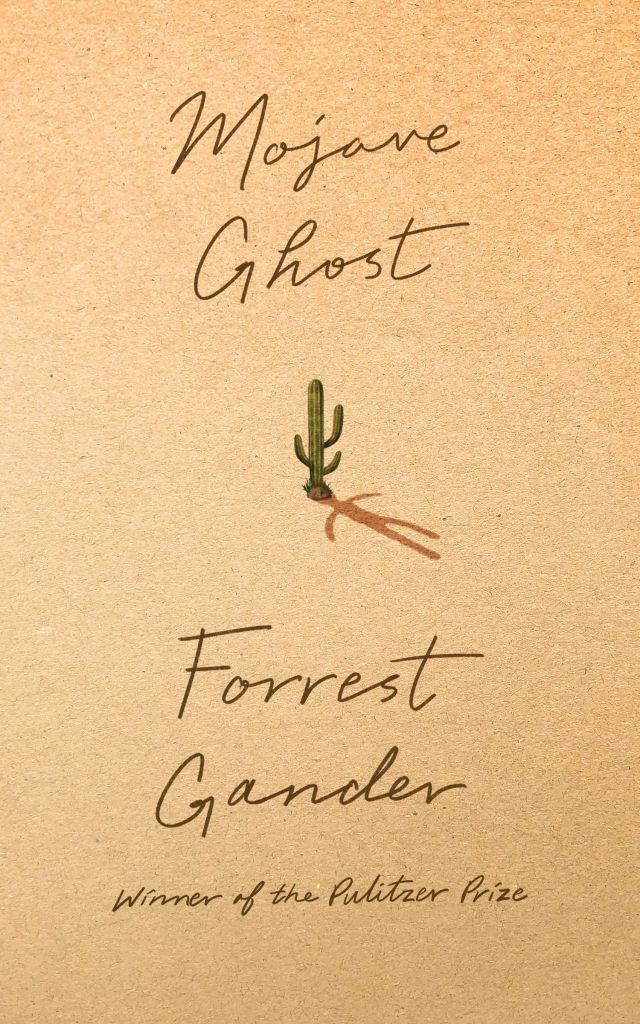
Forrest Gander, Mojave Ghost (New Directions), 80 pp. Paperback, $15.95.
Forrest Gander’s newest book of poetry, Mojave Ghost: A Novel Poem, wants to move as a desert wind—in multiple directions. From its outset, the work questions a traditional linear structure, insisting instead on simultaneity and multiplicity. For Pulitzer Prize–winner Gander, this project to challenge linearity is an expansive dialogue that might be read across his larger body of work, particularly in the writing published after the death of his wife, the celebrated poet C. D. Wright. As with many aspects of Gander’s work, this theme isn’t simply metaphorical but literally present too, such that the poems talk back: to the reader, to the writer, and to other poems as well. In Mojave Ghost, Gander’s own awareness of this process is striking, acknowledged explicitly in the book’s epigraph. Here Gander borrows from his 2021 collection Twice Alive, wherein he wrote, “Isn’t it often in our most intimate relations that we come to realize that our identity, all identity, is combinatory?”
The identity of this most recent work is combinatory as well. Beyond the direct authorial link to prior poetry, the book’s title—Mojave Ghost: A Novel Poem—itself might be identified in multiple ways. One way of interpreting the subtitle, “A Novel Poem,” is to read the work as one long narrative poem, a story in verse. All the same, the word “novel” might simply mean “new” (“A New Poem”). In the work of a lesser poet, a writer not so explicitly concerned with the relational, this line of inquiry might be overly indulgent. But here, in a book which calls language “just another kind of coordination,” it seems unfair not to consider this reading. Yet what makes this poem new?
One answer to this question appears in a brief, prefatory “Author’s Note,” in which Gander writes that the first dirt he tasted “was a fistful of siltstone dust” in Barstow, where he was born. Here Gander locates himself, contextualizing the lines and the life of this geologist-turned-poet. In a moment of explicit narrative, Gander tells us what has happened: his mother passed away, just three years after the passing of his wife of over three decades, C. D. Wright. In the wake of these earth-shattering griefs, Gander finds himself walking along the San Andreas fault with another woman, the artist Ashwini Bhat, who will become his second wife.
What is novel here is what Gander writes of his mother, his first point of connection to the desert; her passion for the canyons and washes is what inspired him to pursue geology. He writes, “Whenever I return to the Mojave Desert, I truly, not metaphorically, feel her ghost in the ever-so-light breeze. I see the landscape through her voice, her eyes.” If Gander might be led by his dead mother along an 800-mile fault line—if he might hear her speak—it follows that none of this book ought to be read as figurative. And a literal reading fits well with the desert poem: Gander has journeyed along a rift—personal, physical, true—examining the overlap, the cracks. The risk was falling in, a total loss of self, yet this has become a “permeable dimension” and the central subject of the work.
Within the sixty-four pages of poetry which make up Mojave Ghost, Gander’s greatest moments of poetic insight occur when he looks toward the relationship between I and you. Despite the autobiographical nature of the author’s note, there are no names in the collection itself, such that the “you” of any given line might be the speaker himself (whom we’ve been instructed to read as Gander) or any number of figures—among them, his mother, his current partner, and his first wife. Because of this, neither speaker nor subject is static. Rather, the boundaries of the self and the other are permeable; more than that, they are iterative.
Gander has journeyed along a rift—personal, physical, true—examining the overlap, the cracks.
Likewise, Gander’s poetic approach to this subject iterates and reiterates throughout. Though at times encapsulated directly, as in “I simply / finds no way,” at other points the poem twists as a snake might through a desert wash. This is most evident in various lines which echo throughout the poem, recurring across moving contexts and seemingly in reference to shifting subjects. Take, for instance, the following short stanza:
What is it you’re thinking, your forehead knotted up like that?
I was thinking of you.
What were you thinking?
In the stanza’s first appearance, the “you” might be any one of Gander’s loves. Yet, some thirty pages later, when it appears again, exactly the same, its lines seem to reference Ashwini Bhat. Still, what is more interesting than guessing at voices is following the poetry’s leaps. When this “I” is consumed by “you” (thinking explicitly of “you”), it is this very mental activity that prevents the “I” from being fully present with this same “you,” regardless of whether the “you” is physically present. Though a bit dizzying, this dance is not accidental. Gander’s work draws readers’ eyes toward the everyday, ordinary ways that attention is constantly split, suggesting that such fracturing is the very nature of even our most-labored attentions.
These cracks in attention populate Mojave Ghost, characterizing the long poem as a distinctly human stream of thought that keeps scrambling between love, loss, renewal, and the natural world. This perspective disintegrates the boundaries between subject and object, life and death, and internal and external environment. In Gander’s eyes, the natural world around him is not separate from his own emotional experience, and vice versa. Toward the end of the poem’s main movement (before its “Coda”), he writes, “Burned oaks footed in naked rock crevices. / A light so sharp, it’s percussive”—an arresting description for any reader but especially for someone who knows the Mojave, where on the right days, the light cuts like a blade. But what is especially astonishing is the next line, in which Gander asks, “Is there an emotion of awareness?” The reader might wonder if this emotion is not both grief and love. This is what Gander shows us in Mojave Ghost—that when one tends to their grief as a garden, this attention expands to a larger cultivation of awareness one can only call love.
To write anything new of love—even lost love—is a challenge as ancient as it is infamous. It is the oldest subject for a reason: everyone loves; everyone loses. Throughout the work, Gander writes simply but beautifully in a way that is not always wholly original, yet at moments he does arrive somewhere that feels new, despite the well-worn path of his subject—as when he asks, “Because if love doesn’t survive, why would you want to?” What another poet might reduce to pure melodrama, Gander expands via the association and iteration of internal landscape turned inside out. He maintains that love survives, across time, across memory, across death. Because of this, the poet must survive, must attempt to flourish even in the desert which grief makes of us. Mojave Ghost is Gander’s own attempt toward this flourishing. Above all else, it is true.
 Las Vegas Review of Books