Gregory Pardlo, Spectral Evidence (Knopf), 128 pp. Hardback, $28.00.
The Ferguson, Missouri, police officer who shot and killed Black teenager Michel Brown testified in his own defense that Brown appeared supernaturally enraged, “like a demon.” The argument was that the policeman was reasonably frightened for his life and therefore fired his weapon in self-defense. The grand jury agreed.
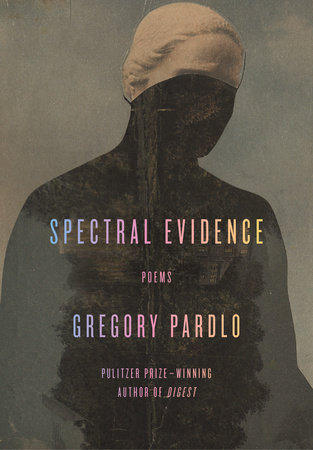
In a Prologue to Spectral Evidence, the follow-up to his Pulitzer Prize-winning poetry collection Digest (2014), Gregory Pardlo begins with this repeatedly conjured image of the Black person as a demon or other paranormal entity. He suggests that the modern move to invoke the monstrous is really no different from the “spectral evidence” used to convict women in the Salem Witchcraft Trials of the 1690s. In this case—controversial even in the seventeenth century—a victim’s claims to having been harmed or frightened by a specter of the accused was admissible in court as eyewitness testimony; the idea was that only those in league with the Devil could cause themselves to appear in such a threatening way to their neighbors. “Spectral evidence is evidence that, technically speaking, does not exist,” writes Pardlo. “The magic in witch trials was real. We just attributed it to the wrong parties.”
Testimony today suggests that fear of the demonic remains quite strong, and Pardlo claims that his book “is about the legal means by which fear is used to rationalize the persecution of people imagined to be in league with and possessed of supernatural forces.” One standout poem here, “Occult,” (which first appeared in the Summer 2022 issue of The Paris Review), is about Tituba, the enslaved Barbadian woman who was one of the first accused in Salem—and later became a well-known character through Arthur Miller’s popular play The Crucible. Pardlo jokingly describes the arraigned Tituba as a “flight / risk.” He exhorts the goddesses of Justice and Retribution to allow this nonwhite woman to take ultimate control of the court proceedings: “With no standing on her own behalf, / let her sit in judgment.”
Pardlo’s book isn’t really a concept collection with a central narrative; it isn’t a work like Tyehimba Jess’s Olio (2016), for example. Instead, Spectral Evidence much more resembles Pardlo’s own Digest, a collection of short, compact poems that swiftly shift between classical allusions, philosophical digressions, ekphrastic descriptions, and humorous apercus. His verses juggle scholastic theology, Renaissance painting, and contemporary pop culture. (“I corral a spectrum in the field / of my embrace,” he says in an earlier poem.) A wonderful example of such uncommon shuffling is the comparison, in “Dragonflies,” between Goya’s Saturn and Sesame Street. An expression on his nephew’s face “is so freaking cute I wish I could / Cookie Monster his whole head.” Sometimes the movement is dizzying, even overwhelming. “Tall Poppies,” for example, in fewer than forty brief lines zips from Rwandan State radio to the ancient Roman King Tarquin the Proud to the nineteenth-century opium wars to the modern pharmaceutical industry to aggressive Israeli military officers.
Pardlo is a master of nimble intellectual acrobatics, finding the invisible dance steps that connect disparate elements of our shared culture.
One could label this poetry “academic” (Pardlo is a college professor) for the degree of philosophy, history, literature, and the fine arts suffusing every poem. The reader is expected to know a thing or two about Hesiod, Augustine, Locke, and Caravaggio. But there is nothing fusty about the subject matter. Such wonderful richness is Pardlo’s calling card; he is a master of nimble intellectual acrobatics, finding the invisible dance steps that connect disparate elements of our shared culture. Furthermore, he has the rare gift of understanding how the pop culture of the present is privileged by an enormous and weighty inheritance, a ponderous genealogy stretching from antiquity through modernity.
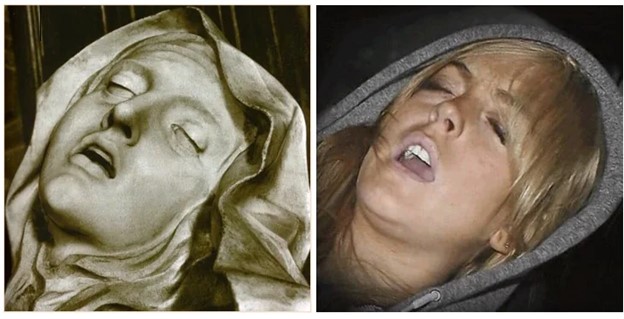
This style will be familiar to fans of his work. (Anyone who has come across Pardlo’s terrific 2012 poem “Philadelphia, Negro” knows that they are in the presence of a sophisticated talent.) In Spectral Evidence, a recurring figure is Saint Teresa of Ávila. Known to levitate, Teresa oddly suggests to Pardlo the tragic death of professional wrestler Owen Hart. But the poet is particularly drawn to Gian Lorenzo Bernini’s 1652 sculpture The Ecstasy of Saint Teresa—“her spirit / burst forth, O Lord, like a jelly jar full of lightning / bugs clumsied from my handlebars.” A popular Internet meme, Pardlo points out, juxtaposes the statue’s face with a paparazzi snapshot of Lindsay Lohan passed out after a night of partying. “Who wouldn’t want to be / a white woman in ecstasy?”
While the poems in the collection often share an interest in the supernatural, they can certainly be read profitably on their own. “Convertible,” a tribute to his father, is brief and beautiful. (An earlier version appeared in The Fight & The Fiddle in 2017, but Pardlo has revised it by cutting out the middle lines, making it much more powerful.) “Magnificat,” a meditation on Piero della Francesca’s Madonna del Parto (c.1460s), considers a palimpsestic pregnant Mary, “counting down to anno domini.” And, in one of three pieces titled “Theater Selfie,” the poet tries to buy expensive seats for a production of Hamilton, to the consternation of the box office clerk: “Those? He snarled, / you can’t—his pause—its meaning irretrievable now— / was heavy with the ghosts of Broadway’s sins.”
The real magic, it turns out, is not the conjuring of spectral evidence but the artistry of the poet, and Pardlo is especially attentive to the wonders of writing: “I’m clinging to earlier drafts, intimate as chalk outlines, screen / burns, they surface when I hot-breath the mirror.” (“Think of reading as resurrection,” he suggests.) Superfans who want to compare some of these poems with their original periodical publications will be impressed by the careful revisions that heighten the effects of the verses. But even very casual readers should come away affected by the engaging assortment they will find in Spectral Evidence—a study of “racial bias in pain assessment,” a consideration of a “beauty school wig head,” a suggestion that Kyrie Irving is a Surrealist poet. Through dad jokes and endnotes, legal briefs and altar pieces, Pardlo has crafted an impressive collection that speaks with poetic urgency to our own weighty moment.
 Las Vegas Review of Books