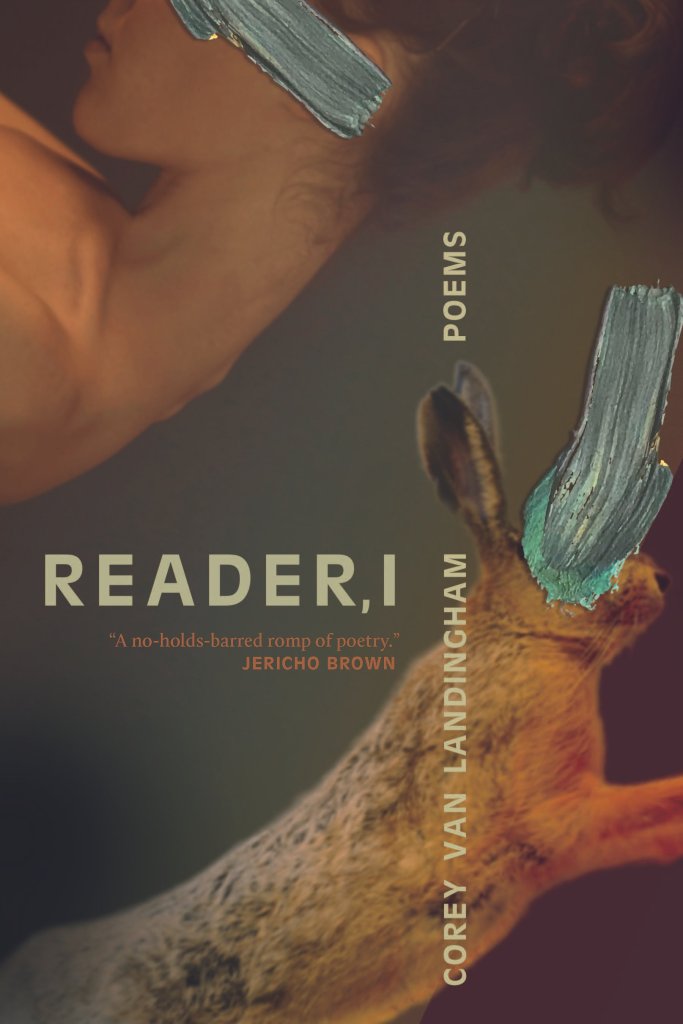
Corey Van Landingham, Reader, I (Sarabande), 100 pp. Paperback, $17.95.
“Reader, I married him.” It might be the most well-known line in any Victorian novel. As scholar Sharon Marcus explains, in her Introduction to the new Norton Library edition of Charlotte Brontë’s Jane Eyre, the famous catchphrase “foregrounds Jane’s intentions and assertiveness: not ‘Reader, he married me,’ nor ‘Reader, we married,’ but ‘Reader, I married him.’ Jane is the subject of this sentence, her own narrator, a woman making her own choices.” In other words, the line is deservedly famous. It sums up, in a short and simple sentence, the compelling power and agency of the speaker.
Corey Van Landingham takes a cue from Jane in Reader, I, her new collection of poems. Most—24 out of 37—of the pieces here are prose poems titled and beginning with the phrase “Reader, I.” These and a dozen others, in various forms, chronicle the initial period following the marriage of the speaker. The book opens with an amusing epigraph from Brontë that complicates any happily-ever-after ending: “It is a solemn and strange and perilous thing for a woman to become a wife.” Brontë wrote this in 1854, just months after getting married.
The book opens with a bang; the first two poems are extremely strong.
The title also obviously gestures to the confessional style. Van Landingham herself married the poet Christopher Kempf in 2017. (They now both teach at the University of Illinois.) But it would be wrong to read these poems as transparently autobiographical; Van Landingham has created a persona here, albeit one that would seem to resonate in certain respects with the actual poet. “These poems are not autobiographical,” she explicitly declared in an interview. The “I” on display is an I for the reader of poetry, a presence created by the lines themselves. It is far more artful and interesting than an honest recounting of the facts.
The book opens with a bang; the first two poems are extremely strong. The initial “Reader, I” poem considers Creusa and Dido, the wife and the girlfriend Aeneas successively leaves to their deaths. Moving from Virgil to Longfellow, Van Landingham finds an epic, primeval world filled with weeping and wailing wives: “Dactyls upon dactyls of bridal beds aflame, sad wraiths, lustrous oceans of tears.” Things don’t portend well for the soon-to-be-married here.
The next poem, “GILLY’S BOWL & GRILLE,” which was originally published in The New Yorker magazine, features wavy tercets suggestive of the strikes-and-gutters rhythms of the bowling alley. (There really was a Gilly’s Bowl & Grille in Gettysburg, Pennsylvania, where Van Landingham used to work—and where several of the poems in her last book, Love Letter to Who Owns the Heavens, are set. She was also married there.) The poem’s speaker travels far from her West Coast origins, still grieving the passing of her father many years earlier, swearing to herself that she won’t have kids who could be similarly devastated by the death of a parent. The alleys, neatly lined up like the rows of corn outside, suggest quiet despair—a sanitized spacing out, a place where people might “drink under the neon lights and hurl their lives away.” She hopes the owner’s daughter, Gilly, can get out.
The speaker ends up marrying a man from Ohio, a state she grows to love. In Martins Ferry, home of the poet James Wright (whose “Autumn Begins in Martins Ferry, Ohio” is a short modern masterpiece), she learns to see the beauty of dirty water (“sometimes you don’t have to see straight through a thing”), and she listens to her husband’s relaxed language: “What I love is how he talked there, shearing his to be. The Impala that needs washed.” It’s a nice metaphor; the marriage is very much about understanding what goes unsaid.
To be sure, it’s not paradise. And the central relationship in this book seems to involve a lot of fighting. Tempers occasionally flare: “we can smash a glass or two / on a Tuesday, unwind some / old wound.” Even ardent fans of Jane Eyre may overlook the fact that the heroine’s surname puns on several words: air, heir, and ire. The last, her anger, arises many times in the novel. And the speaker in Reader, I similarly boils over again and again. “Dear, dear reader—please excuse my flickers of ire,” she tells us. “I just feel so much, sometimes, midaltercation, so tin-struck in my whine, believe I might really levitate—such a kingdom is my ire.”
The danger of the prose poem is typically the tendency to slide toward the prosaic—to lose the language along with the line. But such danger is avoided here. Many of the “Reader, I” poems, for instance, feature a strong internal rhyme scheme. In one, the desire to be a “casual bride” resonates through a tidy series of terms: inside, snide, hide, Telluride, cried, decide, insecticide, untied, lakeside. It’s almost too much. But it hangs together, as the speaker removes her shoes to glide across the dance floor.
There are many other treats—a surprisingly erotic jogging poem, a bickering over vocabulary errors, an ode to the regal pleasures of adult swim at a community pool. The verses are often quite literary, and the classic references are multiple (Shakespeare, Milton, Johnson, etc.). But Van Landingham only takes what she needs. The poetry is never stuffy.
The point throughout is not to debate the merits of or downsides to marriage but rather to explore the self-transformation that naturally occurs in a union. So much first-person poetry is painfully self-absorbed; it’s refreshing to see a self gradually finding definition in a relationship—to focus on that necessary to be elided by her partner’s Ohio dialect.
 Las Vegas Review of Books