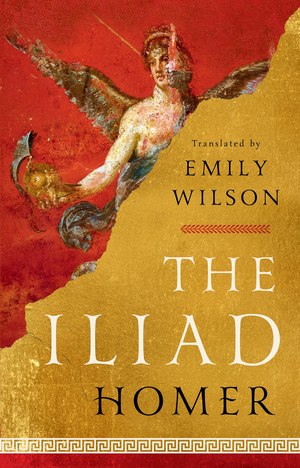
Homer, The Iliad, translated by Emily Wilson (Norton), 848 pp. Hardback, $39.95.
Much anticipation attended the publication of Emily Wilson’s translation of Homer’s Iliad, largely due to the overwhelmingly positive reception her 2017 Odyssey translation earned from both the literary community and the world of classical scholars. Thus it is hard not to compare Wilson’s new Iliad with her successful Odyssey, and the most noticeable change in her translation strategy has been one of economy. Her Odyssey replicated the exact same number of lines for each book as the original Greek text, but the compression of the original’s dactylic hexameter into English blank verse required her to trim some of the repetitions of Homeric epithets or other “extraneous” verbiage. The result was a lean, vigorous translation that moved quickly and packed a punch. Having discarded this stricture for her Iliad, Wilson now takes her time with her translations of Homeric diction (with some critical approval), but the result loses a little of its force, and the slower tempo of her translation deprives the poem of some vitality without adding the grandeur that might have been provided by using more archaic or elevated diction (instead of the contemporary colloquialisms she sometimes chooses, such as when Hephaestus asks Zeus and Hera not to “cause a ruckus”).
To be fair, Wilson’s Iliad is replete with many fine phrases: “My hands work hardest in the frenzied fighting, / but when we share the spoils, you get much more,” complains Achilles to Agamemnon. Later, a divine dream sent to Agamemnon “suffused his senses when he woke from sleep.” But Wilson’s overarching approach, aiming for contemporary readability, sometimes humbles the epic scale a little too noticeably. Consider a passage (emphasized by Wilson in her Introduction) in which Sarpedon explains to his companion Glaucus the logic of a warrior elite as the two invade the Greek camp. The stately 1951 translation of Richmond Lattimore, still eminent although somewhat dusty today, brings out Sarpedon’s panache:
Man, supposing you and I, escaping this battle,
would be able to live on forever, ageless, immortal,
so neither would I myself go on fighting in the foremost
nor would I urge you into the fighting where men win glory.
But now, seeing that the spirits of death stand close about us
in their thousands, no man can turn aside nor escape them,
let us go on and win glory for ourselves, or yield it to others.
Even a recent (2015) translation by Peter Green captures the gallantry of the sentiment:
Ah, my friend, if the two of us could escape from this war,
and be both immortal and ageless for all eternity,
then neither would I myself be among the foremost fighters
nor would I send you out into battle that wins men honor;
but now—since come what may the death-spirits around us
are myriad, something no mortal can flee or avoid—
let’s go on, to win ourselves glory, or yield it to others.
But Wilson’s simplistic rendering makes Sarpedon sound like he has given this way of life very little contemplation:
You see, my brother, if we could escape
this way and then be free from age and death
forever, I would never choose to fight
or join the champion fighters at the front,
nor would I urge you to participate
in war where men win glory. But in fact,
a million ways to die stand all around us.
No mortal can escape or flee from death.
So let us go. Perhaps we shall succeed,
and win a triumph from another’s death,
or somebody may triumph over us.
The original text’s σὲ στέλλοιμι μάχην (“dispatch you into battle”) is translated by Wilson with the bloodless phrase “urge you to participate in war.” Where the Greek text κῆρες θανάτοιο μυρίαι invokes “countless fates of death,” Wilson uses the Seth MacFarlane-esque idiom “a million ways to die.” (The κῆρες could also refer to Valkyrie-like female spirits of Greek mythology, which both Lattimore and Green chose to emphasize for further epic tone.) Sarpedon’s closing line, ἴομεν ἠέ τῳ εὖχος ὀρέξομεν ἠέ τις ἡμῖν (“Let us go, whether we shall fulfill the prayer of another or another shall fulfill ours”) re-asserts the attitude that warfare is a meaningful site of heroic behavior and destiny; Wilson, adding the unnecessary (Roman-sounding) detail of “win a triumph,” detaches the first half from the second, which makes death in battle seem to be a totally random process: “So let us go. Perhaps we shall succeed, / and win a triumph from another’s death, / or somebody may triumph over us.” Homeric conquest should not sound like the flip of a coin.
Wilson’s Odyssey rendered that poem’s opening line, “Tell me about a complicated [πολύτροπον] man,” which controversially processed that enigmatic word with the Millennial language of Avril Lavigne and Facebook relationship status updates (“It’s complicated”). Much more successfully has Wilson handled the Iliad’s intro: “Goddess, sing of the cataclysmic [οὐλομένην] wrath of great Achilles,” capturing in a single word how the warrior’s wrath was not simply destructive but also epochal: the fall of Troy was also the end of the Heroic Age of mythological warriors, a more spirit-haunted time that Homer’s audience looked back toward with longing. (This sense of loss was already present in the poem itself, as when Nestor recalls the valor of an earlier generation in Book 1.)
Before encountering this cataclysmic wrath, however, the reader first meets a quite extensive set of introductory material (including some wonderful maps) totaling 75 pages. The centerpiece of this is an “Introduction” by Wilson that really serves as a long essay on her interpretation of the epic as a whole. For Wilson, the poem is largely a meditation on death. Sometimes this morbid focus serves to illuminate, as when she writes: “In the end, we all lose. Our best hope is to accept partial, temporary limits on conflict, accepting human companionship and community as our only, always inadequate compensation, for the pervasive experience of loss.” But at times it can feel like a bit much; her concluding gesture to climate change feels quite forced, and anyone who has ever played amateur sports (or the Dozens, for that matter) will be surprised to read this observation: “Homeric characters express their intense emotions in ways that are likely to be alien to many modern readers. Men regularly show their rage by hurling inventive insults and threats at one another, even in the midst of battle.”
The Iliad is less a depiction of the futility of resisting one’s own demise than it is a dramatization of a man realizing that his old way of looking at life is ultimately unsatisfying.
This death-focused outlook (perhaps influenced by autobiographical aspects noted in this fall’s New Yorker profile of Wilson) saps much of the fun, even the joy, of the Homeric world that draws so many readers to the Iliad in the first place. A recent negative review suggested that this dour reading of the Iliad led Wilson to depict her characters as unheroic fools whose perspectives were almost comically misguided. Wilson’s own words (“You will die. Everyone you love will also die … Nothing you can do will bring them back. You know this. Your knowing changes nothing.”) seem even more pessimistic than the gloomy Greek attitude expressed by Achilles at the end of the poem, when he describes the two urns from which Zeus distributes outcomes to mankind. “Two jars are set upon the floor of Zeus,” he says.
From one, he gives good things, the other, bad.
When thundering Zeus gives somebody a mixture,
their life is sometimes bad and sometimes good
But those he serves with unmixed suffering
are wretched.
Pointedly, Achilles never suggests the possibility that some lucky folks might receive nothing but blessings. But Homer’s heroes all seem to partake in both the sufferings of war and the many blessings of a privileged life. Wilson’s nihilistic take on the Homeric world reduces the latter to empty shadows.
Yet if Odysseus is a “complicated” man, then surely the value-system of his Bronze Age warrior milieu cannot be so simple. The Iliad is less a depiction of the futility of resisting one’s own demise than it is a dramatization of a man realizing that his old way of looking at life, in terms of prioritizing the acquisition of respect over everything else, is ultimately unsatisfying (especially in light of our own mortality). Rather than emphasize our distinctions, through social mechanisms like status, we should emphasize our connections—in particular, the universal experience of grief. The Iliad is a deeply humanist text precisely because it shows that suffering—be it through war, poverty, bereavement—does not need to be an individual experience of misery but can serve as a common bond, even among vastly disparate peoples. While Wilson’s Iliad is a tremendous accomplishment and is likely destined for fame among an entire generation of Homer readers, one wishes she had been more receptive to a reading of the epic that found something worth preserving in the values of the ancient world it depicts.
 Las Vegas Review of Books