Matthew Davis, A Biography of a Mountain: The Making and Meaning of Mount Rushmore (St. Martin’s), 336 pp. Hardback, $30.00.
Mount Rushmore had six different dedication ceremonies—in 1925, 1927, 1930, 1936, 1937, and 1939. There was one for the securing of the location in western South Dakota, one for the initial drilling into the rock, and one for each of the completed faces of the four U.S. Presidents appearing in granite: Washington, Jefferson, Lincoln, and Roosevelt.
As Matthew Davis points out in A Biography of a Mountain, his history of and meditation on “our most visible piece of Americana,” Mount Rushmore has had many different meanings and purposes for different people in different times. The several dedications stressed different aspects of just what was being memorialized; one suggested the glories of the westward course of empire, another patriotic reverence for our nation’s forefathers, and a third the enduring ideals of democratic politics.
Searching for the “interpretive soul” of this memorial, Davis’s book takes a much wider view of such various meanings. “Mount Rushmore is an international symbol of white supremacy and injustice,” says Nick Tilsen, a Native American activist and leader in the Land Back movement. “It was the first graffiti that ever became a national monument,” notes retired superintendent Gerard Baker, the highest-ranking Native American in this history of the National Park Service. “It was a marvelous graffiti but still graffiti.”
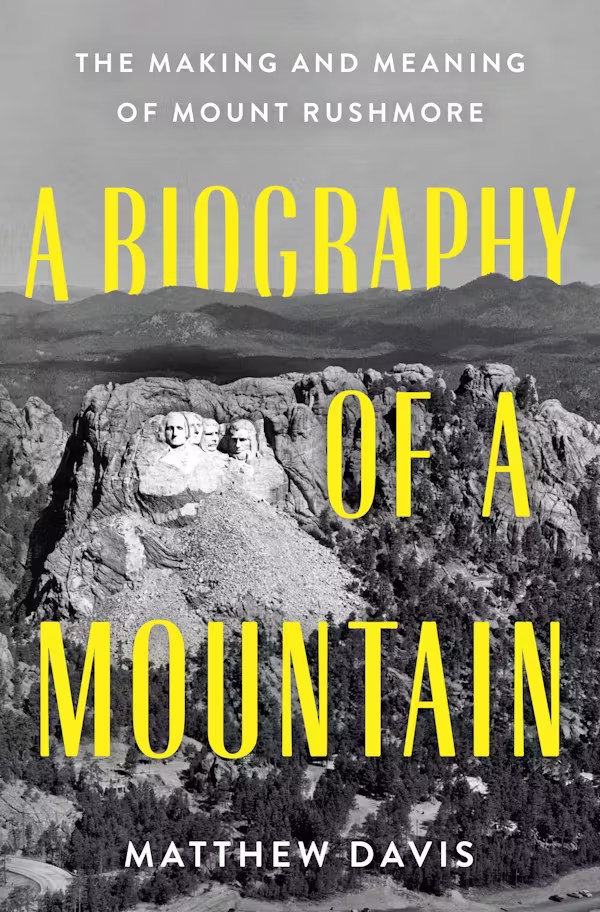
The reason Davis titles his book A Biography of a Mountain—rather than A Biography of a Monument—is that Mount Rushmore is carved into the Black Hills, or Paha Sapa, which have themselves been considered sacred ground by the Lakota people for hundreds of years. (“Land is monument,” as one Lakota administrator observes.) Most striking is Davis’s cover image, a photograph of the enormity of the Black Hills that reveals the relative smallness of the Mount Rushmore sculpture.
Davis takes great pains to account for the very controversial history of this location. Inhabited by the Lakota people since the 1700s, the Black Hills have been contested grounds for centuries. While the Mount Rushmore monument has its origins in the 1920s, the land has long been a flashpoint for competing narratives of American history. Going back to the Fort Laramie Treaty of 1868 (which designated the region as Lakota land), Davis reveals the troubled history of western South Dakota through well-known conflicts: the Battle of Little Bighorn (or Battle of the Greasy Grass) in 1876, the murder of Crazy Horse in 1877, the Wounded Knee Massacre in 1890. South Dakota was only granted statehood in 1889—and didn’t recognize the right to vote for Native Americans until 1951. In 1980, the U.S. Supreme Court affirmed that government had illegally seized the land from the Lakota in violation of the Fort Laramie Treaty and awarded over $100 million as restitution—a payment that the Lakota have ever refused to accept.
Yet although this is the biography of a mountain, the star of the book is clearly Gutzon Borglum, the mercurial sculptor who carved the four U.S. Presidents in stone. Drawing on archival manuscripts, Davis reveals that Borglum was born in Idaho to Danish Mormon immigrant parents who practiced plural marriage—details the artist never made public. Borglum quickly found success as a young western painter, especially under the patronage of Jessie Benton Frémont. He then traveled to Europe and fell under the spell of Auguste Rodin, becoming a sought-after sculptor by the early years of the twentieth century. It was perfect timing, as a “monument mania” was just about to sweep through the United States, providing plenty of commissions to a man eager to memorialize his country’s past.
What does it mean to privilege the history of this site—a history which may reveal more about the true character of America than that of any other?
Borglum’s career, however, was odd—to say the least. Just before he began work on Mount Rushmore, he was fired from his job designing the Stone Mountain monument to the Confederacy in Georgia—a massive sculpture of Jefferson Davis, Robert E. Lee, and Stonewall Jackson on horseback, largely spearheaded and organized by the Ku Klux Klan. Borglum seemed happy to work with the KKK—until they cut his funding and fired him. In an angry fit, Borglum smashed and destroyed the models and designs for the project, and then, under threat of arrest for this act, he fled—in an actual police pursuit—to North Carolina, where the governor (a friend) refused to extradite him back to Georgia.
Borglum doesn’t seem to have been an actual member of the Klan, but his eager willingness to work with them (his initial design for Stone Mountain included hooded Klansmen) ineradicably taints his later productions. “Stone Mountain was the rough draft for Mount Rushmore,” notes Davis. It would be too simple to see the faces of U.S. Presidents as merely a continuation of Confederate sculptures; Davis’s book suggests that Borglum was a professional artist always on the hunt for new commissions. He was usually most excited about securing funding, and he modified his designs endlessly. A telling note is that, in the late 1920s, while he was beginning work on Mount Rushmore, he completed a sculpture of Sacco and Vanzetti, the Italian-American anarchists controversially executed for murder in 1927. He did so at the behest of his friend Felix Frankfurter, later a Supreme Court Justice. Stonewall Jackson, John Ruskin, Teddy Roosevelt, Nicola Sacco—Borglum sculpted a lot of figures, and his choices don’t easily fit into a tidy narrative.
The story presented here about the artwork is interesting—Davis points out, for example, that the carving of Teddy Roosevelt’s glasses are “a sculptural innovation, a suggestion of spectacles rather than a physical manifestation”—though it doesn’t always have much to do with the longer history of Lakota lands. Davis brings these strands together by offering several concluding chapters that focus on the much more recent history of Mount Rushmore through interviews with people who have a stake in the monument’s meaning today.
He notes that Mount Rushmore’s reputation as perhaps the most famous United States monument really began in the 1990s; before then, it was more of a small local attraction for South Dakota. A visit by President George H. W. Bush in 1991 helped to thrust the sculpture from regional into national distinction. Tourism ticked up, and now several million people visit annually. A campaign speech by President Donald Trump at Mount Rushmore in 2020 again brought increased attention and highlighted the controversial clashes of meanings Americans invest in the monument.
For Davis, the land is always key. This is as much a story of the West as it is about public art and monumentalization. “If you took Rushmore out of the Black Hills,” he asks, “would it retain the patriotic significance and democratic devotion many audiences feel toward the memorial today?” What does it mean to center national attention upon South Dakota? And what does it mean to privilege the history of this site—a history which may reveal more about the true character of America than that of any other?
 Las Vegas Review of Books