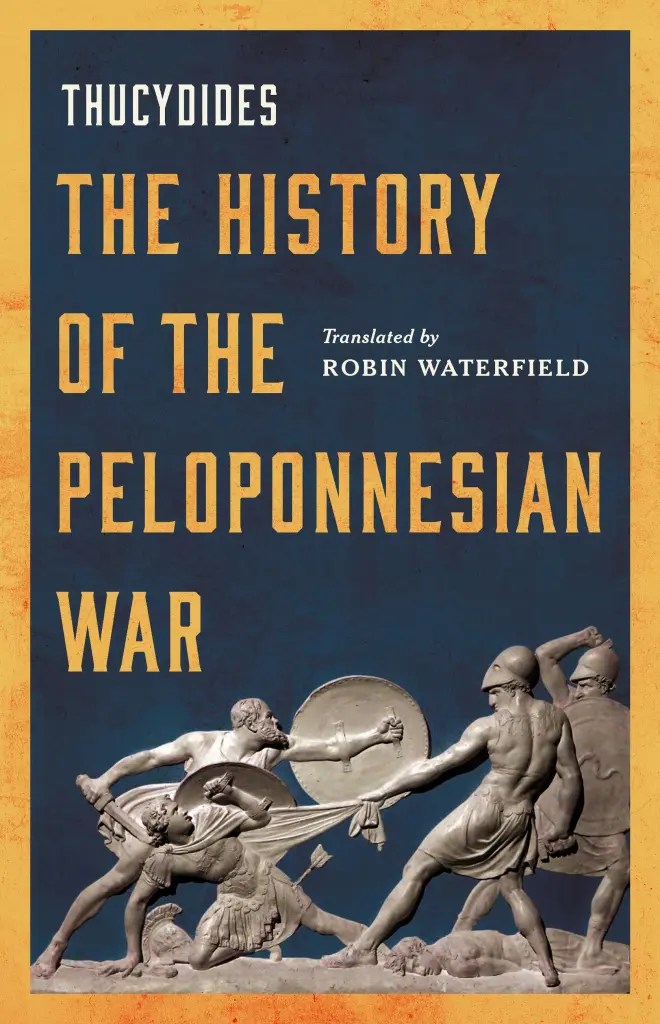
Thucydides, The History of the Peloponnesian War, translated by Robin Waterfield (Basic Books), 752 pp. Hardback, $40.00.
It is hard to imagine a time in American history when Thucydides did not seem relevant to readers. An Athenian general of the late fifth century BCE, Thucydides wrote a historical account of the contemporaneous Peloponnesian War that pitted the naval superpower Athens and its subjects against an alliance led by Sparta, long the supreme Greek military force but increasingly wary of its neighbor to the northeast. In doing so, he created a blueprint for the craft of the historian: reliance on eyewitness testimony, preference for rational causation rather than divine intervention, and a cynical outlook on the facades of politics and the gulf that often forms between words and deeds.
Anyone living in a wobbly democracy or observing the actions of international adversaries can find something of value in his account of the war ravaging the Aegean world during this moment in antiquity. Readers finishing Robin Waterfield’s accessible new translation will likely nod in agreement with the sentiment of John Adams, who told his son John Quincy Adams in 1777 that the work is “full of instruction to the orator, the statesman, the general, as well as to the historian and the philosopher.” This new translation’s introduction, by the historian Polly Low, also cites a World War I memoirist who “read and re-read Thucydides, for he also had lived among crumbling institutions.” Even today, political theorists speak of a “Thucydides trap” to explain Sino-American relations in the twenty-first century: as Sparta’s fear of the growing military and economic power of Athens led to open hostilities, so might American concerns about China lead to a tragic conflict.
The roles of orator and statesman are best combined in the personage of Pericles, the Athenian leader at the outbreak of war, who reminds his countrymen of their cultural values and aspirations during his famous Funeral Oration. He declares that Athenians “treat wealth as something that creates opportunities for action rather than as a reason for boasting, and poverty not as something that a person need be ashamed to admit; what’s shameful, rather, is not actively trying to escape it.” Pericles’ tragic death soon thereafter (during a plague) left a leadership void that less virtuous men simply could not fill, to the detriment of their democracy.
The demagogues and grifters who populate the political world after Pericles only exacerbate tensions, leading to hostilities within city-states. As government disintegrates on the island of Corcyra, Thucydides’s blunt description of the mindlessness of its civil war rings true: “reckless daring was regarded as courage and as displaying loyalty to one’s political group, and prudent hesitation as specious cowardice; moderation was considered a screen for lack of courage; applying intelligence to everything was judged an excuse for doing nothing.” Stripped of their underlying values, the old buzzwords serve simply as cudgels in the quest for power.
* * *
Many modern readers of Thucydides in English encounter him through The Landmark Thucydides, the first volume of Robert Strassler’s Landmark series, which publishes translations of ancient historiographers with detailed footnotes, marginalia, maps, and other helpful editorial additions. But the Landmark Thucydides uses a revision of Richard Crawley’s 1874 translation that in many places can seem overly stilted today. When Athenian ambassadors try to bully the tiny neutral island Melos into submitting to their rule rather than fighting back, the Landmark renders their argument with almost Dickensian prolixity:
“Hope, danger’s comforter, may be indulged in by those who have abundant resources, if not without loss, at all events without ruin; but its nature is to be extravagant, and those who go so far as to stake their all upon the venture see it in its true colors only when they are ruined; but so long as the discovery would enable them to guard against it, it is never found wanting.”
If that sounds a bit too Victorian for some tastes, Waterfield’s version will be easier to digest:
“Hope is a source of comfort at times of danger, and the damage she does to those who rely on her isn’t fatal, provided they have further resources to draw on. But hope is costly, and those who stake their all on a roll of the dice understand this only when they’re ruined and it’s no longer possible for them to act on that understanding and protect themselves against her.”
Waterfield has done a more effective job of making the Athenian embassy’s point: weak states making decisions based on slim hopes realize the illogic of their decisions only once they have committed themselves to disaster—like a Vegas gambler regretting the fortune she lost by betting on longshots. Melos should take their advice and not be forced to learn the hard way.
Another common Thucydides translation competing with Waterfield in the market is the 1998 edition by Steven Lattimore (son of the famous Homer translator). Lattimore often attempted to reproduce the deliberately labyrinthine prose of the original Greek, prioritizing fidelity over clarity. The result was an elevated but sometimes obfuscatory work, exemplified in this complaint by the Athenian rabble-rouser Cleon:
“And the greatest danger of all is that we will not stand fast over anything that is decided and will not realize that by following worse laws without deviation a state is stronger than when it has good laws that are not binding, that ignorance combined with self-control is more beneficial than cleverness combined with intemperance, and that compared with more intelligent men the less gifted usually run their states better.”
Waterfield’s version is much clearer:
“Most alarming of all is the prospect of inconstancy in our decision-making. You need to appreciate that a city that relies on laws that go unchallenged, even if they’re imperfect, is stronger than one that relies on laws that are fine in themselves, but are unenforced; that unsophisticated self-discipline is more practical than undisciplined cleverness; and that ordinary people can generally manage their cities better than their intellectual superiors can.”
This clarity almost makes one begin to trust Cleon’s argument—even though he spoke in favor of massacring the entire adult male population of Mytilene to punish a brief revolt.
* * *
A recent review referred to Waterfield’s prose as “a vernacular for our time.” Sometimes, however, the literary artistry of the original Greek is flattened out by overly simplistic translations. Diodotus, arguing against Cleon in the Mytilenean Debate, insists, “The issue for us today, if we’re sensible, isn’t whether they’ve done wrong, but whether we’re making decisions that are right for us.” But Thucydides actually wrote οὐ γὰρ περὶ τῆς ἐκείνων ἀδικίας ἡμῖν ὁ ἀγών, εἰ σωφρονοῦμεν, ἀλλὰ περὶ τῆς ἡμετέρας εὐβουλίας (“for our discussion is not about their ἀδικία [adikia, injustice], if we are being prudent, but about our εὐβουλία [euboulia, good counsel]”). We lose the intricate verbal parallelism when Waterfield renders εὐβουλία as “making decisions that are right for us,” thus turning complex nouns into basic verbs. Indeed, this parallelism can clarify how Diodotus has shifted the terms of the debate from justice to opportunism.
Waterfield’s translation offers a lucid narrative of imperial decay and a warning to the free societies of the future about how democracies decline by prioritizing expediency over justice.
Similarly, the lapidary line uttered by the Athenians in the Melian dialogue (which every international relations student knows by heart) has been published in the Landmark edition and elsewhere as “the strong do what they can and the weak suffer what they must” (δυνατὰ δὲ οἱ προύχοντες πράσσουσι καὶ οἱ ἀσθενεῖς ξυγχωροῦσιν). While Lattimore’s ultra-literal translation gives us “possibilities are what superiors impose and the weak acquiesce to,” Waterfield tries in vain to split the difference by offering up “the strong do what they can and the weak concede them that right.” Nevertheless, one should be reluctant to cast aspersions too quickly. As the renowned classicist Barry Strauss recently admitted in his positive review of this work, it is already difficult to get modern readers to approach the classics, so a little grace should be granted for someone grappling with a 752-page book.
One suspects that Thucydides’ reputation as a difficult prose stylist (both in the original Greek and in these translations) has stunted his popularity in America, despite the importance that many place on his ideas. If so, then the need for an accessible new translation today is all the more pressing, and Waterfield should be commended for producing one. His version offers a lucid narrative of imperial decay and a warning to the free societies of the future about how democracies decline by prioritizing expediency over justice. When the state lacks the right leaders to inspire and persuade the citizenry, words lose their meanings and become mere weapons in power struggles. By the end of the Peloponnesian War, even the Athenian ambassadors to Melos mocked the concept of “honor” that mattered so much to Pericles. The modern reader (and not just the American worrying about the erosion of norms and the volatility of the voting populace) will likely find parallels to current events all throughout this work.
Waterfield has perhaps deprived us of an encounter with Thucydides the literary artist. But Thucydides the thinker stands out in high definition, and this translation will help to bring those ideas to a new generation of readers.
 Las Vegas Review of Books