Fifty Years of The Godfather Part II, directed by Francis Ford Coppola
The Godfather Part II, which premiered in December 1974, is essentially a Nevada movie. It begins and ends at Michael Corleone’s compound at Lake Tahoe, and its sequence of events follows directly from the assassination, at the end of the first Godfather film, of Moe Greene in Las Vegas—an act for which Hyman Roth then seeks revenge. The Corleones were the most successful crime family in New York; their relocation to Nevada grotesquely enriches and effectively destroys them.
After fifty years, this film has lost none of its power. Whereas the first Godfather movie was an aristocratic succession story (Coppola himself called it “a romance about a king with three sons”), Part II is a tragedy about an immensely powerful man losing everything of true value. Moreover, this tragedy is especially and amusingly classic, in the same vein as the ancient Greek tragedies, a somewhat rare element in American cultural history. Whereas modern American tragedies tend to ascribe moral responsibility to their protagonists (typically via some poor decision or “tragic flaw,” a Protestant Christian reminder of the need to remain self-vigilant against indwelling sin), classic tragedies operate through the logic of fate: protagonists suffer not because of moral lapses in behavior but because of inexorable forces beyond their control. There is nothing for Michael Corleone to do in The Godfather Part II—no crossroads, no character development, no ultimate decision. The machinery has been put into motion before the film even begins.
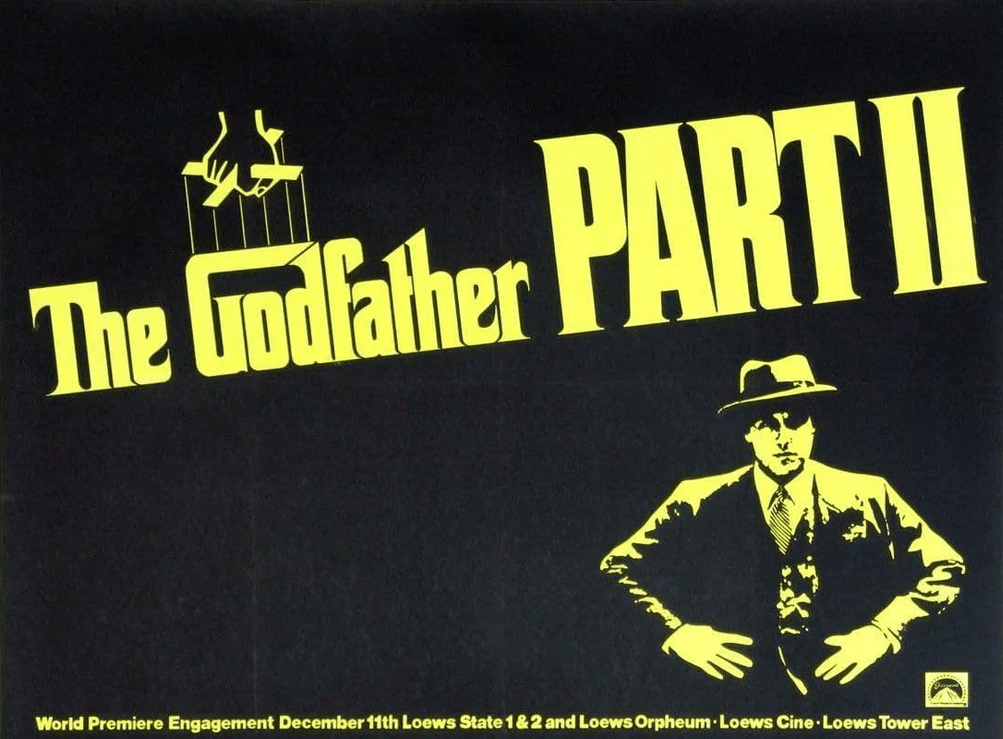
What remains impressive about the film is its status as a sequel; it is the rare movie sequel that might be said to improve on its fantastically successful predecessor. (Both films won Academy Awards for Best Picture, for 1972 and 1974, respectively.) This is, in part, because it was more formally ambitious and inventive—most obviously in splicing together both a “prequel” component (in which Robert De Niro’s young Vito Corleone immigrates to America and begins his ascendancy) and a “sequel” component (in which Al Pacino’s Michael Corleone enhances and secures his organized criminal empire).
The contrapuntal movement between father and son can, at times, be a bit overbearing. Formally, Coppola clearly favors the optical effect of the dissolve, allowing Michael’s face to fade back into young Vito and his world—as if we are supposed to feel the percolation of genetic inheritance. The contrast between the two lives is stark. Vito arrives in New York a penniless orphan and becomes the paterfamilias of a prosperous family; Michael was raised rich and becomes enormously wealthy but seemingly at the cost of his wife, his brother, and his unborn child.
But there’s more here than simply a father-and-son dynamic. Coppola has clearly, even more than in the first Godfather film, set out to establish a period piece. The viewer is continually reminded of the historical setting, even provided with cues to the years in which scenes take place. Vito flourishes in the Roaring Twenties and profits from (among other things) automotive technology. Michael finds himself in the middle of the Cuban Revolution on New Year’s Eve in 1958—and, in a slight anachronism, appears to take part in one of the Kefauver Committee hearings on organized crime (which had actually concluded in 1951).
Michael is no godfather; he’s a cold-hearted businessman who can only see family as ornament or obstacle.
Watching the film in 2024, however, a viewer might particularly notice what the film owes to its own moment, premiering in the early months of the Ford Administration in 1974. This is a movie about crooked senators and corporate malfeasance. The critic Jon Lewis, in his recently published book on The Godfather Part II (Bloomsbury, 2022), argues that it “resonated with a deeply cynical post-Watergate zeitgeist.” “We’re both part of the same hypocrisy,” Michael tells Nevada Senator Pat Geary in the opening scene. Viewers might hear the resonance of this line both with the illicit activities of the Nixon Administration and with the aging Vito Corleone’s apologetic explanation to Michael, in the first Godfather film, that he had wanted him to escape the crime business and become a legitimate leader—to be, instead, “Senator Corleone.”
It’s also very apparent today that The Godfather Part II doesn’t pass the Bechdel test. The callous attitude toward the murder of a sex worker in an extortion scheme is chilling. But the now-famous theatrical exclamation of Diane Keaton’s Kay—“It was an abortion, Michael!”—feels remarkably significant. The Roe v. Wade (1973) decision legalizing abortion had been handed down just the year before the film’s premiere—and the 2022 Dobbs decision, overturning Roe, makes Keaton’s line seem just as relevant now as it was then.
Kay represents a problematic “Americanization” aspect of the Corleone family—namely, that Fredo, Michael, and Connie have all married non-Italians. In the opening Tahoe scene, Frank Pentangeli (brilliantly played by Michael V. Gazzo, an established playwright with little actual acting experience) repeatedly expresses his dismay at how un-Italian little Anthony’s first communion party seems to be. Michael can speak Italian to Pentangeli, but in his move to Nevada he has shed any Old-World sensibility he may have once possessed.
And the film’s final flashback (to the old dinner table) reinforces the idea that Michael never really fit into this “Sicilian thing.” His brothers can’t understand why he would enlist in the USMC after Pearl Harbor; it’s not what his father—his family—had planned for him. He fits, rather, D. H. Lawrence’s description of “the essential American soul”: “hard, isolate, stoic, and a killer.” The first film suggested that Michael would be a greater godfather than Vito. But the sequel reveals that he is poorly suited for that role. Michael is no godfather; he’s a cold-hearted businessman who can only see family as ornament or obstacle.
 Las Vegas Review of Books