Forty Years of The Wild Shore, by Kim Stanley Robinson
“To make America great again, to make it what it was before the war, the best nation on Earth. That’s our goal.”
It’s not Donald Trump. The speaker here is Timothy Danforth, the Mayor of San Diego in the year 2047 in Kim Stanley Robinson’s first novel, The Wild Shore, which was published in 1984. In the novel, the United States had been wiped out—in the year 1984—by a devastating nuclear attack, bombed nearly into oblivion by foreign forces. The rest of the world has escaped the horrors of atomic warfare; only the North American continent was destroyed, as part of a remarkably swift and well-coordinated sneak attack. Now, six decades later, the descendants of the few straggling survivors strive to maintain small-scale farming and fishing villages along the California coast.
San Diego has come farthest, attempting to rebuild railroads and re-establish a printing press. But it would seem that the United Nations is bent on keeping the Americans under control; surveillance satellites monitor their movements. The Japanese navy patrols the waters off the Pacific coastline, and rockets occasionally whiz through the sky to destroy obviously repaired rail lines.
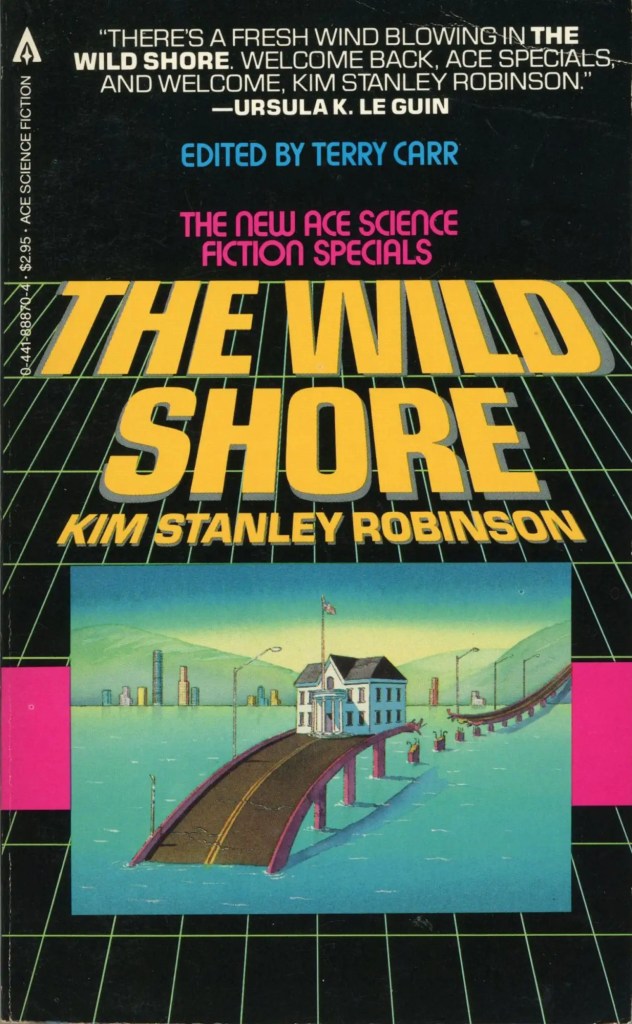
Mayor Danforth is a visionary. He wants to unite Southern California communities so that he can recruit an army to fight back against the Japanese military forces, who have occupied Catalina Island. Henry Fletcher, or “Hank,” the seventeen-year-old narrator-protagonist of the novel, is unsure. Hank has grown up in the small village of Onofre (formerly San Onofre State Beach), where he has been tutored by the village elder, Tom Barnard—the one local who can recall the time before the war. Tom has long regaled Hank and the other Onofre youths with stories about the glories of pre-apocalyptic America, a world with airplanes and automobiles and televisions.
So when Hank and Tom visit San Diego discover that the city is building back up under Mayor Danforth, Hank becomes excited. But Tom has reservations. He suddenly tries to qualify his stories about America’s former greatness: “America was great like a whale—it was giant and majestic, but it stank and was a killer. Lots of fish died to make it so big.” This tension is at the heart of the novel. Should the Onofre villagers join a much bigger fight, of which they can’t quite make out the contours? Or is the dream of greater power exactly what led to such devastation in the first place?
To underscore this dilemma, in one of the most memorable passages of the novel, Robinson has an ailing Tom recall wandering through the nuclear aftermath. Tom (like Robinson) had been a student at UC San Diego, but he had been hiking in the mountains when the bombs went off. When he returned to his destroyed home in Orange County, he passed through the wreckage and rubble of Disneyland. “Main Street was all full of trash, dead people here and there, ruins, the smell of death,” he recalls. “Around the corner the steamboat used to come … but now the lake was chock with corpses.” The Happiest Place on Earth had become a charnel house, a nightmare from which he cannot awaken.
* * *
Even though The Wild Shore was Robinson’s first novel, he had, by 1984, already built up a reputation as a rising science fiction writer. He had begun publishing short stories in the mid-1970s, submitting work to magazines while he worked on his Ph.D. in English at UCSD. He started this graduate work under the mentorship of Fredric Jameson (one of the most significant living literary critics), who urged him to focus his doctoral studies on the novels of Philip K. Dick—which is indeed what Robinson did, defending his scholarly dissertation on that topic in 1982.
Despite fitting well within the postapocalyptic genre, “The Wild Shore” is quite original, and it doesn’t rely on juvenile escapades or cheap reveals.
By that time, he was hitting his stride as a creative writer. He had taken a writing workshop at UCSD with Ursula K. Le Guin (who later promoted The Wild Shore), and he also studied with the poet Gary Snyder (at UC Davis), who helped him to find a “California” voice. Robinson’s 1981 story “Venice Drowned” was nominated for a Nebula Award, and his 1982 novella “To Leave a Mark” was nominated for a Hugo Award. The Wild Shore (its working title was The Bare Winter Shore) wasn’t exactly coming out of nowhere. Robinson himself has indicated how important an influence George R. Stewart’s Earth Abides (1949) had on him at this time (he would later write an Introduction for a new reissue of Earth Abides in 2020), as well as Philip K. Dick’s Dr. Bloodmoney (1965).
Later, Robinson would package The Wild Shore with two successive novels, The Gold Coast (1988) and Pacific Edge (1990), and named it the Three Californias trilogy—bound in a single, 900-page edition by Tor Books in 2020. The three novels in the trilogy are all set in Orange County, where Robinson grew up, and they imagine different futures for the region.
Though he would become much better known for his Mars trilogy (1992–1996) and subsequent novels such as 2312 (2012) and New York 2140 (2017), Robinson’s first novel deserves renewed attention. Despite fitting well within the postapocalyptic genre, The Wild Shore is quite original, and it doesn’t rely on juvenile escapades or cheap reveals. It is contemporary with David Brin’s related postapocalyptic novel The Postman (1985), though quite different in detail. Their chief similarity is a resistance to the tropes that were becoming explosively popular with the success of the 1981 film Mad Max 2: The Road Warrior.
The Wild Shore is also a reasonably quick read. As Robinson found greater success, he also moved toward greater length; his last half-dozen novels have averaged around 500 pages apiece. That expansiveness hasn’t always strengthened the work. Readers who have found the future ecological scenarios in Robinson’s later novels appealing may be especially pleased by the vision of the California coast laid out in this first book.
 Las Vegas Review of Books