Fifty Years of Court and Spark, by Joni Mitchell
This year marks the fiftieth anniversary of Joni Mitchell’s seminal album Court and Spark. Half a century is a long time, and so it is perhaps surprising that over the last year Mitchell, who has been notoriously reclusive following numerous health challenges, has made something of a comeback.
In July 2022 she gave a surprise performance at the Newport Folk Festival alongside Brandi Carlisle and the “Joni Jam” (a group that included Wynona Judd, Marcus Mumford, and others). Video of her performance of “Both Sides, Now” quickly became an internet sensation, bringing tears to more than a few listeners. When she first penned the song, she was a 23-year-old reading Saul Bellow on an airplane. At 80, having recovered from a 2015 brain aneurism that required her to relearn to walk, talk, and play again, it means something different to sing, “I’ve looked at life from both sides now.” Mitchell’s pleasure is palpable, and you hear her gentle laughter and sighs as the track comes to a close.
There is something affirming about watching a mature performer being allowed to receive their flowers while they’re still alive. In 2023, Mitchell was awarded the George Gershwin Prize at the Library of Congress. And a year after her appearance at Newport, the full performance was released as an album (including songs from Court and Spark—notably a rollicking guitar version of “Just Like this Train”), which received the Grammy for Best Folk Album in 2024. Later this year, she is expected to perform two shows at the Hollywood Bowl.
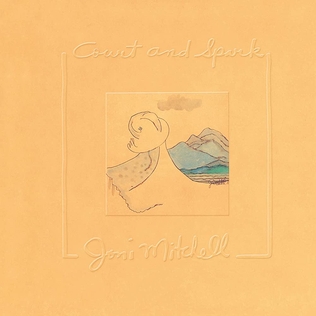
Listening to Court and Spark in light of Joni Mitchell’s recent return to the stage invites us to think not only about what the album meant in its own time but about what it means now. When originally released by David Geffen’s Asylum Records in January 1974, it marked a departure from Mitchell’s earlier acoustic folk sound; collaborators like David Crosby and Graham Nash still make appearances, but their cameos give way to more extensive partnerships with jazz figures like Joe Sample and José Feliciano. While Mitchell’s vocals still have the sensitive, expressive mezzo-soprano range of the earlier albums, the album presents a different soundscape that would have been unfamiliar to her fans.
The new sound on Court and Spark partly results from her collaboration—musically and romantically—with drummer John Guerin, who brought with him the jazz-rock-fusion ensemble L.A. Express. These musicians, including Tom Scott (woodwinds), Max Bennett (bass), and Larry Carlton (guitar), played on the album and helped redefine its rhythms and general vibe. In contrast to the relatively pared-down piano and guitar-forward folk arrangements of Mitchell’s earlier work, Court and Spark features multiple layers of new instrumentation and complex polyrhythms. The already heady harmonics of her unique guitar playing, with those trademark open tunings, are multiplied across the more jazz-driven arrangements. Even a track like “Help Me,” the hit single from the record, is deceptively complex; its melodic lines ascend and descend into unresolved spaces and evade all typical pop-song expectations, even while still deploying a verse-chorus structure.
Mitchell had loved jazz from a young age, but it wasn’t until Court and Spark that she actually began to play with jazz musicians. (She would later collaborate with Charles Mingus on the 1979 album Mingus.) Of course, this was the era of jazz fusion, with the appearance of albums like Miles Davis’s Bitches Brew (1970) and Herbie Hancock’s Head Hunters (1973). But few would think to label Court and Spark a jazz album; it’s a Joni Mitchell album unfettered by genres, and it marked a new, mature direction in her work, leading to The Hissing of Summer Lawns (1975) and Hejira (1976). If her earlier songwriting was deeply introspective and confessional, Court and Spark finds her looking outward and offering social commentary, especially on Los Angeles and its music scene.
Mitchell played a key role in defining the “album” as a cohesive work of art.
On “Free Man in Paris,” she takes on a persona inspired by her friend and producer David Geffen. As she later recalled, “I wrote that in Paris for David Geffen, taking a lot of it from the things he said … Another song about show business and the pressures. He didn’t like it at the time. He begged me to take it off the record. I think he felt uncomfortable being shown in that light.” David Yaffe has posited that Geffen was afraid that the song might “out” him as gay at a time when he was still in the closet, but the song never names him or directly mentions male lovers; mostly it focuses on the conflicted role of being a music business impresario. As the chorus goes:
I was a free man in Paris, I felt unfettered and alive
There was nobody calling me up for favors
And no one’s future to decide
You know I’d go back there tomorrow
But for the work I’ve taken on
Stoking the star maker machinery behind the popular song
Here we find Mitchell deftly commenting on her particular time and place—and yet, that specificity does not hinder the album’s timeless appeal. In his excellent biography of Mitchell, Reckless Daughter, Yaffe writes, “It’s a festival for one, and every Court and Spark encounter is a little different every time, and for each person who hears it. Open your eyes, and you are just looking at yourself, or the person lying next to you. Close them again. It’s a festival in your mind.”
As NME’s recent piece on the album suggests, Joni Mitchell has become a kind of “cool aunt” to at least two generations of young songwriters. Blue might remain her most popular album, but Court and Spark “contains important lessons for young musicians” about what it means to be fearless and innovative as an artist over the course of a career.
Part of what makes Court and Spark worth listening to fifty years later is the way Mitchell played a key role in defining the “album” as a cohesive work of art, even as a work of literature. Until the 1970s, most albums functioned merely as marketable collections of songs, but as the recording studio became a more important space of artistic innovation and creation, where artists like Mitchell took more control as producers, the notion of the album as a holistic work emerged. Tracks like “People’s Parties” and “The Same Situation” are great on their own, but Court and Spark appeals because it creates a total effect—of a woman at an artistic crossroads under the smog-hazed lights of LA with its sage-scented canyons and its traffic and its parties.
 Las Vegas Review of Books