Seventy-Five Years of Fire, by George R. Stewart
George R. Stewart isn’t a household name these days, but he should be. Best known, when known at all, for his 1949 postapocalyptic novel Earth Abides (which Stephen King has acknowledged as a major influence on his own novel The Stand), Stewart, a longtime English professor at Berkeley, authored dozens of other titles both fictional and scholarly.
Several of Stewart’s books have been reissued in the last two decades. Earth Abides was republished in 2020 with an Introduction by Kim Stanley Robinson (who, like Stephen King, has noted its effect on his own work). Names on the Land: A Historical Account of Place-Naming in the United States, Stewart’s popular 1945 study of American geographical nomenclature, reappeared in 2008 as part of the NYRB Classics series. And in 2021, NYRB Classics put out a new edition of Storm, Stewart’s bestselling novel from 1941, which follows the trajectory of an enormous Pacific cyclone—a storm affectionately named “Maria” by a San Francisco meteorologist.
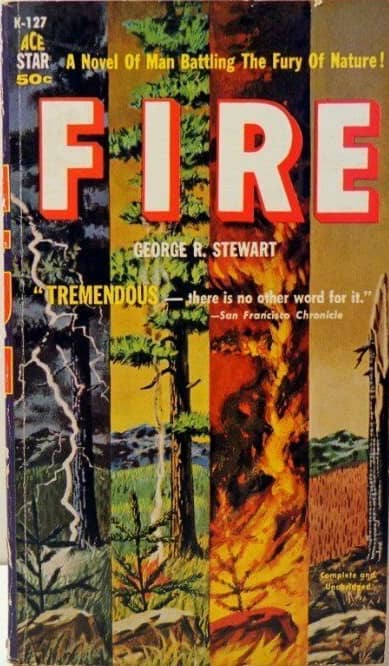
Storm’s success was partially responsible for the National Weather Service’s practice of assigning human names to hurricanes and tropical storms. The fictional cyclone, “Maria,” is the novel’s main character—not especially anthropomorphized but given a level of attention and seriousness rare for realist literature. (Rachel Carson was a fan.) Stewart’s next novel, Fire (1948), would act as a semi-sequel, this time following the “Spitcat” fire in the fictional Ponderosa National Forest near Mount Shasta in Northern California (arguably quite similar to the real-life Tahoe National Forest). Like Storm, it was a bestseller and a Book-of-the-Month Club selection. Now enjoying its 75th anniversary, Fire will also be reissued next summer by NYRB Classics, after being out of print for decades.

Stewart took his work for Fire seriously; in the summer of 1945, at the age of 50, he worked as a fire tower lookout and even helped fight a flare-up as part of his research for the novel. He also had his son take some plaster and help him build a topographical relief map of the national park that would feature his fictional conflagration—so that he could get the details just right. And as a study into the intimate workings of a forest fire, the novel is quite impressive. A lightning bolt strikes an old pine; a spark smolders in a pile of dried leaves, spreading very slowly for days. When a pine cone ignites and rolls down a hill, the blaze suddenly springs up in a much larger territory. The park service responds with tactical maneuvers and courage under fire.
While it’s fair to say that the deadly “Spitcat” fire is itself the protagonist of the novel, Stewart rarely personifies it (even making a joke about the pathetic fallacy at one point). The action unfolds over eleven chapters, each dedicated to one day of the fire’s existence. The narration keeps switching, fairly rapidly, between the perspectives of the various characters—such as Judith Godoy, a young woman running a lookout tower, and Ranger Jones, the park supervisor. (The Berkeley professor seems to have been wary of Nevadans; he describes volunteer firefighters from Reno as “the worn-down survivors of many a skid-row brawl and bender, with missing teeth and broken noses, and here and there a finger gone or only a shrunken lid where once was an eye.”) This swift movement propels the prose; what might otherwise be a dry description of a natural phenomenon takes on a heightened, dramatic intensity.
Stewart’s emphasis on the awesome power of natural forces raises his literary voice in the context of climate change.
As the critic Christine Smallwood has observed, Stewart was largely responsible for popularizing the genre of the environmental thriller: “Man versus nature, and the ability of humans to cope under environmental stress, are Stewart’s two obsessions and the genre’s enduring conventions.” As such, Fire doesn’t really aspire to the kind of lyric sophistication of what is now called literary fiction. It’s an action-packed, fast-paced narrative. The characters have names like Bart, Bud, and Slugger, and they respond to disaster by saying things like, “There’s trouble all right.” If you liked the Hardy Boys as a kid, you’ll probably enjoy reading Fire as an adult.
Yet every now and then, Stewart elevates his language, as when he describes the incipient inferno’s status following a cool autumn night:
As, after some great gang of the underworld has been shattered, a few of the desperate and dangerous still sit nursing their hatred in hidden cellars and lonely rooms, hoping for the time when they may again go out to steal and kill, so in hidden and lonely places the fire still lived. From the lower side of a log, a faint smoke arose. Underground, a dead root smouldered. In deep duff, though the surface was black, a living fire still ate ahead.
Stewart wrote environmental thrillers, not environmentalist thrillers—he wasn’t really worried about loggers or fossil fuels or pollution, and his fictional forest fire is started by lightning, not by a carelessly discarded cigarette. But his emphasis on the awesome power of natural forces raises his literary voice in the context of climate change. “Stewart’s body of work,” writes Matthew Sherrill, “feels proleptically tailored to an era of catastrophic ecological decline.”
Amitav Ghosh has recently called, in the face of climate change, for more novels that offer “a visionary placement of the human within the nonhuman,” a type of fiction that might resist the narrow focus on the moral decision-making of the Romantic individual. This is exactly what Stewart was up to, and his fiction feels all the more prescient as fires burn brighter. His novels will only become more relevant over time.
 Las Vegas Review of Books