Two Hundred and Fifty Years of the Declaration of Independence
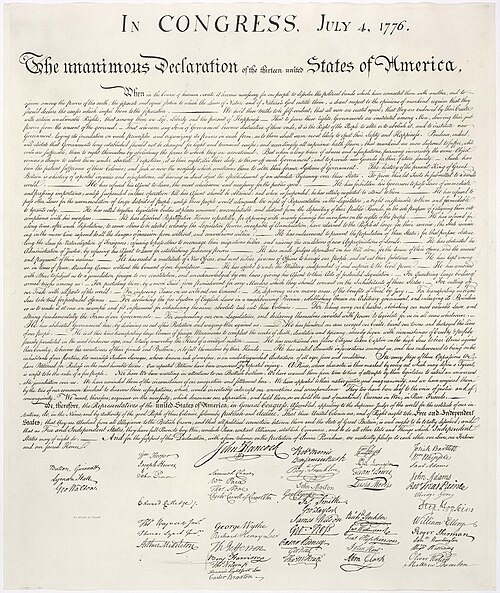
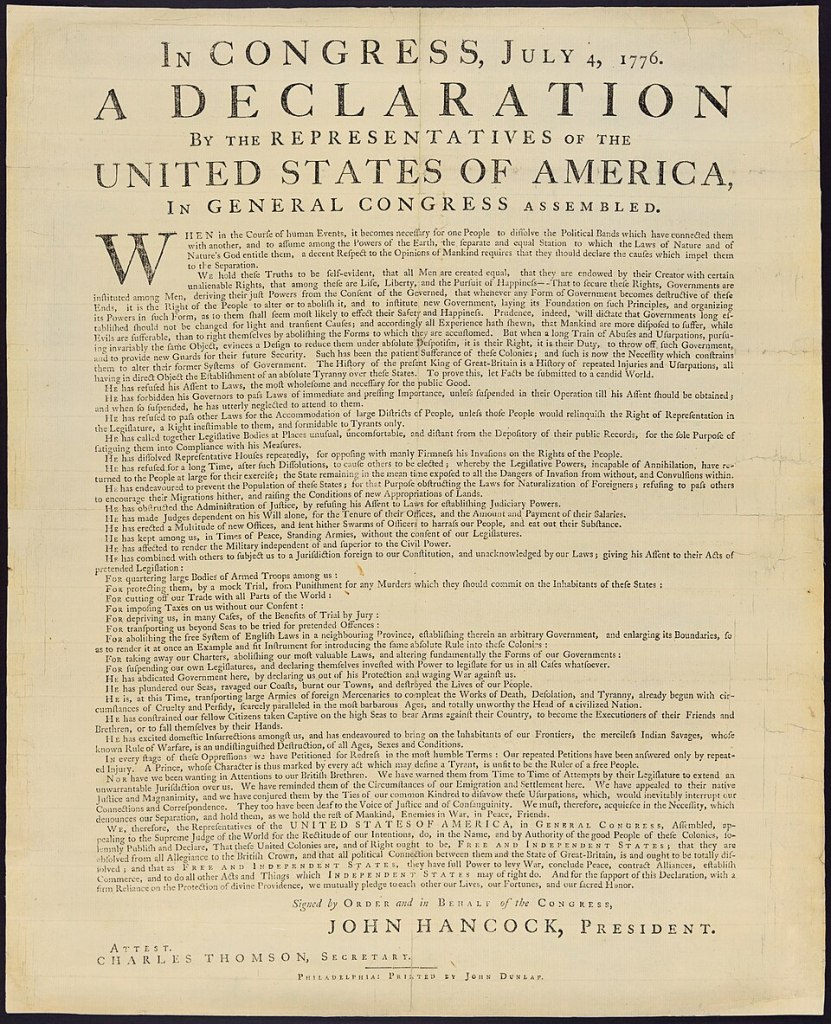
The United States of America is a country that dates its birth to a document. On July 4, 1776, the Continental Congress, presided over by John Hancock of Massachusetts, signed the Declaration of Independence and submitted it—not simply to King George III of Great Britain but “to a candid world.” A new nation was born.
By the time the delegates decided to declare a split from England, the American Revolutionary War had already been going on for about a year; fighting began with the Battles of Lexington and Concord in the spring of 1775. By the summer of ’76, it was hard to see a viable path back to normalcy while remaining thirteen colonies of the Crown. They were clearly fighting for political independence.
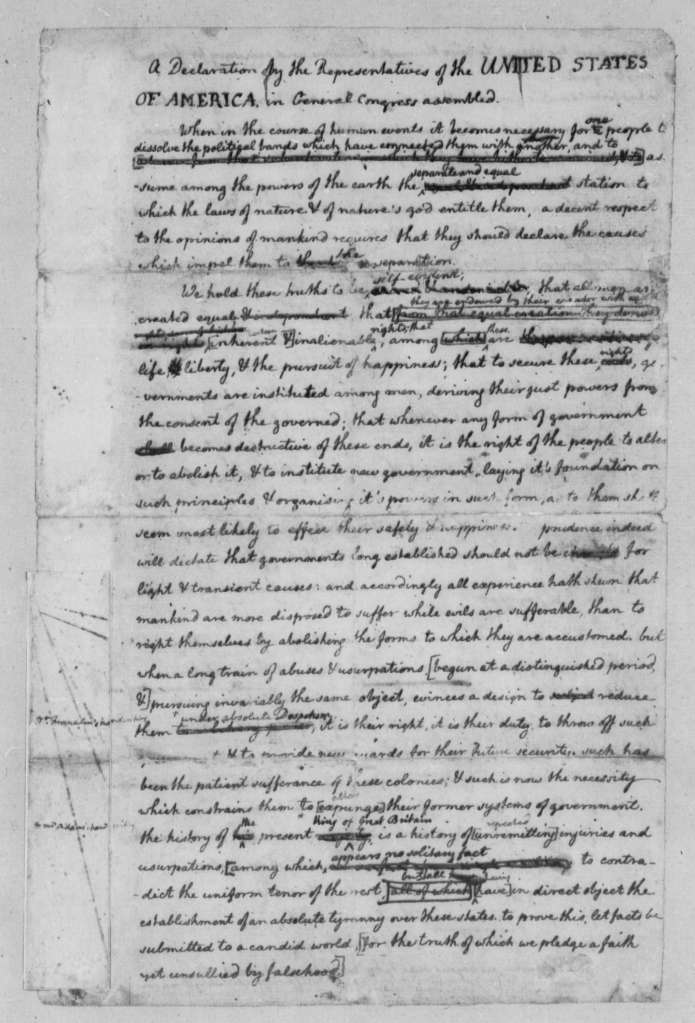
Within the Congress, gathered in Philadelphia, a committee of five was designated to draft the official document. It consisted of Thomas Jefferson, John Adams, Benjamin Franklin, Robert R. Livingston, and Roger Sherman. If you’ve ever been part of a group tasked with writing a paper, you know that one person usually ends up doing all the work. That was Jefferson, who was 33 years old at the time.
Jefferson hammered out a draft of what would shortly become one of the most extraordinarily powerful and influential texts in the annals of humankind. “We hold these truths to be self-evident, that all men are created equal, that they are endowed by their Creator with certain unalienable Rights, that among these are Life, Liberty and the pursuit of Happiness.” Nobler words have never been written. (Walter Isaacson calls it “the greatest sentence ever crafted by human hand.”)
This year, the semiquincentennial of the Declaration, it’s especially worth reflecting on the meaning of this text. The Declaration’s position in America’s cultural identity has always been a bit dicey. While undoubtedly important, the document’s relevance to present-day politics is far from clear. Is it simply a revered artifact, a reminder of the “spirit of ’76” that distinguished the patriots from the redcoats? Or is it a collection of statements that continue to animate the ongoing project of American democracy? Are we still the “we” of the Declaration?
Ted Widmer’s wonderful new book, The Living Declaration: A Biography of America’s Founding Text (Library of America), suggests that, just as jurists sometimes speak of a “living Constitution,” so should we consider a “living Declaration.” Drawing on (and reproducing) centuries of commentary, Widmer urges us to attend to the “afterlife of a text whose meaning has shifted over time.” We’ve come a long way from 1776, but the principles recorded on this parchment remain the foundation of civic life in the United States. To understand it is to understand who we are.
Whatever it is, the Declaration is not a legal document—or at least, it no longer is. During the Revolutionary War, it served as an official proclamation of intent, a potentially treasonous publication that effectively beseeched other nations (such as France) to provide military support to a new ally. Following the 1783 Treaty of Paris, the Declaration became legally unnecessary. And once the U.S. Constitution was ratified in 1788, statesmen and lawyers had little need to appeal to a document drafted as a wartime exigency.
In the early 1800s, the Declaration became something of an annual pageant. One a year, as part of a town’s Fourth of July celebrations, the local newspaper might print it in a special issue, and a local official might even read it aloud on the steps of Town Hall. Then it would get folded up and put away until the next year’s Independence Day. But in the decade leading up to the Civil War, the Declaration took on a new significance as politicians quarreled over the legal status of slavery. If the United States was committed to the proposition—the self-evident truth—that all men are created equal, then slavery could not be legally justifiable.
It’s remarkable that the statement appears in the Declaration of Independence at all. In part, this was because Jefferson himself was no abolitionist; he claimed to own over 80 people in bondage when he penned those lines. His biographers consistently grapple with this problem. Jefferson deserves credit for authoring the famous phrase, but no one could seriously believe that he was a radical egalitarian. What is also extraordinary, though, is the fact that the very purpose of the Declaration was to make official the political separation from Great Britain in order to encourage alliances with other foreign nations. It simply wasn’t necessary for this document to make a claim for the fundamental equality of human beings.
“We hold these truths to be self-evident, that all men are created equal, that they are endowed by their Creator with certain unalienable Rights, that among these are Life, Liberty and the pursuit of Happiness.” Nobler words have never been written.
Over the years, many objected to its “self-evidence.” John Adams himself later wrote to his wife, Abigail, that this equality was “moral and political only” and that God had obviously established unchangeable physical and intellectual inequalities among individuals. In 1826, the 50th anniversary of the Declaration, Senator John Randolph of Virginia, who claimed ownership of hundreds of human beings, insisted that Jefferson’s sentence on equality was “a most pernicious falsehood” to which he would never assent. And in the infamous Dred Scott decision of 1857, Supreme Court Justice Roger Taney wrote that even though the Declaration’s statement “would seem to embrace the whole human family,” it was, nevertheless, “too clear for dispute that the enslaved African race were not intended to be included.”
Jefferson’s text was arguably reborn through the readings of abolitionists. Frederick Douglass, who was born into slavery, insisted that recognition of “the great principles of political freedom and of natural justice, embodied in that Declaration of Independence,” were essential for understanding and interpreting the U.S. Constitution. And Abraham Lincoln, following Douglass, persuasively maintained that the Founders’ gesture to equality was not an observation of the facts of their present moment but a commitment to the ongoing project of democracy:
The assertion that ‘all men are created equal’ was of no practical use in effecting our separation from Great Britain; and it was placed in the Declaration, nor for that, but for future use. Its authors meant it to be, thank God, it is now proving itself, a stumbling block to those who in after times might seek to turn a free people back into the hateful paths of despotism.
The notion of a design for future use would seem to be further reflected in the famous phrase “pursuit of happiness.” As has often been observed, Jefferson was influenced by John Locke’s Second Treatise of Government (1689), which repeatedly mentions “life,” “liberty,” and various other terms amounting to “property” (“possessions,” “estate,” etc.). Why gesture to the “pursuit of happiness” instead?
Jefferson may have been pressured by Adams. In her recently republished 2014 book Our Declaration: A Reading of the Declaration of Independence in Defense of Equality (Liveright), Harvard historian Dannielle Allen suggests that Adams pushed for the concept of “happiness” as especially relevant. But the term might strike today’s readers as odd. Did the Founders just want their neighbors to be glad?
Some confusion can be cleared away by observing that the word “happy” meant something a little different back in the eighteenth century. The root of happy is hap—the same as for words like perhaps or happening. And hap meant something like chance or fortune. So when Jefferson promotes “the pursuit of happiness,” he’s not talking about smiley contentment—he’s talking about the pursuit of good fortune. A human being has a right to strive for a better life—a right to try one’s luck. In a feudal, aristocratic society, if you’re born a peasant, you will die a peasant. But in a democracy, you can work to improve your station. (You can emulate Jefferson’s colleague Benjamin Franklin.)
And this is not just about money and material possessions. You can become not just a richer person but a better person—a more virtuous person. You might pursue the esteem of your peers, of your countrymen. You could become a statesman, a sage, a civic leader. So the right to pursue happiness—to pursue fortune and esteem—is more holistic than the right to property.
Quibbles about happiness aside, one of the most powerful aspects of the Declaration remains its readability. The writing style itself—simple, direct, forceful—suggests a break with aristocratic manners in favor of a democratic spirit. It’s no surprise that one of the most influential texts for Jefferson was Tom Paine’s Common Sense (1776), “arguably the most important pamphlet in American history” (as Joseph Rezek notes).
Thomas Jefferson was a college-educated Southern gentleman. He could have used a florid, highfalutin style if he had preferred. But this was not a personal proclamation. He knew that the Declaration of Independence needed to project the voice of the American people. It needed to speak plainly and reasonably, without sacrificing intellect or integrity. The resulting language is tremendously powerful—bold, philosophical, abrasive, eloquent.
In 1825, near the end of his life, Jefferson wrote a famous reflection on his drafting of the document:
This was the object of the Declaration of Independence. Not to find out new principles, or new arguments, never before thought of, not merely to say things which had never been said before, but to place before mankind the common sense of the subject, in terms so plain and firm as to command their assent, and to justify ourselves in the independent stand we are compelled to take. Neither aiming at originality of principle or sentiment, nor yet copied from any particular and previous writing, it was intended to be an expression of the American mind, and to give to that expression the proper tone and spirit called for by the occasion. All its authority rests on the harmonizing sentiments of the day, whether expressed in conversation, letters, printed essays, or in the elementary books of public right, as Aristotle, Cicero, Locke, Sidney, &c.
It was all there, he says—in the newspaper articles, in the barroom conversations, in the classroom classics. He merely attempted to synthesize the sentiments already animating America. What’s great about the Declaration is that it wasn’t written by one man named Thomas Jefferson; it was a social text written by all of America. It was spoken into existence by the voice of the people. And America continues to speak through it today.

