One Hundred and Fifty Years of Robert’s Rules of Order
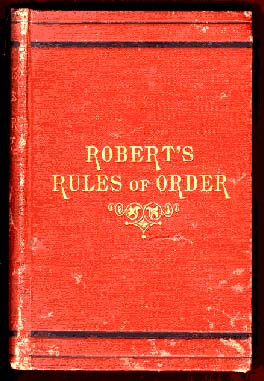
In February of 1876, a Chicago firm published a modest volume titled Pocket Manual of Rules of Order for Deliberative Assemblies. The author—who privately assumed the publication costs of what certainly didn’t look like a bestseller—was a U.S. military engineering officer (a major at the time, though he eventually became a brigadier general) named Henry Martyn Robert, a native South Carolinian who fought for the North in the Civil War. On the front cover of his book, the publisher stamped the abbreviated title of Robert’s Rules of Order. In his experiences sitting on various church societies and civil committees (including the Board of Directors for the San Francisco YMCA), Robert realized that greater guidance was needed for appropriately conducting meetings and approving policies. Using the rules and procedures of Congress as a template, he designed a relatively simple set of parliamentary guidelines that might be adopted by ordinary organizations and associations.
His Rules proved unexpectedly and immediately popular. A slightly revised edition published the following year boasted that 12,000 copies had already been printed. By 1885, the number was 62,000. And by the time Robert prepared a more extensive revised edition in 1915, eight years before his death, half a million copies had already been sold.
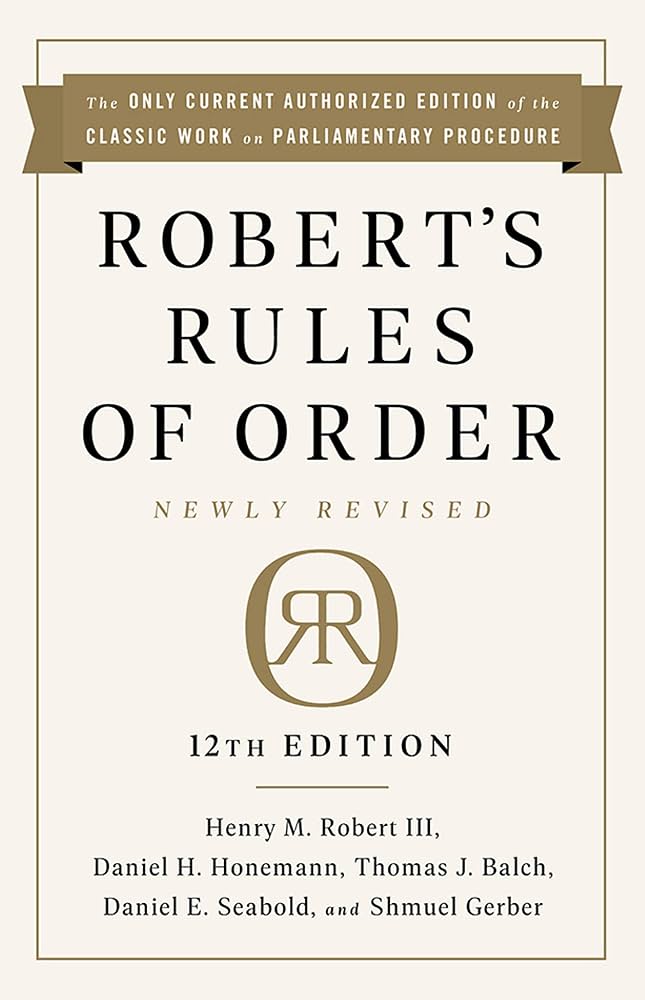
Now in its twelfth edition (from 2020), Robert’s Rules of Order has become an institution unto itself, the agreed-upon current standard in a genre that dates back to the fourteenth-century Modus Tenendi Parliamentum (“Method of Holding Parliaments”). Robert’s Rules ranks with Webster’s Dictionary (1828), Roget’s Thesaurus (1852), and Bartlett’s Familiar Quotations (1855) as an indispensable eponymous authority from the nineteenth century; as a reference book, it is an integral part of modern culture. And it might be considered a family business—until his death at the age of 98 in 2019, Robert’s grandson, Henry M. Robert III, helped to prepare new editions—or even a cottage industry.
The official website, geared toward “parliamentarians and novice club presidents alike,” offers various different versions of the guide for ease and accessibility. While the standard edition runs to 700 pages, the “In Brief” edition is just a little over 200. And readers have their choice of hardcover, paperback, or e-book versions. Plus, if you’re visually impaired (or suffer from insomnia), you can purchase a four-hour audiobook of the “In Brief” edition. Sadly, this doesn’t yet exist for the standard edition—but the technologically fastidious can nevertheless obtain it on CD-ROM or USB.
Robert’s Rules ranks with Webster’s Dictionary and Roget’s Thesaurus as an indispensable eponymous authority from the nineteenth century.
A new edition of Robert’s Rules has been appearing every ten years or so, and updates reflect our changing times. At several points, the current edition grapples with the problems introduced by “electronic meetings.” Can a committee hold a valid electronic meeting if not explicitly authorized to do so in the bylaws? (As it turns out, it’s complicated.) Overall, however, the digital age has pushed only lightly upon Robert’s Rules. Curious readers may be impressed how little the incursion of emailing and videoconferencing has altered the parliamentarian principles still so widely adopted by manifold organizations today.
At the core of Robert’s Rules of Order is the democratic principle of majoritarianism—a systemic design that allows for unambiguous voting mechanisms to determine the will of the majority of a society’s members. But—key for Robert and for the United States of America—this must be a deliberative majority. As the first edition of 1876 made clear, the book was authored for deliberative assemblies. Order is ultimately achieved through a fair process of careful deliberation. Minority opinions may not win the day, but they must have a chance to persuade the committee in a meeting. Only by deliberating can an organization arrive at a true and binding consensus.
The pages of a reference book may be dry, but that doesn’t mean they aren’t worthy of perusal. Robert’s Rules can reward a reader. As with many instruction manuals, the real fun is in the footnotes. The current edition observes, for example, in a note about voting by ballot, that many “secret societies” have traditionally considered the admission of candidates to membership by placing black and white balls in a box—white for a yes vote and black for a no vote—with the understanding that even a small number of negative votes will result in the candidate’s rejection. “This custom, however,” note the editors, “is apparently declining.” Folks aren’t getting blackballed the way they used to. Other notes might indicate the correct pronunciation of Latin terms (sine die is SIGN-ee DYE-ee) or explain how dead members of a fixed board might still count toward the overall membership number.
And if you think Reddit forums are cool, wait’ll you see the official online Robert’s Rules Q&A Forums. A robust back-and-forth from September of 2025 regarded whether at-large members of a board of directors can be elected by plurality. A 2023 question about the appropriate procedure for removing disruptive parents from a school band’s booster club received 125 replies and over 10,000 views. An insider might tell you that the forums are where the real action is. Especially thorny issues here will likely influence the revisions for the next published edition.
In other words, the devil is in the details. A 2007 New York Times feature referred to Robert’s Rules of Order as “mind-numbingly technical.” That may be true for most minds, but some clearly find the minutiae of parliamentary law to be quite stimulating, a fascinating field worthy of the closest attention. For those few, we motion to approve this sesquicentennial as a cause for celebration.

