One Hundred Years of Gentlemen Prefer Blondes, by Anita Loos
Lorelei Lee would have loved Las Vegas. The heroine-narrator of Anita Loos’s Gentlemen Prefer Blondes, now enjoying its hundredth anniversary, could spend hours at the Forum Shops or the Shops at Crystals, picking up the essentials from Balenciaga, Cartier, Chanel, Hermès, Prada, and Tiffany’s. And she probably wouldn’t have trouble finding a high roller to date.
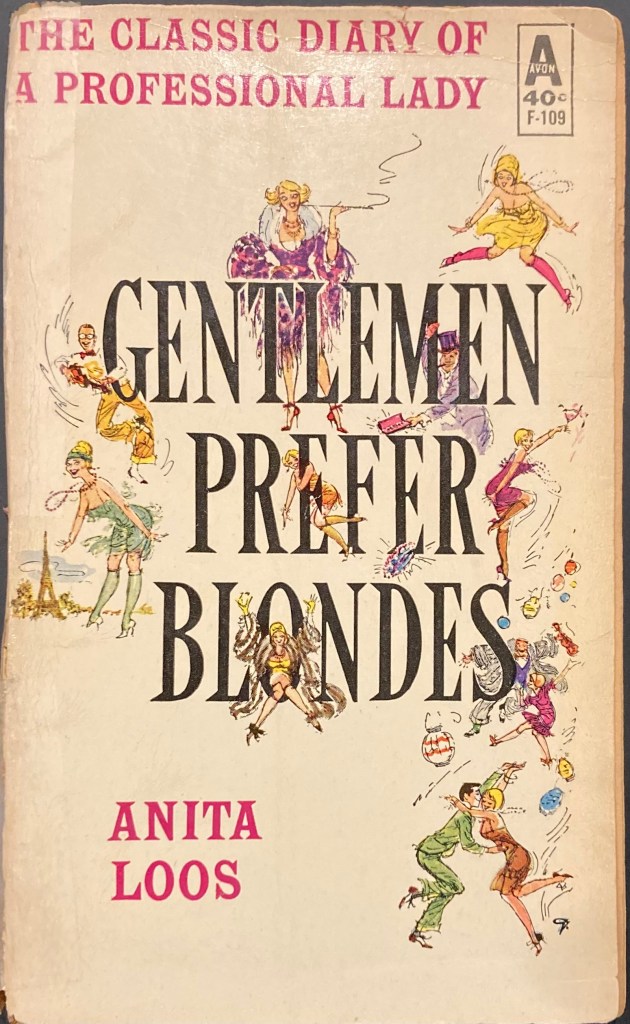
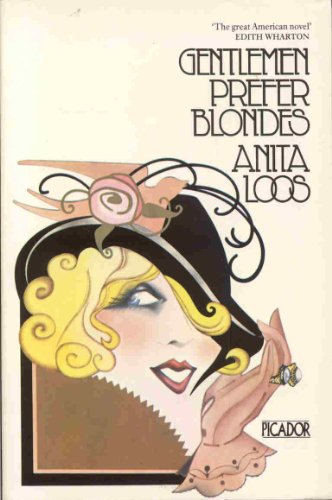
Loos’s short novel (just six chapters) appears in the form of Lorelei’s diary, an account of her successful attempts to live the high life while depending on the kindnesses and attentions of wealthy men. A satirical send-up of the excesses of the Jazz Age, it has lost none of its bite. The platinum-haired Lorelei—who appreciates big diamonds and wild parties but also preaches self-restraint and refinement—evokes today’s social-media “influencers” just as much as the socialite “flappers” of the 1920s.
Loos herself had a successful career as a Hollywood screenwriter. She was known for risqué (“riskay,” per Lorelei) material that would eventually lead to the enforcement of the Hays Code in 1934, an attempt to reign in the Babylonian immodesties of feature films deemed too mature for Main Street. But she was also a rarely mentioned modernist novelist. Gentlemen Prefer Blondes, after appearing serially in Harper’s Bazaar, was published by Boni & Liveright in 1925. The same year, that esteemed firm would also publish books by Theodore Dreiser, T. S. Eliot, William Faulkner, and Ernest Hemingway. Not bad company.
Lorelei Lee would have loved Las Vegas.
And Loos’s novel immediately found impressive fans. James Joyce loved it. So did Edith Wharton. Faulkner told her he only wished he himself had thought of the characters first. Gentlemen Prefer Blondes, while maybe not as “serious” as works like The Waste Land or The Sound and the Fury, nevertheless spoke to a modernist sensibility and even shared some of that generations favorite themes. In fact, Lorelei Lee—who grows up outside of Little Rock, Arkansas, but learns to use her looks and her wiles to vault herself into the company of the coastal elites—is amusingly similar to Jay Gatsby, another iconic 1925 American literary invention.
What really distinguishes Lorelei isn’t her canary-colored hair; it’s her voice. Her diary, notes Jenny McPhee, features “a cacophony of loopy cadences, alliteration, redundancies, oxymorons, malapropisms, multilingual puns, homophones, innuendo, euphemisms, double entendres, and more.” The misspellings and repetitions suggest a childlike approach to authorship, as when Lorelei mentions meeting a “gentleman who is a famous playright who writes very, very famous plays that are all about Life.” But Lorelei is no child, and her seemingly artless expressions are often artful evasions around her more adult activities—as when, in her youth, she caught a man cheating on her and discovered, after a blank period of hysteria, that she was holding a revolver and that the cheater “became shot.”
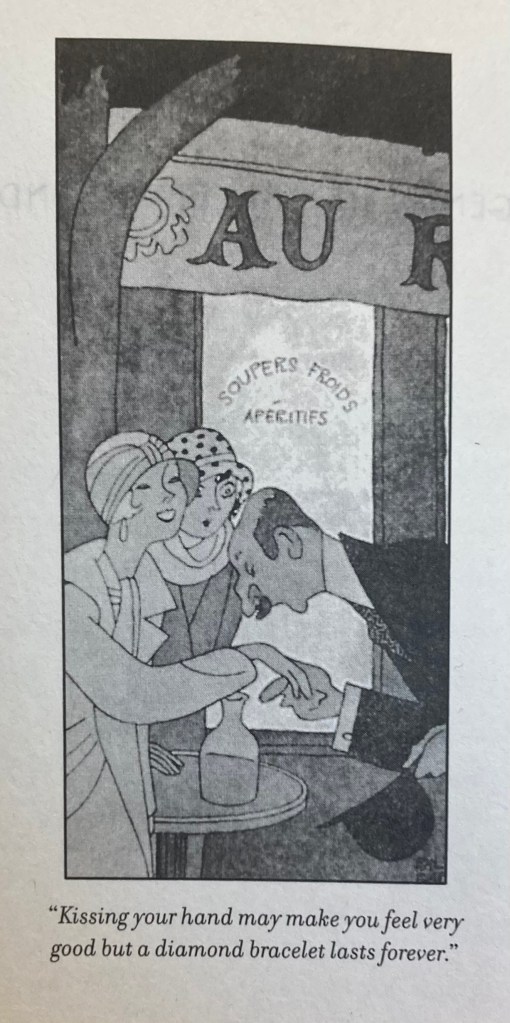
The scholar Susan Hegeman has suggested that Lorelei has a “problematic relationship to agency”: “Is she a sexual predator, or is she an innocent party; does she coax men into recklessness, or is she the passive object of their dangerous passions?” Lorelei, of course, insists that she has no real plans or schemes. “Fate Keeps on Happening,” she titles her second chapter. But she’s very good at encouraging and conditioning her suitors. (“I always think that spending money is only just a habit and if you get a gentleman started on buying one dozen orchids at a time he really gets very good habits.”) And she’s quite savvy about arranging incriminating scenarios for wealthy men who might be looking to leave her without a parting gift.
Lorelei doesn’t act alone. Her parter in crime is her brunette pal Dorothy, another player in the lucrative dating scene—though with a bit less tact. Together, they represent a formidable force. As Regina Barreca has pointed out, Lorelei and Dorothy never get duped: “they learn to believe in the word ‘trust’ only when the word ‘fund’ follows.” And their penchant for diamonds is potentially strategic; in an era when a young, single woman couldn’t open her own bank account, valuable jewelry offered a significant form of liquidity.
Gentlemen Prefer Blondes becomes especially fun when Lorelei and Dorothy tour Europe at the expense of a business magnate (actually a button magnate—he manufactures buttons) named Mr. Eisman. While on a train, they meet “Mr. Spoffard,” an even wealthier man who would like to show Lorelei all the fine arts in Germany. “Art,” she learns, is pronounced kunst is German, and she plans to spend a day wandering through the museums in Munich with her new acquaintance. But Dorothy enjoins her to go to the famous Hofbräuhaus instead. Lorelei weighs her options but ultimately suspects that her friend’s tastes may be too “unrefined”: “Dorothy said I could be a high brow and get full of kunst, but she is satisfide to be a Half brow and get full of beer.”
As Jeewon Yoo has observed, we may be tempted to think of Lorelei as either “too fast and loose or a little slow on the uptake.” But what she really displays, in the end, is perfect timing.
 Las Vegas Review of Books