One Hundred Years of The Great Gatsby, by F. Scott Fitzgerald
If, in the final pages of The Great Gatsby, Jay Gatsby had not met his tragic end but instead lived on, paddling against the current, there’s a good chance that he would have ended up in Las Vegas.
Perhaps this seems like a counterfactual wish—a premise for fanfiction. But given the number of Prohibition-era bootleggers and mobsters who opened up casinos in Las Vegas in the 1940s after alcohol and gambling were legalized in Nevada, it’s not hard to imagine Jay Gatsby building a lavish (if gaudy) hotel-casino and throwing beautiful parties there. Take Bugsy Siegel, the handsome, blue-eyed mobster who built the Flamingo. Though Siegel was more muscle than matinee idol in real life, he and his partners Meyer Lansky and Lucky Luciano would become important shareholders in some of the early Strip casinos and set the tone for Las Vegas decadence. In another timeline, maybe a middle-aged Daisy and Tom Buchanan would have wandered into a Vegas showroom to hear some of the musicians they’d enjoyed in the 1920s and ’30s and lamented a civilization going to pieces in the desert.
“He’s a bootlegger,” said the young ladies, moving somewhere between his cocktails and his flowers. “One time he killed a man who had found out that he was nephew to Von Hindenburg and second cousin to the devil. Reach me a rose, honey, and pour me a last drop into that there crystal glass.”
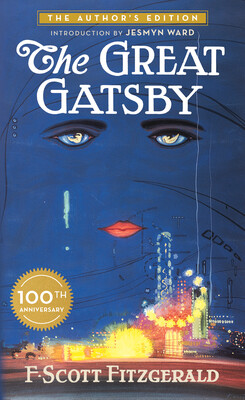
When reading The Great Gatsby this year, the novel’s 100th anniversary, UNLV English majors, like so many before them, had their own theories about who Jay Gatsby would be had Fitzgerald penned the novel today. If Fitzgerald were writing it in 2025, Gatsby would be a crypto bro, they insisted. Tom Buchanan would be a misguided listener to The Joe Rogan Experience and an afficionado of the manosphere. Daisy would be a social media influencer. And Nick? Well, it’s hard to say. Disaffected Ivy grads who attempt to go into finance are still a dime a dozen.
Indulging in their own brat summer, Fitzgerald’s characters might be found listening to Charli xcx, students argued, especially to her song “party 4 you,” an explicit allusion to Fitzgerald’s novel and the parties Gatsby threw to attract Daisy’s attention—at least according to TikTok.
I only threw this party for you
Only threw this party for you, for you, for you
I was hopin’ you would come through
I was hopin’ you would come through, it’s true, it’s true
Only threw this party for you
I only threw this party for you, for you, for you
I’m about to party on you
Watch me, watch me party on you, yeah
—Charli xcx, “party 4 u”
The desire to think of The Great Gatsby in relation to popular music is not new. Its pages ring with the lyrics of the hit songs of its day, from “Sheik of Araby” to “Beale Street Blues,” and Daisy’s voice, which Fitzgerald repeatedly describes, is “full of money.” The novel is so emblematic of the excesses of the Jazz Age (a term Fitzgerald himself helped to define) that readers see the party but sometimes miss the ways that Fitzgerald’s very prose lilts to the syncopated rhythms of the music.
There was dancing now on the canvas in the garden; old men pushing young girls backward in eternal graceless circles, superior couples holding each other tortuously, fashionably, and keeping in the corners—and a great number of single girls dancing individualistically or relieving the orchestra for a moment of the burden of the banjo or the traps. By midnight the hilarity had increased. A celebrated tenor had sung in Italian and a notorious contralto had sung in jazz, and between the numbers people were doing “stunts” all over the garden, while happy vacuous bursts of laughter rose toward the summer sky. A pair of stage twins, who turned out to be the girls in yellow, did a baby act in costume, and champagne was served in glasses bigger than finger-bowls. The moon had risen higher, and floating in the Sound was a triangle of silver scales, trembling a little to the stiff, tinny drip of the banjoes on the lawn.
Read the passage aloud and you’ll hear all the sibilant s and st sounds—the very sounds of the brushes on the drums and strumming of the banjo so characteristic of early jazz. Compared to the staccato of Hemingway’s writing, or the dialect of Faulkner’s, the musicality of Fitzgerald’s prose is often understated, even muted, and yet its melodic and rhythmic qualities are part of the reason his novel is so frequently adapted for stage and screen. The experimental theatre company Elevator Repair Service staged an eight-hour version called Gatz (2010), in which the entire novel is read aloud. And this past year, as the centenary approached, not just one but two musical versions of Gatsby have emerged, including a Broadway production. The tunes nod to the 1920s, which is arguably when the modern musical was born, but with a decidedly contemporary, glossy sound. And, of course, there is Baz Lurhmann’s well-loved 2013 film starring Leonardo DiCaprio, which deployed hip-hop and pop music curated by Jay-Z as an anachronistic roar in an otherwise strict period piece.
* * *
Because of its rich adaptability, Gatsby has become a classroom fixture. According to Andrew Newman, it is now “the most frequently assigned novel in American high schools,” and Open Syllabus suggests that it is also one of the most commonly covered novels in college literature courses. Students who read The Great Gatsby today are skilled enough at imagining presentist visions and adaptations of the novel because its careless characters do not feel so far removed from our own times. (Just look at Sarah Wynn-Williams’s new memoir about Facebook, Careless People, which takes its title from Fitzgerald’s novel.) What’s harder is trying to understand 1925 as something distinct and the novel as a product of its times.
It’s not hard to imagine Jay Gatsby building a lavish (if gaudy) hotel-casino and throwing beautiful parties in Las Vegas.
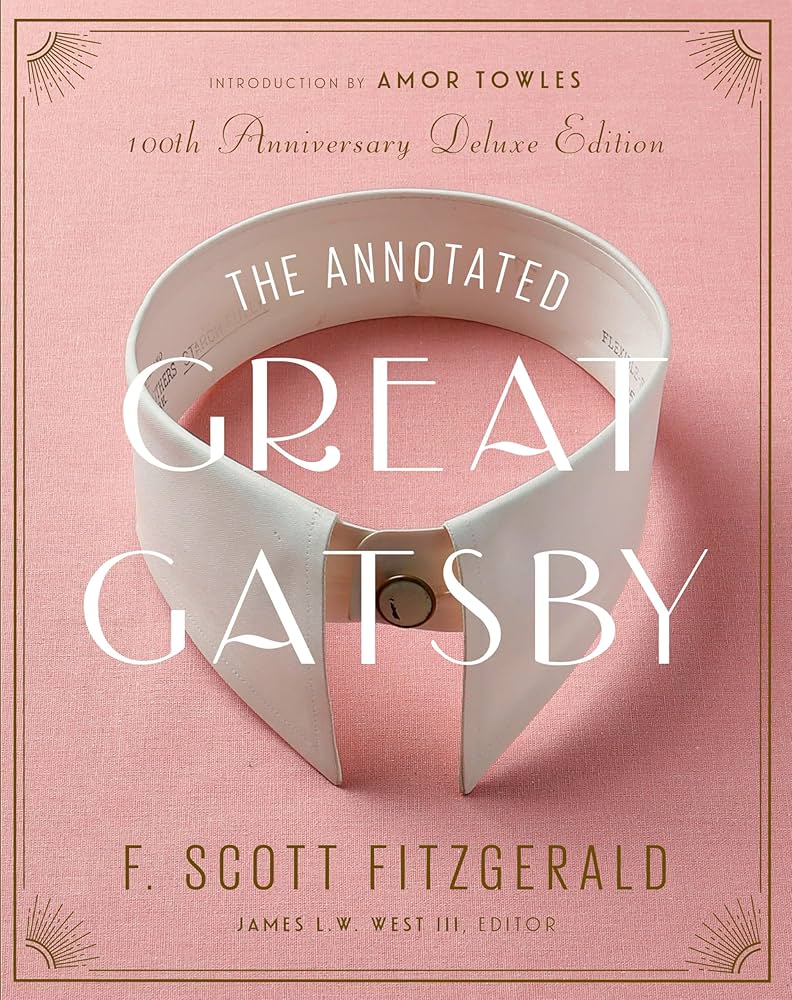
The new annotated edition produced by Library of America in honor of the 100th anniversary attempts to put the novel back in its historical context. With rich illustrations and elegant blue marginal annotations, one can learn just who Paul von Hindenburg was (“field marshal of the German armed forces during World War I”) and view a delightful self-portrait of Zelda Fitzgerald swimming in a champagne glass. For Fitzgerald fans as well as scholars, the photos, facsimile manuscript pages, scrapbooks, excerpted letters, and the final chronology make the edition an especially pleasurable compendium. That it is all printed on crisp, cream paper and wrapped in the image of one of Gatsby’s pink shirts makes it all the more sumptuous for consumption.
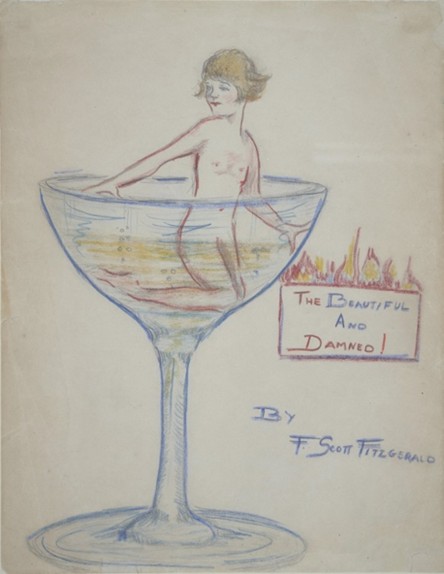
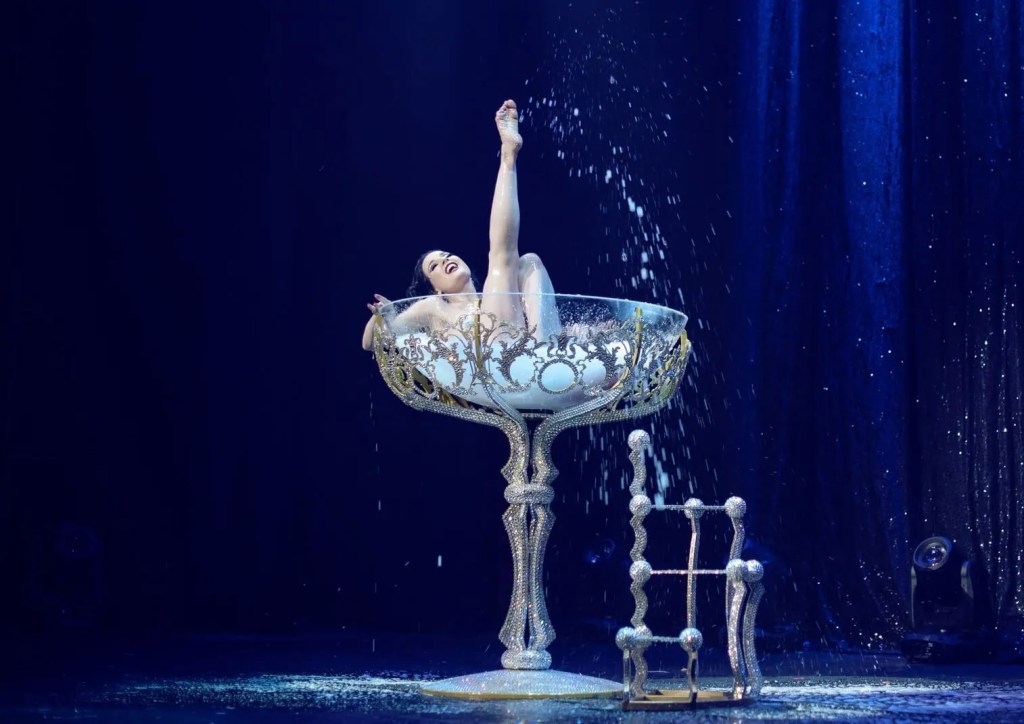
It’s not that the new edition is all surface, all visual; far from it—it is meticulously edited and curated by James L.W. West III, emeritus Professor of English and book history at Penn State. If a print edition of the novel could make the 1920s come alive again, it’s this one. However, marginal annotations can only hint at Fitzgerald’s music and what it might have evoked in readers, such as the inclusion of the 1922 sheet music and lyrics for Julián Robledo’s “Three O’Clock in the Morning.” Fitzgerald describes it as a “neat, sad little waltz”—but Paul Whiteman’s popular recording of it sounds almost painfully, naively romantic. Not unlike Daisy, or even Gatsby himself. Like so much pop music, it is more wistful, more elevated than the momentary experience of love.
After all, in the very casualness of Gatsby’s party there were romantic possibilities totally absent from her world. What was it up there in the song that seemed to be calling her back inside? What would happen now in the dim, incalculable hours? Perhaps some unbelievable guest would arrive, a person infinitely rare and to be marvelled at, some authentically radiant young girl who with one fresh glance at Gatsby, one moment of magical encounter, would blot out those five years of unwavering devotion.
If Gatsby stays with us one hundred years later, it is perhaps this musical quality more than any other that explains its staying power. Were it merely a good story, or a cast of good characters, or even a good allegory for the failure of the American Dream, I’m not sure we’d keep reading it. But instead, like a popular song, Fitzgerald’s writing stays with us, like an earworm with its hooks in you.
 Las Vegas Review of Books