Alison Bechdel, Spent: A Comic Novel (Mariner Books), 272 pp. Hardback, $32.00.
In a moment when literature often struggles to articulate personal responsibility within collective crisis, Alison Bechdel stages her own complicity as a kind of punchline and a form of therapy. What results is a book that reads like both an indictment and a confession, wrapped in the exaggerated linework of a cartoonist who knows that the only way through catastrophe might be self-lacerating comedy.
While it has become an increasing trend in the literary world for books to blend the passionate with the political, few do so with the formal inventiveness of Bechdel’s Spent: A Comic Novel. As a graphic memoir posing as fiction, or perhaps a fiction masquerading as memoir, Spent offers a self-reflexive meditation on artistic purpose and the absurdities of late-stage capitalism while never straying far from the author’s trademark neurotic wit.

Set in a Vermont goat sanctuary that seems part refuge and part absurdist retreat, the novel follows a cartoonist named Alison Bechdel who is unmistakably a caricature of the author. This doubling is not new for her work—Fun Home and Are You My Mother? both filtered autobiography through intertextual lenses—but Spent pushes the meta apparatus further. The character Alison is ostensibly working on a long-delayed graphic novel titled $um, a project that looms like an albatross over the narrative. Here, the author-as-character is not merely telling her story but actively questioning the point of telling it. The book becomes a recursive loop in which Bechdel watches herself try to salvage meaning from a world she no longer believes can be saved, only to fall deeper into the well of her own anxieties.
What makes Spent formally exciting is the way it treats narrative itself as a symptom. Panels lurch from didactic self-exploration to farcical episodes involving climate doom (like Alison’s fixation on two teenagers who stage increasingly dangerous climate protests), domestic chaos (her growing unease about her conservative sister, who is now writing a memoir of her own), and the occasional literary impostor syndrome (her spiraling anxiety over how she’s portrayed in a televised adaptation of one of her books). Whereas Fun Home was steeped in tragic family history and classical literature, Spent is riddled with influencer parodies and ecological dread. Bechdel is still reading, still overthinking, but now the literary texts are literal text messages.
Yet for all its cultural reference points and structural gamesmanship, the novel remains anchored in a relatively simple question: What does it mean to do good in a broken world? Bechdel the character is an aging artist, politically conscious but existentially paralyzed, unsure if her work is alleviating the problem or feeding it. Her goat sanctuary, with its absurd blend of earnest pastoralism and Instagram-ready eco-aesthetic, becomes a metaphor for the contradictions of contemporary liberal identity. It’s not that Bechdel mocks political activism, though she certainly skewers its hypocrisies; it’s that she refuses to exempt herself from critique. The cartoonist’s attempts at ethical living descend into obsessive self-scrutiny, and the book begins to feel like a study in masochistic reflection: Can one atone by documenting one’s privilege in graphic detail?
“Spent” is a portrait of the artist as unsure, anxious, and self-implicating—a book that does not resolve so much as document the process of unraveling.
In this way, Spent is not just a satire of progressivism but a dissection of its psychological toll. Bechdel plays with the tension between performance and sincerity, revealing how the moral pressure to “do the right thing” often curdles into neurotic self-monitoring. One might say that she draws the liberal subject as a kind of tragicomic figure: constantly refreshing the news, donating to causes, interrogating their own footprint, and still feeling like they’ve done nothing. The book asks whether personal virtue can coexist with political ineffectiveness and whether trying to reconcile the two is itself a symptom of narcissism.
At times, the narrative buckles under the weight of its self-awareness. There are long stretches where Bechdel the character is less a person than a mouthpiece for essays that might have appeared in The New Yorker or n+1. Panels are crowded with speech bubbles that edge into polemic, and while this density is deliberate, it occasionally mutes the book’s emotional stakes. Even if the overstuffed quality is the aesthetic strategy, where Bechdel is drawing the experience of being underprepared for the end of the world, it eliminates one of Bechdel’s greatest strengths in connecting the global to the local.
The second-to-last chapter of Spent, pointedly titled “The Circumstances which, Independently of the Proportional Division of the Surplus-Value into Capital and Revenue, Determine the Extent of Accumulation, namely, the Degree of Exploitation of Labour-Power, the Productivity of Labour, and the Growing Difference in Amount Between Capital Employed and Capital Consumed, and the Magnitude of the Capital Advanced,” stands out for its theoretical ambition. Borrowing the title wholesale from Karl Marx’s Capital, Bechdel signals her intention to engage directly with Marx, not merely as a historical reference but as a theoretical frame through which to view her own complicity. Throughout the chapter, Marx serves less as a historical figure than as a ghostly mouthpiece Bechdel animates to interrogate her own contradictions. She overlays the comic’s visual space with marginalia, pulling from Capital’s most impenetrable passages and attempting to illustrate them literally. These visual metaphors oscillate between clever and ridiculous. Bechdel is not pretending to offer a rigorous Marxist analysis; instead, she’s satirizing her own desperate desire to intellectualize a moral failing. The Marx she conjures is a voice reminding her that every dollar of her memoir advance contains hidden labor she cannot trace. Her invocation of Marx doesn’t elevate her argument, it burdens it, and that’s the point. By dragging theory into her domestic, pastoral world, she’s showing just how unmanageable the problem becomes once truly considered.
This chapter doesn’t pretend to resolve the economic critiques it raises. If anything, it highlights their unresolvability within the framework of memoir or artistic guilt. The language of capital accumulation and the exploitation of labor becomes another way to confess, to suggest that even as she draws her goats and her neuroses, Bechdel is feeding off a system whose violence she cannot directly see.
Still, Spent avoids becoming a purely intellectual exercise because of Bechdel’s gift for physical comedy and emotional timing. Her linework, while tight and economical, retains a looseness that makes the characters feel alive even as they monologue. She draws herself with a kind of loving cruelty—baggy-eyed, stoop-shouldered, always teetering on the edge of ridiculousness.
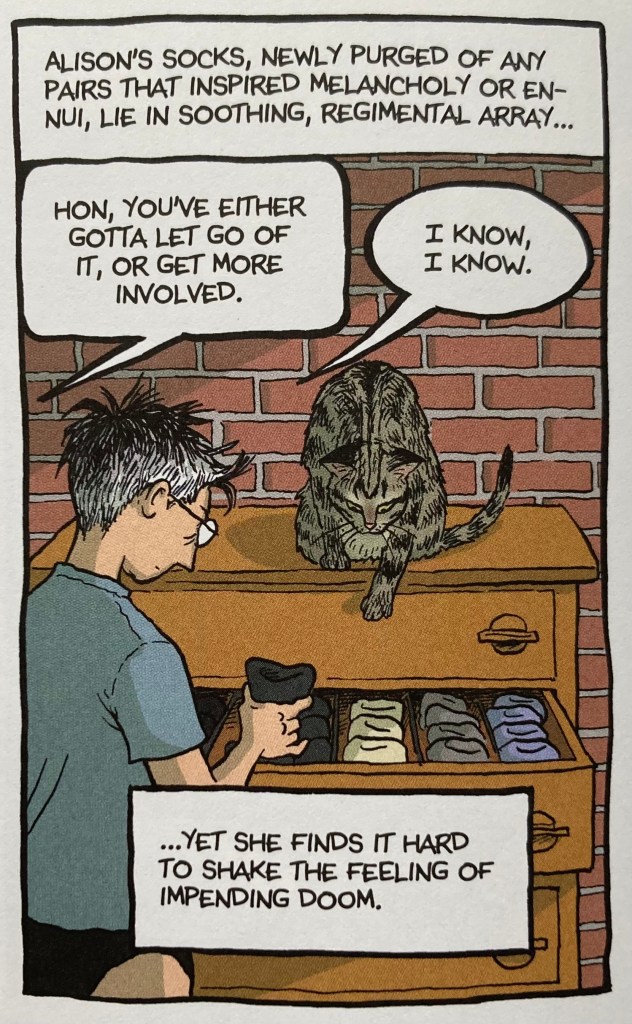
Spent also contributes to a growing trend in literature that blurs memoir and autofiction to explore themes of complicity and collapse. Alongside works like Eliza Clark’s Penance, Sheila Heti’s Pure Colour, and Mira Jacob’s Good Talk, Bechdel’s novel participates in a larger inquiry: How do we live with knowledge of harm? How do we tell stories in an age of burnout, misinformation, and looming ecological collapse? What distinguishes Bechdel is her refusal to claim wisdom. If anything, Spent is a portrait of the artist as unsure, anxious, and self-implicating—a book that does not resolve so much as document the process of unraveling.
This openness to failure might be Spent’s most radical gesture. In a culture that prizes certainty and moral clarity, Bechdel offers ambivalence, contradiction, and dark humor. She knows that drawing herself into the problem is not the same as solving it, but she draws anyway.
Spent doesn’t offer a blueprint for redemption. It offers something more honest: the spectacle of a mind trying, and mostly failing, to come to terms with its place in the world. If we can’t escape ourselves, she seems to say, we might as well make it funny.
 Las Vegas Review of Books