The Odyssey, directed by Christopher Nolan (Universal Pictures); adapted from the epic poem by Homer.
Christopher Nolan’s rendition of The Odyssey is a Las Vegas movie. Really. Because it’s all about hospitality.
The ancient Greeks believed in xenia, a term commonly translated as “hospitality.” The idea was that you were expected to be kind to guests, strangers, and foreigners; if they arrive at your home, you give them some food and a warm place to rest. And, in turn, you should also strive to be a good guest, respectful to your hosts when you travel and visit. This was no small detail in a long list of rules. It was the law of Zeus himself, the King of the Gods.
Homer’s Odyssey, as Nolan’s film repeatedly reminds viewers, engages with problems of hospitality. When Odysseus sailed from Ithaca to fight in the Trojan War, he left his palace in the hands of his wife, Penelope, and his son, Telemachus. As the years go by, and Odysseus fails to return home promptly after the end of the war, the palace is besieged by suitors for Penelope’s hand. Is she obligated to feed and shelter all these unwelcome intruders? Or are they a gang of creeps taking unfair advantage?
By shifting back and forth between the palace at Ithaca and the adventures of Odysseus, Nolan mirrors the problem of hospitality at home with the problem of hospitality abroad. Odysseus and his crew keep washing ashore in strange locations, often very hungry. Are they entitled to food and shelter, or are they no better than the suitors threatening Penelope and Odysseus?
* * *
Nolan’s movie was also a gamble. It carried a quarter-billion-dollar budget, a hefty price tag for a film based on a poem. The gamble paid off, as The Odyssey became the smash hit of the summer. Its popularity is undeniable, bringing in more ticket sales than everything other than Spider-Man. But is it a good adaptation of Homer’s classic?
Nolan’s film is big, but it’s not just empty spectacle. It explicitly portrays a powerful civilization at the moment of its apocalyptic unraveling.
Emily Wilson, whose 2018 translation of The Odyssey is taught in classrooms across the country, has written at length about her disappointment in the film—despite the fact that Nolan was reportedly inspired by her version of the text. Wilson highlights the many scenes and episodes from the original that didn’t make it into the screen adaptation, and she rightly points out that the movie’s dialogue can be embarrassing, with mundane expressions like “my dad’s coming home” and “let’s get off this fucking beach” awkwardly juxtaposed against attempts at more grandiose oratory. More crucially, she insists that Matt Damon’s hero is nothing like Homer’s. “Damon’s grizzled Odysseus is neither a master storyteller nor a flirt,” she laments. He’s more of a stoic soldier, doggedly determined to persevere through a harrowing ordeal.
At the end of the day, the classic literary text we know as The Odyssey does two things. First, it gives us a tremendous character, Odysseus, a unusually wily, crafty (Wilson would say “complicated”), three-dimensional trickster who has fascinated readers for millennia. Years ago, the critic Wallace Gray called him “the first total man in Western literature.” Second, The Odyssey lays out an epic account, an impressively rich set of episodes and anecdotes that might serve as the literary identity and ethos for a whole civilization, the ancient Greeks. It’s the story, that is, not just of one man but of an entire people now lost to time.
Nolan’s movie, as Wilson and many others have noted, largely fails to capture the first. Homer’s Odysseus is a terrific adventurer and a terrible leader. He’s witty, charming, lascivious, garrulous, clever, impetuous, mercurial, risky, curious—and an inveterate liar. Matt Damon’s Odysseus is none of these things; he doesn’t even smile. Daniel Mendelsohn, another recent translator of Homer’s text, has suggested that Nolan’s version of Odysseus shares certain features with Nolan’s version of Batman—a gruff, humorless, battle-worn veteran. Along such lines, we might observe that Homer’s original Odysseus is actually more like the Joker, cutting capers and concocting schemes not always necessary for the goals he purportedly wants to achieve.
But if Nolan has failed to portray Homer’s Odysseus, he has very much succeeded in giving modern audiences a truly epic account. His movie is large in all respects—the first Hollywood feature to be shot entirely on 70mm IMAX film, a medium that can only be appreciated in this form on about two dozen screens in this country, one of which happens to be at the Brenden Theatres in the Palms Casino (which had to bring in special projectionists to handle the film). And size matters. At the Palms, the scene in the Cyclops’s cave is incredibly effective, the play of darkness obscuring the immensity of the one-eyed giant until he suddenly appears with tremendous enormity.
Nolan’s film is big, but it’s not just empty spectacle. It explicitly portrays a powerful civilization at the moment of its apocalyptic unraveling. In this account, the Trojan War is the beginning of the end for the Mycenaean Greeks of the Bronze Age. The war itself is not a noble clash of armies but a slow, protracted siege. The Greeks are largely idle, sitting on the beach for years; then, following Odysseus’s advice, they effectively violate Zeus’s law of hospitality with the trick gift of the Trojan Horse—winning the war not through honorable combat but with one brutal night of murder and rape and destruction.
Nolan has said that his inspiration for showing the Trojan Horse partially buried in the sand at the beach was the famous image of the Statue of Liberty from Planet of the Apes (1968). It’s a weapon, that is, analogous to the atomic bomb. And several critics have pointed out that Nolan here seems to be recreating his own last film, Oppenheimer (2023), which offered the story of a man coming to grips with the terrible forces he has unleashed to win a war.
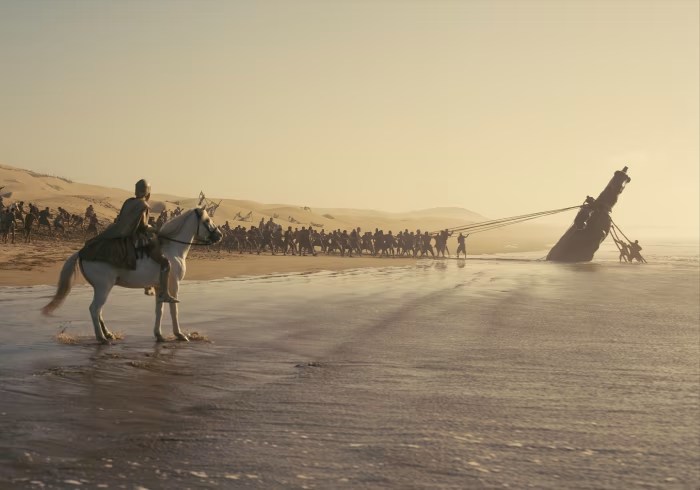
Odysseus, like Oppenheimer, is the apocalyptic architect of the end of civilization—and he carries that guilt. This is perhaps why he can’t “go home.” He has destroyed not just his kingdom but his whole world. In this, Nolan seems to be in accord with Jonathan Shay’s Odysseus in America: Combat Trauma and the Trials of Homecoming (2002), which advanced the now-popular theory that Homer’s epics are essentially about soldiers with PTSD, who cannot easily return from the battlefield to the domestic sphere. In the film, Damon’s Odysseus, drugged into a state of amnesia by the goddess Calypso, struggles to recall his former life, as if his terrible trauma has changed him irrevocably.
Damon’s Odysseus confesses the weight of his guilt to Penelope when he returns, in disguise, to his palace in Ithaca (which has been outfitted with a grated screen curiously resembling a Catholic confessional). He also absolves himself by killing the overstepping suitors—this time in man-to-man combat. Perhaps this too violates the rules of hospitality, but, in the logic of the movie, it allows Odysseus to transfer his kingdom to Telemachus, who mostly stays out of the fight. Partly following Tennyson’s famous 1842 poem “Ulysses,” the reunited couple can then set sail and head west as exiles, exploring the world and making sacrifices for the dead comrades Odysseus couldn’t properly bury.
As his accent helps to make clear, Matt Damon’s Odysseus is an American. He is an elite member of the most powerful civilization in the world, but he sees that his actions have helped to hasten its downfall. This is more Nolan than Homer, though, as Emily Wilson herself argued, the ancient text itself “looks back to a lost age, the time before the Greek dark ages,” and meditates on the changes brought about by “colonizers, traders, and pirates push[ing] outward across the Mediterranean, encountering alien cultures and alien peoples.” Change is coming. The Greeks here cannot simply sing songs about their own greatness, self-identifying as champions because they once were.
The film, like the epic poem, chases greatness by trying to have it both ways. It captures and holds the greatness that is otherwise slipping away and dissolving into history. But it also recognizes and grapples with this dissolution, refusing to turn a blind eye to the awful power of time. Watching a movie isn’t very similar to reading classic literature, but Nolan seems to understand how film can work to preserve the elements that must eventually be lost.

