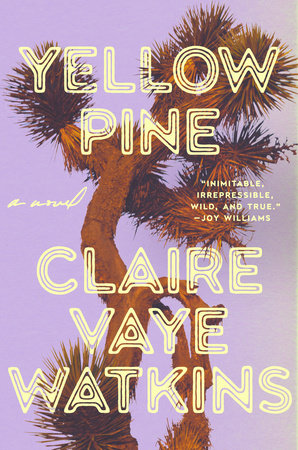
Claire Vaye Watkins, Yellow Pine (Riverhead), 256 pp. Hardback, $29.00.
With Yellow Pine, her third novel and fourth book overall, Claire Vaye Watkins has firmly established herself as a literary representative of the Mojave. “The voice of the desert lives in Watkins’s work,” asserts Emily Adrian in Bookforum. In this new novel, for example, Watkins deftly captures the oppressive early afternoon summertime heat: “It was the time of day that makes you pray rashly for the sun to go down and never come up again, an ocular agony that somehow every day eventually resolved into the prismatic bliss of sunset.” Agony and bliss, the fluctuating extremes of life in the desert.
The title of the novel comes from a real-life parcel of land, located just a few miles outside of Pahrump, developed by the Florida company NextEra into a 3,000-acre solar energy farm. In a 2022 nonfiction essay about it for The Believer, Watkins argued that Yellow Pine exposed the “grim folly” of corporate, for-profit endeavors in renewable energy. The project would destroy large amounts of flora and fauna in the desert; a much better option, as Watkins and her “activist buddies” maintained, would be to demand solar in the cities—on rooftops and over parking lots—rather than in vast stretches of wilderness deemed expendable by investors and politicians.
In the novel, 39-and-a-half-year-old Rose (full name “Rose of Sharon Williams”; her father was a fan of The Grapes of Wrath) lives by herself in Tecopa, a small California community in the Mojave just across the state line from Pahrump, where Rose grew up. She’s divorced, and she has a 7-year-old daughter named Juniper. Rose’s ex-husband moved out to the East Coast for a job, and Rose agreed to a custody arrangement that lets Juniper stay with her father during the school year and visit her in the desert during summers and holidays. (In an interview for Fresh Air, Watkins, who also grew up in Tecopa and Pahrump, told Terry Gross that she has a similar arrangement with her own daughter.)
In Tecopa, which is a “census-designated place” (rather than an actual municipality or township), Rose is essentially part of a small, informal group of a few dozen “jackrabbit homesteaders.” They’re far from the beaten path. Rose herself has been working remotely (since the pandemic) for the Sierra Club, but when her boss is busted for sexual harassment, she and the rest of her team are put on paid leave. She thus enjoys the prospect of a fair stretch of leisure time alone in the desert.
The novel begins with Rose getting a call from an old flame, Miles, whom she had dated when she was a college student at UNR. (They had a messy breakup when he cheated on her.) Miles is out of work and out of sorts, and he’s curious about Rose’s desert-solitary situation—“some Thoreau shit,” as he approvingly labels it. In short, he wants to move out to her and start things up again, and Rose cautiously agrees. Or not so cautiously—soon after Miles moves in, she declares that she wants to try to have a baby (or not not try). Miles seems on board, but their relationship is always a little rocky, largely because they’re both loners pessimistic about the planet’s future. It’s a “doom-and-swoon dynamic, as KNPR’s Mike Prevatt calls it.
Outside of dating Miles, Rose’s other social activity is driving out to Yellow Pine to visit her friend Fran, “an ecofeminist Whitmanic poetess … on hiatus from her PhD at UNLV” (a character based, as Watkins has stated, on her friend Shannon Salter, whose doctorate is now complete). Fran is living in a trailer on public land in order to document and to protest the construction of the solar energy plant that is destroying the desert ecosystem. It’s especially harmful to desert tortoises, which are being displaced from their homes and will likely fail to adapt to new surroundings. And it’s a glaring misnomer; there’s not a pine tree within a hundred miles of the area. As Watkins notes, “Yellow Pine was a fake name for a real place that was really being killed for fake reasons.”
Some of the most memorable scenes in the novel include a kooky cast of minor characters who show up at Yellow Pine potluck protests and espouse an array of eco-activist positions. When Rose laments the loss of wild horses, another protester, Ira, scowls. “I don’t cosign the ungulates,” he tells her. Mustangs, he says, are “an invasive European war machine trampling springs, shitting everywhere, fucking nonstop, taking more than their fare share”—and thus, ironically, a fitting symbol of the American West. Other conversations might regard the effectiveness of “vibrational healing” or which varieties of apples are ethically acceptable.
Watkins threads a needle here. It’s clear that she’s gently mocking such characters, people who drive around listening to “Silent Spring on audiobook.” When they begin complaining about the capitalist destruction of the environment, they eventually get on a roll, “hitting whip-its of confirmation bias.” They’re certainly not dangerous. As protesters, they’re vigilant, but they’re not vigilantes. Yet Watkins also obviously wants to promote much of her activists’ agenda. This comes through most powerfully in evocations of desert beauty, though also through Rose’s dawning recognition of “the false gospel of overresponsibility”—the all-too-common belief that, when it comes to ecological stewardship, each individual is equally accountable for recycling, reusing, composting, etc. But as Rose realizes, those at the top deserve far more of the blame. She wants to avoid “relocate[ing] the responsibility of right living from the architects and profiteers of climate collapse to the individuals suffering under it.”
Her prose has an original poetic component that suggests roughness, self-reliance, and improvisation—suitable for these desert surroundings.
These days, one of the most commonly debated aspects of personal responsibility in the face of impending climate change is the decision to have children. Is it right to bring offspring into the world if you’re convinced that the planet will inevitably become uninhabitable? Toward the end of the novel, Miles leaves and Rose doubles down on her desire to conceive. Procreation is no longer a debatable hypothetical for her; it’s a need bordering on an obsession. Rose adopts a theory that she’s more likely to become pregnant if she’s inseminated by multiple men in the same ovulation cycle, so she prints some waivers for guys to sign to acknowledge her scheme and then tries to hook up with several of the locals. She calls her strategy “the Swirl,” and the novel more or less peters out as Rose ineffectively puts this plan into action. It’s an odd turn for the narrative, though it allows for a future-oriented, optimistic ending in response to the slow violence of environmental disaster.
Watkins’s wordplay, however, is what constitutes both the major strength and the potential weakness of Yellow Pine. The narrative is light on plot because it focuses on poetic endorsements of desert life and idea-driven dialogue (“long, fast-paced, exhilarating discussions”) about environmental activism. (It’s “less of a novel than a novel-length riff,” observes Lauren Christensen for the New York Times.) At its best, Watkins’s language captures the beauty of Rose’s backyard: “its ferocious plants with their intelligent root network, its cryptobiotic crust, its cobble of patinated pebbles locking down dust since the desert was trod upon by giant ground sloths.” But some stretches can be uneven; first person narration awkwardly pops up once to begin the novel and then just once more later on to acknowledge that Rose’s daughter has been ignored. (“We need to say more about Juniper.” Oh yeah …) And some descriptions are awkward. Miles, we’re told, has an “long, unhurried dick.” Unhurried? Does this mean he works slowly and methodically in bed? (Perhaps there’s more stylistic consistency here than meets the eye. Watkins’s first novel, Gold Fame Citrus, featured a character whose “erection was frank and elegant.”)
Yet whether or not a reader finds such language especially appealing, Watkins has pulled off the considerable feat of showcasing an idiosyncratic literary style. Her prose has an original poetic component that suggests roughness, self-reliance, and improvisation—suitable for these desert surroundings. There’s a bookish quality (in Yellow Pine, Rose is always sharing her reading) that draws on a regional literary tradition, and there’s a tremendous attention to the identity and the nomenclature of plants and places resonating across the landscape. It’s a remarkably potent voice, and Yellow Pine is commendable for bringing it to the fore.

