A. Natasha Joukovsky, Medium Rare (Melville House), 304 pp. Paperback, $19.99.
The odds of filling out a perfect March Madness bracket are astronomical—somewhere between one in a hundred billion and one in nine quintillion, depending on whom you ask. It’s never yet happened. But what if it did?
Natasha Joukovsky’s new novel, Medium Rare, centers on 35-year-old D.C. lobbyist Phil Fayeton, who pulls off such a feat. In the story, set in 2019, an enormously wealthy tech guru (owner of Daedalus Industries) had offered a billion-dollar prize to anyone who might improbably achieve such perfection—so Phil becomes not only famous (the media start to pay attention when his bracket enters the Sweet Sixteen without a loss) but rich as well.
Set just before the 2021 decision to allow college athletes to profit from name, image, and likeness, Medium Rare glories in an amateurism that need not be apotheosized to be valuable.
The novel has little to do with sports betting. Medium Rare offers a modern updating of several classic Greek myths. (In this, it is a kind of sequel-in-spirit to Joukovsky’s last novel, The Portrait of a Mirror, which reimagined the story of Narcissus for the twenty-first century.) Phil is a combination of Icarus and Phaeton, a figure who flies too close to the sun and makes a mess of good thing. The “sun” here is “Sunny Sanders,” a hot blonde sports reporter who—to the chagrin of his wife, Raleigh—begins covering Phil’s winning streak with extra attention. (This drama ends up being amusingly similar to the recently revealed relationship between sports journalist Dianna Russini and football coach Mike Vrabel.) In this account, Phil is essentially an Everyman—he looks “like a disappointing version of the man who would play him in a movie, simultaneously insecure and overconfident in his suitability for the role”—but one who is thrust into the spotlight as a marvelous anomaly.
Joukovsky adds to this mix a 34-year-old character-narrator named Cassandra, who, like her Greek counterpart, can see the coming catastrophe but is ignored by all the others. Phil, Raleigh, Cassandra, and Cassandra’s husband, Miles, all went to the University of Virginia—the team that happened to win the NCAA Tournament in 2019. Cassandra and Raleigh even belonged to the same campus sorority. Now they find themselves in D.C. working in politics and business and watching in awe as Phil’s predictions vault him into the realm of TV stardom. (He even gets to meet President Trump, whose “hamburgery breathing” unsettles him.) The success is impressive, but, as Cassandra warns, “stratospheric celebrity melts the wax of mortal wings.”
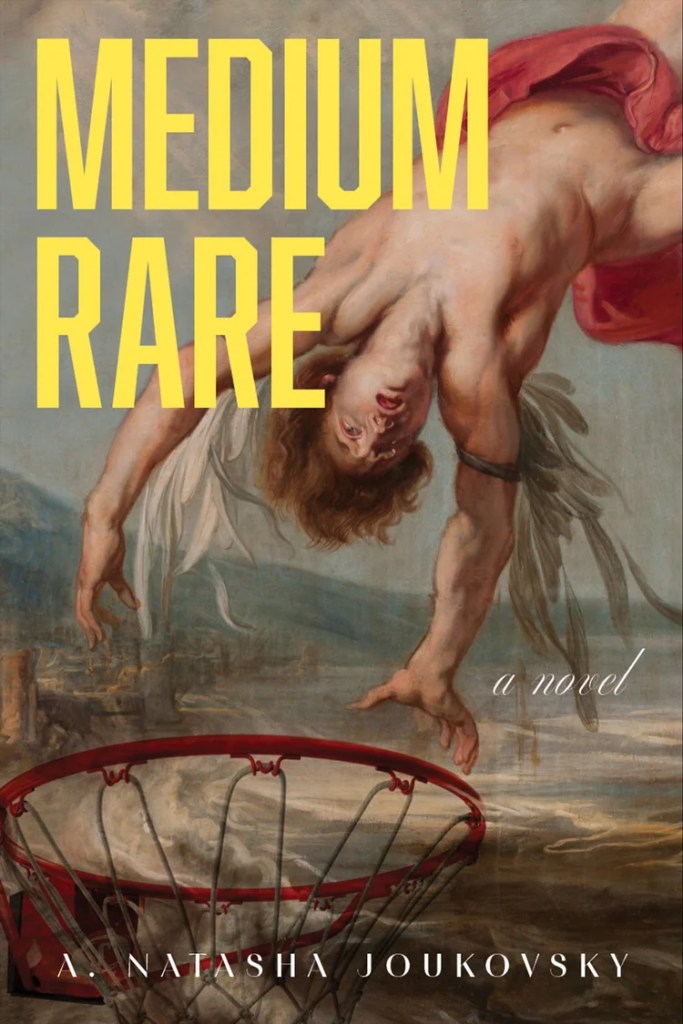
Phil’s rise and fall is evoked by the amusing cover image of the book (in which Icarus seems about to perform a dangerous slam dunk), but Cassandra makes the novel compelling. She is the epitome of the “unreliable narrator”—because no one in the story ever believes her. Sometimes people think she’s joking or being sarcastic, sometimes that she’s just wrong. This feature is often quite funny; whenever Cassandra makes a statement, other characters will reply in disbelief: “Really?” “Do you really know that, though?” As a result, she has learned, in conversation, to cultivate a pattern of non-declarative responses, often rendered as “—Mm.” While the consistency with which she is disbelieved may initially seem unrealistic, Joukosvky manages to render it a remarkably mundane aspect of everyday sexism. “Women,” observes Cassandra, “are always, on some level, unreliable narrators.” (You can choose to believe her or not!) And this is part of the fun of the novel; when Cassandra speculates upon the details of Phil’s relationship with Sunny Sanders, we, as readers, need to decide whether these details belong to the narrated facts of the novel or to the idle imaginings of a gossipy character. Does Cassandra really know what’s going on?
Cassandra intuits Phil’s ensuing downfall with a little bit of schadenfreude. After all, in her account, she is the true seer, whose gifts remain unacknowledged. Phil, meanwhile, is a phony prognosticator. He can’t predict the future; he just got lucky. And as we wouldn’t turn to a lottery winner for advice on economic policy, we shouldn’t see Phil’s bracketological success as indicative of any applicable talent. In the book, show business executives want to promote his media presence into an entertainment asset, suggesting that he has a rare gift as a potent medium. Phil knows that he’s never had any supernatural visions, but it’s easy for him to subscribe to the illusion that he is indeed special, that his intellect is deserving of extended screentime—when, after all, he’s just an average guy. We might say that, in his brief celebrity, Phil is less like Ken Jennings and more like Ken Bone.
Two other elements carry the momentum of the book and keep the story fresh. One is Cassandra’s evolving understanding of her own identity. At first, she sees herself as a cultured intellectual with literary ambitions whose taste and refinement allows her to transcend the muck and mire of D.C. politics and its surrounding bourgeois suburbia. (Joukovsky, it may be worth noting, is the daughter of Nicholas Joukovsky, an English professor who edited the letters of the nineteenth-century British novelist Thomas Love Peacock.) Cassandra looks down on her former sorority sister Raleigh, a stay-at-home mom who projects a commercial femininity. But she gradually realizes that, to any outside observer, she and Raleigh are nearly exactly the same—UVA sorority girls who married well and started families in a fancy zip code. Like Phil, Cassandra isn’t as special as she thinks she is.
The other appealing element is Cassandra’s swooning love affair with college basketball. Having paid the sport relatively little attention in the past, she is suddenly drawn to the improbable rise to the top of her alma mater’s team in 2019. Cassandra studies their unusual strategies and becomes enamored of their ballcourt aesthetics. “Their long, drawn-out offensive possessions unspooled like paragraphs of Proust,” she gushes. At times, she becomes Pynchonesque in her appreciation: “Layups off laser passes. Parabolic threes screaming across the sky.” This unexpected romance adds just the right amount of seriousness to the novel. Set just before the 2021 decision to allow college athletes to profit from name, image, and likeness, Medium Rare glories in an amateurism that need not be apotheosized to be valuable.

