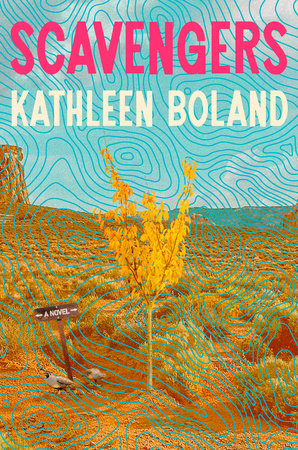
Kathleen Boland, Scavengers (Viking), 304 pp. Hardback, $29.00.
Most of Kathleen Boland’s new novel, Scavengers, takes place in the fictional town of Mercy in Southern Utah. Boland, who has spent a lot of time in the region, offers a quick overview of the area’s ancient history: “This was once the most populated place on the continent, humans everywhere, tens of thousands of them. Elsewhere, there were crusades and gunpowder; here, a sprawling palace, bigger than Buckingham, the beating heart of a forested empire filled with art and agriculture, science and commerce. They had many names, Anasazi, Ancient Puebloans, Hisatsinom.”
Whereas the Southwest’s surface can suggest to many simply a barren desert, for a particularly obsessive few it can suggest something else entirely: buried treasure. In Scavengers, Christy moves from New England to Salt Lake City because she has joined an online community dedicated to discovering the life savings of an eccentric millionaire who, in the mid-2000s, deposited his riches in the wilderness and published a memoir with a poetic set of obscure clues as to their whereabouts. Now, a decade later (the novel is set in the 2010s), “encrypted PDFs and fuzzy scans were readily available on the Conversation,” a virtual discussion board allowing obsessed fortune hunters to trade tips on where the loot might be located.
Whereas the Southwest’s surface can suggest to many simply a barren desert, for a particularly obsessive few it can suggest something else entirely: buried treasure.
It may sound absurd, but this element of the book is loosely based on the real-life Forrest Fenn treasure, recently featured in the Netflix series Gold & Greed. In Boland’s hands, the hunt is really about the relationship between Christy and her adult daughter Bea (short for Beautiful). Bea was working in finance as a risk assessment analyst, making great money and covering her jobless mother’s rent. But when she loses her position to a costly mistake, she’s left with two months of severance pay and the sense that she’s headed for trouble. Deciding to fly out west to pay her mother an overdue visit, she gradually realizes that her own prospects might be grim.
Boland’s novel begins by pivoting between Bea’s and Christy’s points of view. At first, it seems that Christy has been a deadbeat mom who can’t keep her life together (her favorite tune is Joan Jett’s “Bad Reputation”), while Bea has grown up to be the responsible professional who can manage the family’s finances. Bea’s father was a fool-around traveling salesman who eventually left for good, and Christy took off a bit as well, leaving Bea to be raised by her grandmother. Now, as an adult, Bea has tried to create the sort of stability her freewheeling mother never could. But her world is nevertheless fraying at the edges. She’s not as different from her mother as she’s like to think; she’s clearly made some poor choices she’d prefer to ignore.
The real strength of Scavengers is its turning toward the perspective of Christy, who’s proud of her daughter’s success but exasperated by her know-it-all demeanor. After all, Christy couldn’t have been that bad of her mother—her daughter went to college and got a great job. And sometimes a little elbow room is necessary; plans don’t always work out the way you hope, so the ability to improvise is key.
When mother and daughter decide to drive to the town of Mercy to follow a tip about the treasure, the adventure begins. While hoping to strike it rich, Christy is just as interested in meeting middle-aged Bob, a Nevadan correspondent from the “Conversation” and an eligible bachelor. For Bea, this aspect of the trip is horrifying—especially when she discovers that Bob has posted pics of himself pissing in the desert—but Bea’s own love life is a mess; she spends too much time obsessing over social media accounts of the couple whose relationship she envies. In Mercy, she meets Tag, a Tacoma native and ASU dropout, who has just quit a stint as a cannabis chef in California. (His specialty was known as “Dank and Cheese.”) Tag may or may not be a good idea.
Here the novel wears a bit thin as Boland shifts focalization and perspective beyond Bea and Christy. Mercy is a strange place with different figures from all over, folks who have come to Utah looking to make a buck in all kinds of different ways—some honest, some less so. Perhaps these narrative zigs and zags simply emphasize the chaos of an unfamiliar and dangerous landscape. But the core story here is about a mother and daughter, and—though the sentiment is a little trite, even corny—it might go without saying that the real treasure was there all along.
Boland’s descriptions of Southern Utah are spot on, and the apprehensive mood of the novel—what Amanda Norton calls its “gnawing sense of desperation”—offers a nice sense of resonance with literary works in the Western tradition. In other words, even though Scavengers very much takes place in the twenty-first century (with an online discussion board playing a significant role), it’s not hard to imagine the essence of this story set much further back in the past. Lies, love, secrets, sex, treasure, treason. People have ventured out and found such things in the Southwest for a very long time.
 Las Vegas Review of Books