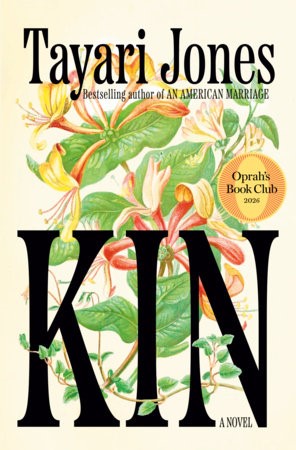
Tayari Jones, Kin (Knopf), 368 pp. Hardback, $32.00.
In the foreword to her 1973 novel Sula, Toni Morrison discusses how Black authors are often beset by “the ‘problem’ of being a ‘Negro’ writer.” They are confronted with “the question,” and their works are only evaluated on the basis of whether they are faithful or faithless to a certain characterization of Black people—whether “Black people are—or are not—like this.” In her foreword, written in 2004, Morrison asserts that this is her concern no longer and that “other questions mattered more. What is friendship between women when unmediated by men? What choices are available to black women outside their own society’s approval?”
In a recent interview, Tayari Jones admits that each book she writes is a nod to Morrison’s legacy: “Every book I write, I make some sort of wink to her.” Channeling Sula and “Recitatif,” Jones, a Spelman College alum and previous Black Mountain Institute fellow, follows in Morrison’s footsteps with her new novel Kin, reaffirming that there are yet more important things to explore in women’s lives.
Set in the Jim Crow South, “Kin” follows two girls, Niecy and Annie, and their lifelong bond as “cradle friends.”
In the same interview, Jones discusses her desire to center female friendships: “This is such a core part of our experience as women.” She points out that these essential relationships are often disregarded as “not real,” while those with parents or kids somehow are. Life-long friendships that shape our lives are often underexplored. Jones is part of a Black literary tradition blazed by women writers such as Zora Neale Hurston, Gwendolyn Brooks, Nella Larsen, and Toni Morrison, who were deeply concerned with the affairs of Black women and their friendships—sometimes friendships so close that you don’t know where one ends and the other begins. The goings-on of women’s lives among one another, outside the domestic sphere, rarely take center stage, but Jones’s novel features them prominently.
Set in the Jim Crow South, Kin follows two girls, Niecy and Annie, and their lifelong bond as “cradle friends.” Brought together by the fate of absent mothers in the fictional Honeysuckle, Louisiana, Annie and Niecy bond over motherlessness and relatives who don’t particularly want to raise them. (Niecy’s mother is dead; Annie’s ran away.) However, this is where the similarities stop, and Niecy’s caretaker, Aunt Irene, straightens it out quickly: “You think Annie is the lucky one because her mama might come walking in her front door one day. She got that hope. But she goes to bed every night shot down. She’s a little girl now, so she can handle it. But trust me. Over time, the daily discouragement will wear her down, like the heel on a loafer.” Just as Aunt Irene predicts, Annie becomes a headstrong girl, dedicated to finding her mother, and Niecy shy and quiet. Mirroring is the theme; Jones marks Annie and Niecy’s reflections of each other, showing how women’s friendships help define and explore their identities, helping Niecy and Annie keep “each other from being the thing [they] most didn’t want to be” when next to each other.
The way their lives diverge is foreshadowed by the last conversation the two girls have for three years, where Annie emphasizes their differences: “Miss Irene been training you to be a young lady since the day they told her that she had to raise you. My granny just wants me to be able to put food on my plate without laying on my back for it.” Through the alternating perspectives and letters between Annie and Niecy, readers witness not only a developing tension but also how their rearing has created the “different circumstances” that shape their adult lives. Niecy, raised in the image of Black respectability, is sent to Spelman College where she learns “how to act,” as Annie puts it. Meanwhile, Annie follows the footsteps of her mother, running off to Memphis in search of her. As Niecy ascends into the upper echelons of Black respectability in Atlanta through marriage, Annie gets stuck in Mississippi for several weeks with her new friends Bobo, Babydoll, and Clyde, where they’re forced to work at a brothel until they’re able to make it to Memphis.
Individually, their paths continue to diverge; Annie works in a bar in Memphis, asking every alcoholic woman who walks in if she’s her mother, while Niecy balances multiple love interests and a prospective marriage. Despite the physical separation, they maintain a correspondence through letters, each one reminiscent of a phone call with a friend you haven’t talked to in months. Through her mentorship from her soon-to-be mother-in-law, Mrs. McHenry, Niecy learns “how to act,” and that includes hiding her colloquialisms prominent in the beginning of the novel, though they come back in full swing in letters to Annie. Through their letters, the girls maintain a sense of home. However, the tension between their lives comes to a head when Annie visits Atlanta for Niecy’s wedding. Her mother-in-law offers her pearl earrings set in gold wire instead of the fake, paste pearl, screw-on earrings from Annie. Despite her mother-in-law’s displeasure, she says, “They are from my family.” It is a testament to chosen family; despite their different paths in life, they always have each other—epitomizing the book’s epigraph from Gwendolyn Brooks: “we are each other’s / business: / we are each other’s / magnitude and bond.”
Just as much as this is a story of two young girls’ friendship, it is also a picture of Black life during the Jim Crow era. Despite all the forces that enable the disenfranchisement of black people, like the violence of Jim Crow and the systemic racism that perpetuates class differences, Black communities persevered, sustaining dynamic and enriching lives rooted in community and friendships. “We did with what we had,” as Niecy puts it. Kin is a book about healing, women’s friendships, and chosen family. Jones’s novel is a phenomenal read and a worthy successor to Toni Morrison’s legacy. Those who cherish works like Sula and Song of Solomon will not be disappointed by Kin.

