Gabriel Tallent, Crux (Riverhead), 416 pp. Hardback, $30.00.
Rock climbing is currently having a moment. It became an Olympic event in 2020, and high-profile climbers like Las Vegas resident Alex Honnold—who just free-soloed Taipei 101 (a 508-meter skyscraper in Taiwan) as part of a live event viewed by millions on Netflix—are now household names. As any old dirtbagger (in climbing culture, someone who chooses a form of voluntary poverty, usually living in a vehicle, in order to climb full-time) will tell you, this is all very new.
While mountaineering has a long history, modern climbing began in the early twentieth century in and around Yosemite Valley in California. The pioneers of the sport looked up at the huge granite faces and decided that how you got to the top mattered just as much as the getting there. (Many of these summits can be attained by hiking up the back rather than by ascending their sheer faces.) In the ’80s, climbers both in the U.S. and in Europe began thinking more about the climbing itself than the rock formations they were tackling and essentially created two distinct forms: sport climbing and bouldering. Both disciplines emphasize difficulty of movement and seek to isolate the strength, power, and skill required to ascend a rock face over, say, the technicalities of gear-based safety often required in mountaineering and what is now called traditional (“trad”) climbing. The first commercial gyms began to appear in the U.S. in the ’90s, but until the climbing boom in the mid-2010s, it remained a fairly obscure sport with zealous if weird acolytes. Climbing was decidedly counterculture, characterized by a refusal to engage with society.
Climbing gained legitimacy throughout Europe in the late ’90s and early 2000s, and soon there were world cup competitions, magazines, and sporting goods corporations producing climbing gear. These changes set the conditions for where climbing is today: no longer obscure, professional climbers are sponsored by major companies such as Coca-Cola and Red Bull; climbing media draws millions of viewers through movies, YouTube videos, social media feeds, and streaming services; climbing gyms have proliferated and professionalized so that setters (those who put the holds on artificial climbing walls), managers, and coaches are now potentially career positions; and a new class of “dirtbags” with well-paying remote jobs and expensive vans (colloquially called “sprinters”) are staples at all major American climbing areas—including Las Vegas’s own Red Rock Canyon, considered a world-class destination that attracts climbers from all over the world.
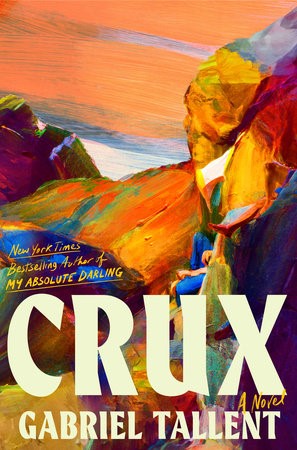
This context is important for understanding Crux, by Gabriel Tallent. The novel’s story appears to take place around 2010, just before climbing exponentially expanded in popularity, and Tallent takes a decidedly old-school approach to the culture. Crux follows Tamarisk (named for an invasive weed in the Mojave Desert and shortened to Tamma) and Dan as they navigate their last year of high school and think about their futures. They’re best friends but could not be more different: Dan is a model student reluctantly working toward a full ride to college who uses feminist theory to critique the renaming of rock climbs because of sexist or vulgar names (a real issue in the climbing world); Tamma is acerbic, vulgar, failing high school, and known to everyone as a future burnout destined never to make it out of town. Dan is prone to bouts of depression; Tamma maniacally flies through life at breakneck speed. While they both dream of taking off after high school to live the dirtbag climber lives of their heroes—Tamma is fully committed to this vision, while Dan is more reticent—their difficult family situations force them both to make hard decisions and to drift apart. Dan’s disappointed mother, a once rising literary star fallen to sickness and writer’s block, encourages him to seek material comforts instead of imaginative adventures. Tamma’s family (her mother, brother, and her mother’s creepy boyfriend) remind her regularly that she’ll never leave town nor amount to anything. Tamma uses climbing as a way to confront and work through these issues, while Dan uses it as a way to try and escape.
Ultimately, this is not a climbing novel (even Tallent admits that, as quoted in Climbing’s review of the novel), nor is it a novel about climbing or climbers—at least, not in a way that would be recognizable to the majority of serious climbers today. The climbing scenes, to be sure, are artfully represented and often capture something true about the experience, but they sensationalize the activity and emphasize the danger that most actual climbers are actively working to avoid. Unfortunately, this leads to a misrepresentation both of the sport and of the characters and implicitly urges the non-climbing reader to associate climbing with “adrenaline junkies” who are “infatuated with climbing because of its danger”—just as Bret Anthony Johnston does in his review of the novel for The New York Times. Very few climbers are in it for the risk, and even those who are tend not to be attracted to the danger itself. The goal is typically to control the moment, not to spike the adrenaline.
Tallent captures the way climbing becomes more than an activity or sport, becomes a choice for the kind of world a climber wants to live in and create.
Most climbers today begin their careers indoors on plastic; they come from more affluent backgrounds, live in urban areas, and would not have made the decisions Dan and Tamma make at the novel’s end. Dedicated climbers might also note other unrealistic elements in Crux. For example, early in the novel, the protagonists find blood at the base of a boulder and learn of a climber who died there. This is incredibly rare; the only story I know of a climber dying from bouldering happened because a boulder rolled onto them. What is more, Tallent’s characters rarely seem to be having fun; they climb for more desperate, personal reasons. While most real climbers do end up grappling with being too attached to the sport, the primary reason almost every climber I know and have ever met gets hooked is simply because it’s fun and playful.
None of this should be considered a hard criticism against the novel, which does get one thing about climbing right: in Crux, climbing becomes a way that the characters, especially Tamma, learn how to understand their own worlds. Tallent’s narrative is at its best when describing how the characters interpret their lives using the language of the sport: effort, projecting, exposure. During a discussion about life during prom, Tamma says to Dan, “It’s cruxes [the most physically difficult parts of a climb] that matter. The top is only a symbol, and without the crux, it refers to nothing.” Later, toward the novel’s end, she thinks to herself while beginning to spiral into anxiety, “Nope. It’s like you’re thirty feet above your bolt and trying to pull a hard move, now is not the time to start thinking bad things, and not because they’re not true, but because they’re not helpful.” Here, climbing becomes, to devotees, something special, something that makes sense of the world—not something that escapes it. Their experiences on the rock give them the language and therefore the ability to work through hard times. And this is what works best in the novel. In choosing to make his characters trad climbers with pointedly old-school dirtbag dreams, Tallent captures the way climbing becomes more than an activity or sport, becomes a choice for the kind of world a climber wants to live in and create.

