E. Y. Zhao, Underspin (Astra House), 304 pp. Hardback, $27.00.
It’s been a big year for table tennis. Josh Safdie’s Marty Supreme, starring Timothée Chalamet as a fictionalized version of real-life phenom Marty Reisman, has drawn far more attention to the sport than earlier films such as Forrest Gump (1994) and Balls of Fury (2007).
Back in August, E. Y. Zhao wrote a long article for Defector covering the World Table Tennis organization’s “Grand Smash” tournament here at the Orleans. Zhao, a nationally ranked player in her youth, noted that this was “the largest international table tennis event to take place in the United States,” though certainly not the first big tournament in Vegas. As is often the case with features on minor sports, the article points out that, while table tennis (don’t call it “Ping Pong”) is currently “considered a hobby and relegated to crumbs in the American sports pie,” it could be poised to explode in popularity, given the relatively untapped market of the United States. The domestic hero at the Orleans appeared to be 25-year-old Kanak Jha, a three-time Olympian from Northern California, who’s currently ranked the 28th best player in the world.
As suggested by a character in Underspin, Zhao’s debut novel about the sport, “Table tennis in America staggers along on the backs of immigrants and foreigners, ails in a system disorganized and laughably ill-funded.” The fictional story here focuses on Ryan Lo, an Asian American table tennis prodigy from Half Moon Bay. At the novel’s outset, we learn that Ryan has died young, in his mid-twenties, his rise to potential stardom cut short. And like the white opaque ball at the center of the sport, Ryan remains a cipher. Each succeeding chapter is narrated from the perspective of a different character (for example, self-deprecating umpire-in-training Kagin, or the pedantic “Herr Doktor Eckert”), allowing us to see Ryan only from others’ points of view. We follow him as a boy training at the local club, improving to a national ranking, joining an elite German professional league (the Bundesliga), and then dropping out and bumming around back in the States shortly before his death.
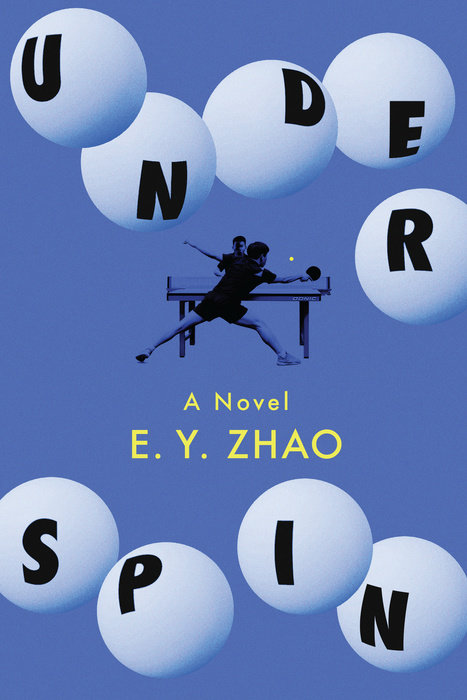
What is clear to nearly all the other characters is that Ryan has an unusual relationship with his coach, Kristian, a severe German ex-pro known for gruffness and discipline. Is Kristian’s mentorship the magic elixir that leads Ryan to international success? Or is it a poison that leads to his death? Or is it both?
Zhao’s choice to narrate each chapter from a different perspective results in a hit-or-miss style; the prose is sometimes compelling and sometimes clunky. As with a linked collection of short stories, some voices will resonate well with readers, and some will feel off. Zhao herself, who received an MFA from the University of Michigan in 2023, has said that each chapter is “some kind of homage to a different writer”—such as Mariana Enriquez, Kazuo Ishiguro, or Adam Johnson. And titles like Elizabeth Strout’s Olive Kitteridge (2008) and Jennifer Egan’s A Visit from the Goon Squad (2010) are models for the structure of Underspin.
This narrative variety ultimately makes sense for the featured story. Ryan Lo himself is a protagonist without much personality; he’s no Marty Supreme. By switching focalization to many other characters in the novel, Zhao offers a larger sense of the odd lifestyles and quirky communities associated with table tennis—“the most underrated sport in America,” according to a character based on Susan Sarandon’s ex-boyfriend (as per Tom LeClair’s review). These aren’t football or basketball stars. Being nationally ranked in table tennis might get you a cup of coffee in the United States—if you have a few bucks in your pocket.
Is Kristian’s mentorship the magic elixir that leads Ryan to international success? Or is it a poison that leads to his death?
The structure of Underspin suggests that it is a kind of mystery (perhaps a murder mystery), and, yes, significant details are revealed by the end of the book, displaying the ugly underside of the sport. But Ryan Lo is best understood not as a pitiable victim but rather as a tragic hero. One appealing passage follows him, when still a kid, escaping from his hotel at a tournament in Paris and running through the Louvre to get a good look at the Winged Victory of Samothrace. It makes sense: he’s a hotshot athlete, and this is a sublime incarnation of the winning spirit. But the irony, given our knowledge of his death, is that Ryan is less like Nike than like Icarus. His wings won’t take him far.
Zhao is especially good at conveying the enthusiasm evinced by the serious patrons of a marginalized sport, a milieu she knows well. “I was raised by a cast of coaches, peers, and senior citizens at the rec center, all of whom appear in Underspin,” she has remarked. The best players, the professionals in their mid-20s, are successful because they’ve continued to train with the same intensity that they had in their teens. But unlike millionaire football players, they’re nobodies—so their extended and enduring adolescence appears especially pitiful. The rest of the world won’t grant them the respect they seem to earn at the table.
Most of them eventually recognize these truths. One slowly realizes that he “might always be a loser.” Another observes that “the more potential you had, the more time you spent feeling bad.” At a key moment, a character acknowledges that the time to convert potential into actual success has passed, that it’s just too late—a “premature but somehow relieving lateness.” How odd to be washed up in one’s twenties, when even the best remain relatively unknown and don’t make much money.
That said, Underspin—like Marty Supreme—still manages to sell the sport to the less familiar. It’s exciting—Tomahawk serves, suspenseful rallies, victorious exclamations (Cho!—“the sport’s meaningless word of celebration”). Inspired locals looking to get involved can check out the Las Vegas Table Tennis Federation. And those itching to play—or simply to hear what Zhao calls “the relentless click of cellulose balls”—can head over to Lee’s Table Tennis Club (just south of the Orleans), run by former pro Emily Gong. Vegas doesn’t have any major tournaments in the near future, but all eyes will be glancing west toward Los Angeles for the 2028 Olympics, surely a big draw and an opportunity to grow the sport in the United States.
 Las Vegas Review of Books