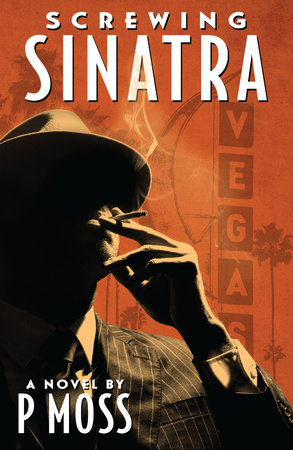
P Moss, Screwing Sinatra (IDW Publishing), 192 pp. Paperback, $15.99.
P Moss wastes no time throwing readers into the Rat Pack’s world of glamor, sleaze, and political ambition. His new novel, Screwing Sinatra, reimagines the glory days of mob-era Vegas and Kennedy’s Camelot as a chaotic collision of celebrity, fantasy, and opportunism. Readers don’t have to look much further than the novel’s opening pages—where Jackie walks in on Marilyn Monroe in bed with her husband in March of 1960—to see how gleefully Moss dismantles familiar myths. Instead of running out, turning a blind eye, and putting on a strong face for the campaign, Jackie forces Jack to sit there and watch as she does it the French way with the famous starlet. “Don’t you think you deserve to have sex with a Kennedy who can last longer than two minutes?” she says, while the future president goes soft at the sight of his wife’s confidence and style—“the mother of his daughter” and the gold standard of American housewives. This isn’t the Ladies’ Home Journal version of Jackie, and her one-upping of JFK sets the tone for Moss’s irreverent approach to historical crime fiction.
The novel’s edge comes from the author’s knowledge of noir and of Vegas during its mob heyday. A long-time Las Vegas local and owner of the Double Down Saloon and Frankie’s Tiki Room, Moss writes with the casual authority of someone who has absorbed the city’s history and channels it through a sharp sensibility. That sensibility extends to the novel’s tight, 182-page structure: its chapters rarely run longer than two or three pages, propelling the narrative forward without indulgence or excess. Likewise, Moss’s dialogue is direct and caustic: “‘Hello, Charlie. Even you couldn’t spoil this beautiful day,’ Frank beamed, then dimmed the wattage as he saw the uneasy look on Lawford’s face. ‘But you’re going to try, aren’t you?’”
In both narrative and dialogue, the novel relies less on immersion than on momentum, exploring Sinatra’s fascination—and later disillusionment—with politics and mob life. Within this compact structure, Moss breathes new life into the usual figures and familiar anecdotes of the early sixties by jumbling facts and recombining them into an outrageous mashup of history and fabrication that never fails to shock or entertain.
Moss’s blend of noir tropes and comic absurdity also shines in smaller scenes, such as when a mob middleman meets a shady photographer to buy back compromising photos of JFK—only to be dragged into a conversation about art-house cinema. “Only an idiot would have a casual conversation about an arthouse film during a blackmail payoff,” the narrator notes, as the photographer pitches Peeping Tom while dodging the actual purpose of the exchange. This dark comic vein runs through Screwing Sinatra, which races through its conspiracy-riddled, star-powered plot while discarding any reverence for the bygone glamor of the 1960s.
At its center, though, stands Sinatra himself, rendered as a larger-than-life personality with devilish charm and a knack for throwing the wildest parties in Vegas and Palm Springs. Before it all blows up in his face, the Sinatra of the novel’s first half delivers as the “king of midnight” who thrives on the “nonstop action of Las Vegas” and knows that wherever he hangs his hat, “his world never stopped spinning.” Even in scenes where he pays for sex, Moss treats him as a “wine-and-dine romantic” who lights cigarettes for sex workers, fills their glasses with champagne, and prefers “an honest working girl to a conniving starlet.” These small details reveal Sinatra’s relationships with women and working people while foreshadowing his uneasy relationship with fame and glamor—the very allure the Kennedy family seeks to harness for political gain. “Presidents were admired by half the country while movie stars were beloved around the globe,” Moss writes, linking Jack Kennedy’s aspirations to the media-savvy strategy behind his campaign.
For readers eager to see how Moss dramatizes the apocryphal intersection of collusion between Sinatra, the Kennedys, and the Chicago Outfit under Sam Giancana, the plot covers familiar territory without sinking into cliché. Sinatra buys into what the Kennedys are selling and spends the novel’s first half working to secure Jack’s election with mob backing—on the promise that a Kennedy administration will ease federal pressure on organized crime. But the second half explores the deep contradictions between JFK’s Camelot image and the Hollywood-style excess surrounding him, contradictions that lead to a public split and leave Sinatra holding the bag. “You can’t be seen cavorting with that womanizing son of a bitch,” Bobby tells his brother. And while Bobby knows full well that his brother is no different than Frank, he insists that what matters is the company one keeps, both in public and in private.
The novel relies less on immersion than on momentum, exploring Sinatra’s fascination—and later disillusionment—with politics and mob life.
Compact and punchy as it is, the novel leans into a theme that resonates well beyond the Rat Pack era: Sinatra is, like anyone else, susceptible to hopeful rhetoric and the easy promises of a better future that sounds too good to be true. “Nobody screws Frank Sinatra!” he yells at Bobby Kennedy when he’s pressured to double-cross the Outfit. But his predicament is one of his own making—and one born of his own legend. Sinatra wanted to play gangster and political fixer but found himself screwed by both the Mafia and the Kennedys.
This fall from grace allows Moss to portray Sinatra as both a relic of an earlier era and a surprisingly vulnerable, even tragic, figure. The novel revels in a recognizable Sinatra: a womanizing, hot-tempered showman whose bluster and late-night excess make him an amusing period artifact and a swaggering remnant of pre-#MeToo masculinity. But Moss also lets the cracks show.
Rather than rehabilitate him or double down on his excesses, Moss depicts a Sinatra capable of self-knowledge once the walls close in and his optimism about Kennedy collapses. Through a figure as famous and mythic as Sinatra, Moss suggests that even the most incorrigible characters can stumble toward a measure of moral clarity—not the sort that solves everything but the hard-earned clarity rarely found in genre fiction about legendary figures. By the novel’s coda, set in the 1970s, when another Hollywood presidential hopeful seeks his endorsement, Sinatra has changed: he finally sees the cost of believing too deeply in his own act. Even icons, Moss shows, are capable of change once they recognize the limits of the stories they tell about themselves.
Before that realization, however, Sinatra must endure the full consequences of his political miscalculation, which take up the second act of the novel. “Do yourself a favor and put whatever is troubling you in the rearview mirror and go back to enjoying life as Frank Sinatra,” Dean Martin tells him at his daughter’s wedding reception. But Sinatra has sunk in too deep with the wrong crowd to return to being the carefree pop icon who once palled around with him. By the end, he goes through hell and back not because of a life of excess but because of his misplaced optimism—his belief that politicians offered something better based on their word. And while the novel takes a wild, unexpected turn with Moss’s own explanation for Kennedy’s assassination, the event leads to genuine growth as Sinatra makes peace with his attempts to shape history. Readers are left with the sense that talk is cheap, and even stars like Sinatra aren’t immune to the disappointments that come with hope—a lesson he pays to learn.
One line resonates after the novel’s end, spoken by George, Sinatra’s trusted Black valet, who tempers his employer’s sky-high expectations for the Kennedy years: “It’s obvious that if there is ever to be racial equality in this country, it will have to happen through activism and protests. Because there will never be anything other than lip service from the Oval Office, no matter who is sitting behind the desk.” In Moss’s telling of Sinatra’s rise, fall, and rise again, readers are cautioned against placing too much faith in politicians and celebrities. Screwing Sinatra takes one of the twentieth century’s most scandalous, enduring myths—the 1960 election and its entanglement of politicians, the mob, and Hollywood—and finds reasons to remain skeptical (though not hopeless) about the promise of easy fixes.
 Las Vegas Review of Books