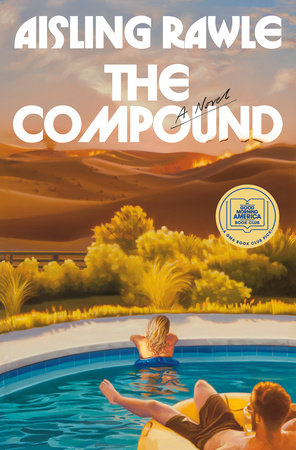
Aisling Rawle, The Compound (Random House, June 24), 304 pp. Hardback, $29.00.
As Lily, the narrator-protagonist of The Compound, and her new housemates get to know each other on the nation’s hottest reality television show, bad behavior erupts quickly. One evening, as Lily sits in the backyard, she senses movement behind her and hears a small voice cry, “Don’t look!”
She turns to look, of course, and sees her new roommate Susie squatting on the pavement near the pool: “It was cold, as it always was at night in the desert, and there was steam rising from below her. Susie was shitting on the concrete. It must have been for a Personal Task, but it didn’t make it any easier to see.”
This is a rare moment of scatological excess in Aisling Rawle’s debut novel, but it cuts to the heart of the medium in which Lily exists. On The Compound (clearly inspired by Big Brother), contestants live full-time in this house in the desert with its ample yard. They may be voted out, or they may choose to leave, but they cannot have contact with the outside world while they stay in the compound. The last to remain wins—and, oddly enough, the grand prize is permission to keep living there indefinitely (if one so chooses).
At first, conditions in the compound are bare bones, but—as Susie’s poolside defecation indicates—contestants may receive limited instructions from the show’s producers that allow them to complete “Personal Tasks” in exchange for small items, ranging from snacks to jewelry. These tasks, it would seem, are largely designed to heighten the drama, intensity, and spectacle of the compound for viewers. Small cameras are purportedly everywhere, though the contestants never find them. And daily Communal Tasks keep the action moving in this socially engineered voyeur-dome.
The most controversial element of this immersive game show would seem to be the stipulation that contestants sleep with—though not necessarily have sex with—each other.
The most controversial element of this immersive game show would seem to be the stipulation that contestants sleep with—though not necessarily have sex with—each other. The show begins with twenty contestants—ten young men and ten young women. But there are only ten beds in one large bedroom. Each night, a bed must be shared by one man and one woman; anyone found sleeping alone at dawn will be eliminated from the competition.
This rule gives The Compound a PG-13 aura that initially plays to its advantage. Some characters are certainly having sex, but the notion that these are merely sleeping arrangements in a televised game contribute to the effect that this is a merely a staged co-ed sleepover. Young people are forced into awkward encounters. The bathroom, for example, doesn’t have a door.
But more disturbing is the novel’s overall setting. What sort of world these characters inhabit is never entirely clear. Lily’s narration never strays beyond her immediate surroundings and situation in the compound. She eventually reveals that she had been selling makeup in a department store, but contestants are at first forbidden and later unwilling to discuss their personal lives outside the show. We learn that “the wars” are going on and that people wear masks in the cities, and we know that the compound itself is in a desert with nothing nearby. But all other details are murky. The novel seems to take place in a near-future when geopolitical relations have taken a turn for the worse.
These external threats gradually infect the supposedly safe haven of the compound. The television producers—never seen—can remove food and water, effectively forcing the group to complete a task. And while the showrunners will, the contestants believe, never let someone die or become severely injured, they won’t prevent small acts of violence; in fact, they might promote such things for the ratings.
The Compound’s biggest weakness is also perhaps its peculiar strength. As a narrator, Lily is quite limited. She is a passive character with little interiority; we learn almost nothing about her past. She repeatedly informs us that she’s a physically attractive young women with little intellect: “Within minutes of speaking to the girls, I knew that I was one of the most beautiful, and one of the least interesting.” As readers, we’re stuck rooting for her to win (it wouldn’t make sense if she were eliminated early on), but her outlook seems depressingly similar to what is encouraged by this hellish TV show. Rawle’s novel would seem to be satirizing the kind of greed and prurience that would support manipulating or even torturing people for televised entertainment, but the narrative’s tight focus purely within the compound itself contributes to a vapidity that simply mirrors what might be critiqued. When Lily develops a relationship with a fellow contestant and starts making out with him, all she can think about is if she looks good on the invisible cameras doubtless recording her. Are we supposed to sympathize? Is this an extended metaphor for the Big Brother of modern techno-surveillance?
This claustrophobic restriction of the narrative to what occurs inside the compound does, however, add a curiously interesting layer to the story. Much of the novel can seem like a pitch for its own screen adaptation; it’s not hard to see how a book about a television show could itself easily become a television show. But the narrative insistence on Lily’s interior perspective, limited though it may be, keeps the text operating in the more intimate space of the novel. A movie version, for example, would probably be pressured to reveal the producers—to create a character like Ed Harris’s Christof in The Truman Show. A multi-episode streaming series based on The Compound would probably focus more on other contestants. But Rawle’s novel keeps us with Lily. In the end, we can never really see her as a television viewer might.
 Las Vegas Review of Books