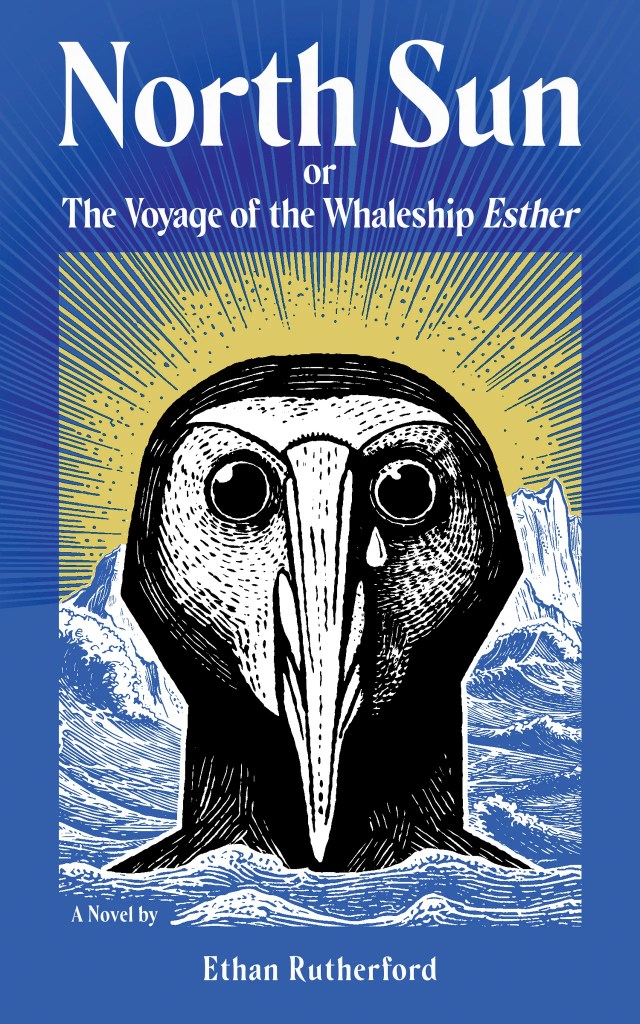
Ethan Rutherford, North Sun; or, The Voyage of the Whaleship Esther (Deep Vellum), 396 pp. Paperback, $17.95.
Moby-Dick was published in 1851 at the very pinnacle of the American whaling industry. By the end of that decade, the first commercial oil well had been drilled in Pennsylvania, setting off a petroleum production rush that would spell doom for the owners of whaling ships. Sperm oil was soon replaced by kerosene as the fuel of choice for domestic lighting.
Herman Melville seemed to be aware that he was writing in a moment when a heroic vocation was about to be eclipsed by the forces of modernity. In fact, while the capital of American whaling was the Massachusetts port of New Bedford, Melville chose to have his Pequod sail forth from the smaller port of Nantucket, which had been the whaling center earlier in the century but was on the decline by 1850. (Nantucket has been devastated by a fire in 1846, and New Bedford’s deeper harbor accommodated larger whaling ships.) Ishmael wants a “quaint craft,” and finds in the Pequod “a ship of the old school, rather small.” It’s an old school novel, in other words—one that most readers didn’t appreciate for another seventy years.
Ethan Rutherford’s debut novel, North Sun, subtitled The Voyage of the Whaleship Esther, taps into this same sense of historical eclipse. It begins in New Bedford in the year 1878, when the American whaling industry is certainly past its prime. Petroleum was outstripping whale oil in value, and overhunting had made prey harder to find. Ships were routinely venturing into the farthest corners of the globe; in the whaling disaster of 1871, dozens of American whalers were caught in polar ice and abandoned in the Arctic—a crippling blow to the industry.
“These are dim days for the leviathan merchants,” notes Rutherford’s narrator. Nevertheless, whaling had made fortunes for some nineteenth-century magnates. At the outset of North Sun, Captain Arnold Lovejoy walks up the narrow streets of New Bedford toward the mansion of the incredibly prosperous and powerful Ashley family. Lovejoy, in contrast, is a failure; his last three-year venture returned, cold and wet, with a small fraction of the expected haul, a bad turn for the owners. Ashley wants to give Lovejoy a second chance—but with a different kind of mission. As commander of the Esther, Lovejoy will be tasked not only with securing whale oil but also—more importantly—with finding an errant sea captain. Benjamin Leander, husband to Ashley’s daughter, seems to have gone mad in the Arctic, abandoning his ship to the ice and running off to join an indigenous community. With the help of a mysterious family friend named Edmund Thule, Lovejoy must hunt down Leander.
North Sun thus evokes several well-known nineteenth-century nautical novels, adding Edgar Allan Poe’s The Narrative of Arthur Gordon Pym (1838) and Joseph Conrad’s Heart of Darkness (1899) to Melville’s Moby-Dick. Its events are rooted in a particular time, 1878–1880, but its elements are romantic and fantastic; as Rutherford states in an “Author’s Note,” the Esther’s adventure is a “dream voyage.” This is most apparent through the appearance of “Old Sorrel,” a giant invisible birdman who can only be seen by the two cabin boys on the ship. Old Sorrel may be the Devil (Old Scratch?), or an angel, or a wizard from another dimension. Whatever he is, he’s not human.
Rutherford is at his best when, like Melville before him, he channels the feeling that a legendary epoch is about to give way to a bleak and depressing future.
Rutherford is at his best when, like Melville before him, he channels the feeling that a legendary epoch is about to give way to a bleak and depressing future. He is writing not of the peak but of the end of an era for American whaling: “Petroleum is cheap as nuts, and its quick extraction has begun calling forth a new age. The railway has connected the oceans, and folds time itself.” Part of the problem, of course, which we can see from our twenty-first-century vantage point, is climate change. The ice-filled world of the Arctic in the 1870s is destined to become relatively iceless. “There is a direct line from what happens now to a world that will never be fully seen: this ice, gone; these ships, gone,” says Old Sorrel. It won’t be long until real polar adventures seem like pure fantasies.
Oscar Dorr captures this aspect of Rutherford’s novel in his review of North Sun for The Baffler. “For the brief period when the American whaling industry overlapped with modern industrial society, this strange and beautiful juxtaposition wove the spirit of great mythological beasts into the fabric of global capitalism, creating a shaky balance between the forces of human endeavor and those of indomitable nature,” Dorr writes. Human beings with simple spears actually used to venture out across the globe and kill sea monsters—the largest animals on the planet—to obtain fuel for lamps. Rutherford taps into such wonder—the sense that such actions couldn’t possibly seem realistic to readers of a later generation.
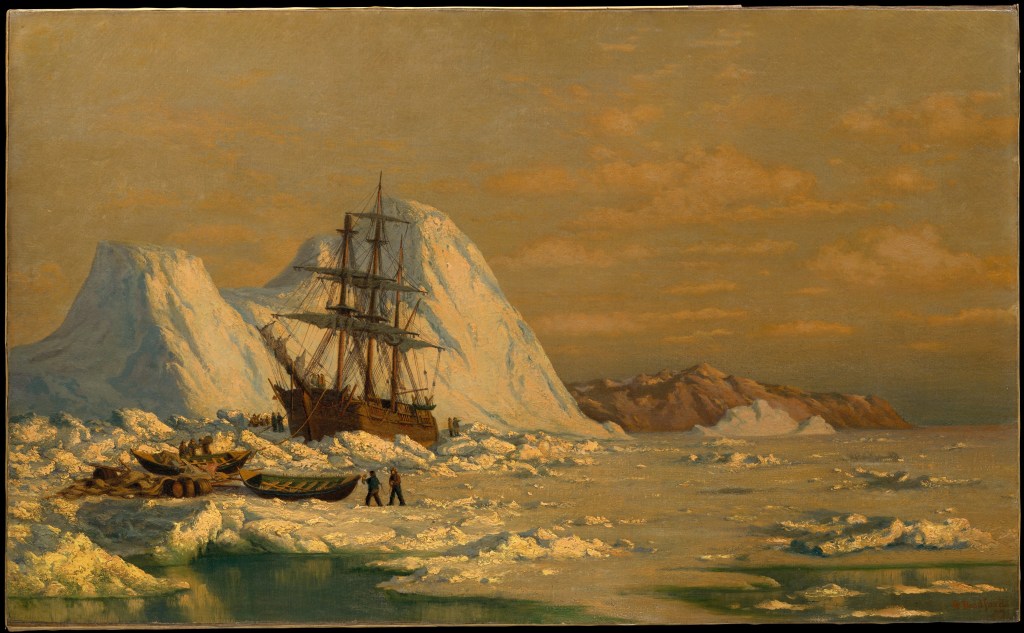
This is also, however, the weakness of the novel. North Sun begins with just the right amount of historical accuracy and weird fantasy. Supernatural malice hovers over the Esther, but the short chapters and sections (creating quite a bit of white space on every page, fitting for an Arctic adventure) keep the business of the whaling ship moving forward. But when the sailors pass through the Bering Strait and enter the icy Chukchi Sea, the supernatural elements become both more explicit and less intelligible; to the extent that there is mystery here, it is never really illuminated. It is as if the Esther has entered another world entirely. “The ice renders time and distance meaningless,” and experience can no longer be distinguished from hallucination.
More compelling than the weird magic is the brutal violence. The butchery of whales and walruses, far more than can be of use, speaks to the wanton disregard of ecological balance that contributed to the decline of the whaling industry. “Such a slaughterous age,” observes a character early in the book. Violence begets violence. The prospects become as empty as the horizon.
 Las Vegas Review of Books