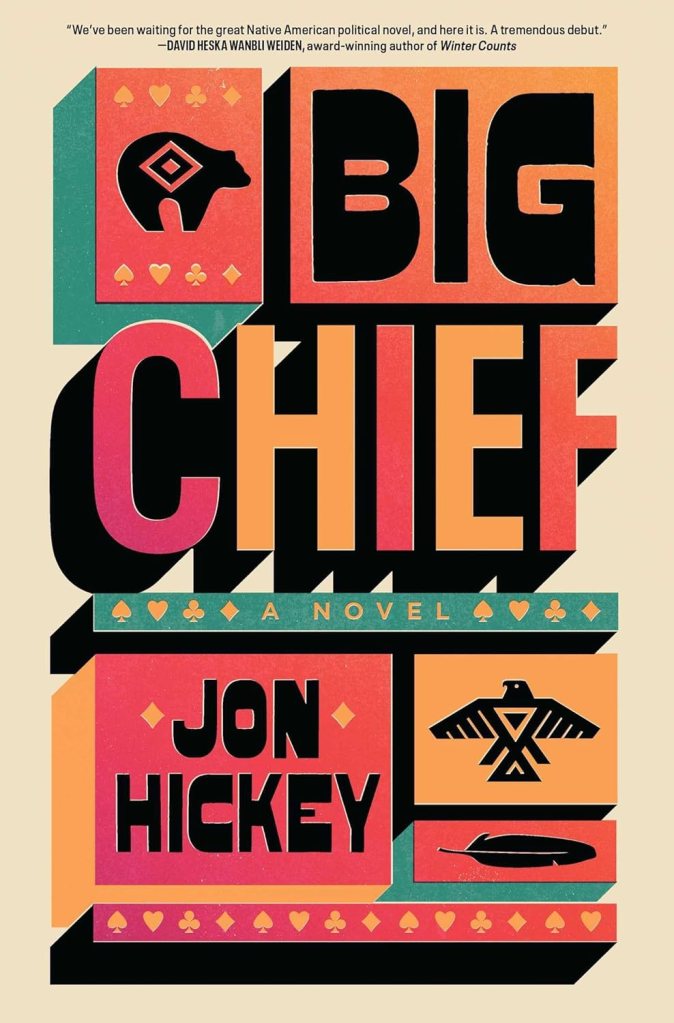
Jon Hickey, Big Chief (Simon & Schuster), 320 pp. Hardback, $28.99.
While many people instantly flash to Las Vegas when imagining legalized gambling, casinos also hold a stake in another universe: Indian reservations. In Jon Hickey’s riveting debut, Big Chief, the casino isn’t just a place; it’s a living metaphor—a ledger of generational loss and aspiration, a revolving door of economic salvation and moral compromise. It’s also the closest thing to a church on the fictional Passage Rouge Reservation, where chips circulate like prayers and justice is always rigged by the house. Narrated by Mitch, a law school grad turned casino executive, Big Chief moves through the smoke and surveillance of Indigenous capitalism with wit, grief, and razor-sharp clarity.
At its heart, this novel is about the cost of double vision. Like Viet Thanh Nguyen’s The Sympathizer, Hickey’s Big Chief explores what happens to a man split between worlds—between tradition and modernity, justice and expedience, survival and betrayal. Mitch is that man. A tribal member with a law degree and a gambler’s instinct, he has returned to the reservation not to practice law but to operate in the gray zone between tribal governance and corporate gaming. As Christopher Sorrentino notes in his review for The New York Times, Mitch is “part chief of staff, part campaign director and part hatchet man,” a figure who “operates in the background, ambivalently overseeing ‘the quiet, permanent tragedy of Passage Rouge,’ a community of 5,000 stricken by poverty, addiction, inadequate housing, corruption and police brutality.” He’s fluent in legalese, casino finance, and rez gossip—but his trilingualism carries more burdens than blessings.
In Hickey’s hands, corruption is not just political—it’s metaphysical.
Hickey renders Mitch’s voice with precision: part confession, part indictment. It echoes the narrative candor of Junot Díaz while resonating more deeply with the emotional topographies of writers like Tommy Orange and Morgan Talty. Mitch is neither a hero nor an antihero; he is haunted—by the institutions he once believed in, by the brother he lost, by the lives he can’t stop failing. Hickey’s refusal to flatten or redeem him is what makes the novel sing.
What distinguishes Big Chief is not just its critique of tribal casino politics but its unflinching examination of the psychic toll exacted by compromised systems. Mitch’s formal training in law makes him fluent in the language of sovereignty, but the deeper he ventures into backroom deals and budget hearings, the more he sees how that sovereignty is continually undermined by economic dependency, settler regulation, and internal corruption. The law doesn’t protect his people; it constrains them.
And yet, Hickey never resorts to moralism. He maps contradiction with care. The casino is both lifeline and liability. It funds schools, elder care, infrastructure—but it also invites profiteering, surveillance, and instability. Mitch and his peers must grapple with impossible questions: Can corruption be a form of care? Can compromise serve collective survival?
These tensions come to a head in Mitch’s fraught relationship with Mack, a charismatic councilman whose ambitions are cloaked in the rhetoric of prosperity. Mack isn’t a villain; he’s a mirror. He knows how to manipulate both the casino’s rules and the colonial system that looms above it. Hickey uses their dynamic to pose a devastating question: what happens when the pursuit of self-determination begins to resemble the very systems that once oppressed you?
The novel roots these political tensions in deeply personal relationships. Mitch’s mother represents a cultural inheritance he both reveres and rejects. Layla, his cousin and a passionate activist, challenges his every move with unswerving conviction. And the memory of Mitch’s deceased brother lingers like smoke over every decision. These relationships are not neat; they are shaped by love, estrangement, and ideological divergence. Layla, especially, is not just a foil to Mitch’s pragmatism—she embodies the novel’s most urgent question: what does loyalty look like when the system fails everyone?
The ethical heart of the novel centers on a dilemma: is corruption ever justifiable if it leads to greater tribal independence? Hickey refuses easy answers. The corruption on Passage Rouge is not cartoonish—it’s insidious. Mitch doesn’t set out to “break bad.” He cuts corners, rationalizes, looks the other way. The novel suggests that corruption doesn’t begin with greed—it begins with exhaustion. The cumulative weight of jurisdictional overreach, intergenerational trauma, and settler bureaucracy makes compromise feel like a cure-all. The more Mitch rationalizes, the more he erodes his own sense of self. In Hickey’s hands, corruption is not just political—it’s metaphysical. This slow erosion is what makes Big Chief such a powerful tragedy—not a fall from grace but the dawning realization that grace may have been a myth all along.
An environmental subplot adds yet another layer to the novel’s moral complexity. Mitch is tasked with drafting legal frameworks for land development, while Layla fights to preserve sacred wildlife habitats and Mack pushes for full-scale expansion. The land, like the people, is caught between profit and preservation. Symbolism and foreshadowing deepen these stakes: deer that linger too long at the roadside, glitching security cameras, broken elevators. The landscape feels sentient, as if the land itself is watching.
Hickey’s symbolic lexicon is rich but never overbearing. The titular “Big Chief” is not just a ceremonial figure but a spectral presence—a recurring dream, an ancestral echo, a warning. The pacing is tight, the dialogue sharp, but it’s the still moments—when Mitch remembers his brother’s laugh or listens to Layla’s quiet fury—that truly devastate. Hickey uses flashback not as ornament but as revelation. Each memory unlocks another angle of Mitch’s present, layering the reader’s understanding of the past into every choice he makes.
By the novel’s end, Mitch is no longer the man who believed he could outwit the system. He’s wearier, more clear-eyed. His arc is not one of redemption but one of reckoning. When the final political crisis explodes, Hickey renders it with tragic inevitability. And yet, even in collapse, the novel finds something resilient. Not a solution but a clarity.
Big Chief is a remarkable debut—gritty, gorgeously written, politically astute, and emotionally resonant. It belongs on the shelf alongside There There, The Sympathizer, and Night of the Living Rez. It’s a novel for readers who want to be challenged, not comforted—for those who know that sovereignty is not abstract but lived. Survival, too, comes at a cost.
In Big Chief, the house always wins. But sometimes, telling the story—this clearly, this bravely—is a way of breaking the game.
 Las Vegas Review of Books