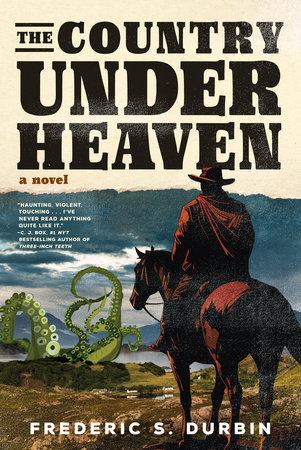
Frederic S. Durbin, The Country Under Heaven (Melville House), 336 pp. Paperback, $19.99.
The Weird Western, particularly in film and TV, draws a cult audience. A movie like S. Craig Zahler’s Bone Tomahawk (2015), despite minimal box-office receipts, continues to grow in popularity since its release ten years ago. Today, sadly, literary agents and publishers try to persuade young writers that the Weird Western is an unpopular genre and not worth writing, even though Blood Meridian (1985) remains a perpetual favorite of budding novelists. Cormac McCarthy’s masterpiece is, after all, the weirdest of Weird Westerns, a literary horror saga that refuses to compromise on any level, including the use of punctuation. The book’s antagonist, supernatural Judge Holden, is a Captain Ahab of the desert, cruel and cunning and eager to engage in extravagant mutilation and wholesale murder. Such a villain makes sense in the confines of the Weird Western, where historical revisionism and surreal violence lie comfortably together in a cliché-ridden bed of frontier adventure and manifest destiny. Weird Western writers honor the rule that sometimes distortion must be employed to reach beyond the Western myth to arrive at what we used to call the truth. Supernaturalism provides the distortion, which mainstream Western readers, God bless them, dislike. Hence, the Weird Western is inherently deconstructive. Still, despite commercial limits and bad advice, young novelists keep writing Weird Westerns because they offer abysses into which haunted characters might stare and fall. It is, in other words, an irresistible genre.
Neither young nor especially old, Frederic S. Durbin has published several fantasy books, giving him the confidence necessary to attempt a “Louis L’Amour meets H.P. Lovecraft” epic Western, The Country Under Heaven. It’s an entertaining read, largely due to the protagonist, Ovid Vesper, a Union veteran of the Civil War. After surviving Antietam, Ovid suffers eerie visions that foreshadow and provide second sight into his battles against spectral forces. Along the way, he reunites with and meets for the first time interesting characters pitted against paranormalities. If this sounds like the formula for a pulp adventure hero ripped from the pages of the early twentieth-century magazine boom in the U.S. (Weird Tales, Unknown), that’s because Durbin indeed mines the format of serialized pulp. Lacking an overarching plot, Under Heaven nevertheless offers a vivid portrait of haunted Ovid in the Weird West.
In the opening chapter, “The Fresh Air Above,” Ovid heads West for reasons he can’t articulate: “Looking for what, I didn’t precisely know.” More than a decade after the war, he stops to visit his former Union commander John Clement on his Missouri farm. Poor Clement has suffered a tragedy, his daughter murdered as she fished along a nearby creek. The killer remains unpunished. Ovid plans to stay a week, but an attraction sets up at the intersection of a few farmsteads outside the nearest town. A traveling mystic, Doctor Bellerophon Cinch (Durbin’s character names are always fun) uses a “Fate Machine” to translate messages from beyond. After a hokey onstage magnesium flash, Cinch plays his seer role to the hilt until his machine gets the upper hand. Ovid alone recognizes that the performer isn’t in control. Soon, Clement’s wife plops down fifty cents for an answer to the mystery of her daughter’s death. Sweating bullets and pulled toward the contraption, Cinch spools a sheet of paper into place and begins clacking the keys. What is revealed rips the community apart and nearly gets Ovid and Clement killed, if not for the interference of a phantasmic entity.
Durbin builds every chapter around a set piece, a visually powerful moment that pushes Ovid deeper into the enigma of his ability to see visions. In the next chapter, “The Hungry Hills,” Ovid rides cattle across Texas with a trail boss he admires. Ovid helps his fellow cowboys evade and eventually clash with otherworldly killers through his precognition skills. In the book’s interludes, we learn about an interdimensional monster that has tracked Ovid since the war, which he calls the Craither (based on craythur, an Irish variant of creature). Ovid first sighted it while fetching water to boil the day after President Lincoln’s visit to Antietam. Years go by without Ovid seeing it again, and Under Heaven weaves the Craither’s appearances as a way to hang the novel’s chapters together. For the most part, it works, suggesting Durbin, in addition to paying tribute to old pulp adventures featuring a recurring character, is also aiming for an episodic streaming series.
The Country Under Heaven serves as a tintype snapshot of a war-ravaged nation haunted by ghosts of brother-on-brother bloodshed.
Overall, Ovid is an intriguing if unknowable character. A bit passive, he’s an empathic observer, not a knuckle-dragging gladiator—a curious chronicler rather than an intellectual sleuth. His voice is poetic but not purple. The violence he describes is mild, never nearing the pitch of Blood Meridian. (Like McCarthy, though, Durbin discards quotation marks in dialogue.) Ovid doesn’t yearn for anything specific or bright. Instead, he travels the country like a wandering gunfighter minus the samurai status. Midway through the book, in Kansas, we meet the widow Nancy Mavornen, Ovid’s love interest. We learn about a rash of cattle killings on the prairie, done by invisible, sinister agents. In a saloon, Ovid converses with a fellow scryer named Ezekiel Smith, who has learned to ride, with ship-worthy sails attached to his wagon, powerful storm winds in the area and journey into unseen worlds. Driving his “windwagon,” Smith has seen the slicers responsible for the animal mutilations. Ovid joins him; the cost is tremendous, if predictable. However, in this and other chapters, the fantasy element is delicious, making the book a fun read, even if Ovid might benefit from a dash of Zorro-grade energy.
Moreover, his connection to the natural world is alluring and lyrical, as when he reaches the Grand Canyon on his horse, Jack:
At the end of a long, dry day of riding, with Jack and me having to tote any water we fancied drinking, we had the reward of that sight: the canyon in the evening effulgence, the rainbows of those rocky walls and towers, one of the world’s most magnificent artworks, wrought by God’s chisels and paintbrushes, made from a river and a long, long time. In the light reflected from it all, the cares of life settled into their proper perspectives. If I were about to die, I would not regret moving on. I’d lived deep and full, and I’d be going at last to that better place.
Under Heaven serves as a tintype snapshot of a war-ravaged nation, haunted by ghosts of brother-on-brother bloodshed, compounded by an ongoing war against indigenous people and by the ramping up of industrialization on the cusp of the twentieth century. Indeed, a core quality of the Weird Western is its underscoring of the nightmarish transition between the Civil War and World War I—highlighting the menacing leap from wilderness to civilization, from the human to the inhuman. Ovid is an ideal guide through this devastating metamorphosis, and Durbin’s novel stands as a darkly fun trip through the moral gloam of nineteenth-century America.
 Las Vegas Review of Books