Donald E. Westlake, Lemons Never Lie (Hard Case Crime), 224 pp. Paperback, $16.99.
As the spine of Donald Westlake’s paperback thriller Lemons Never Lie indicates, the publisher, Hard Case Crime, is celebrating twenty years in the business; their first book, a reprint of Lawrence Block’s 1961 novel Grifter’s Game, appeared in September 2004. Since then, the imprint has put out nearly two hundred titles in the hardboiled crime fiction category.
Some of the works in the series are new editions of the long out-of-print midcentury paperbacks that made the publisher’s founder, Charles Ardai, fall in love with the genre. And some are new original works—the most lucrative being those written by Stephen King for the series, such as The Colorado Kid (2005).

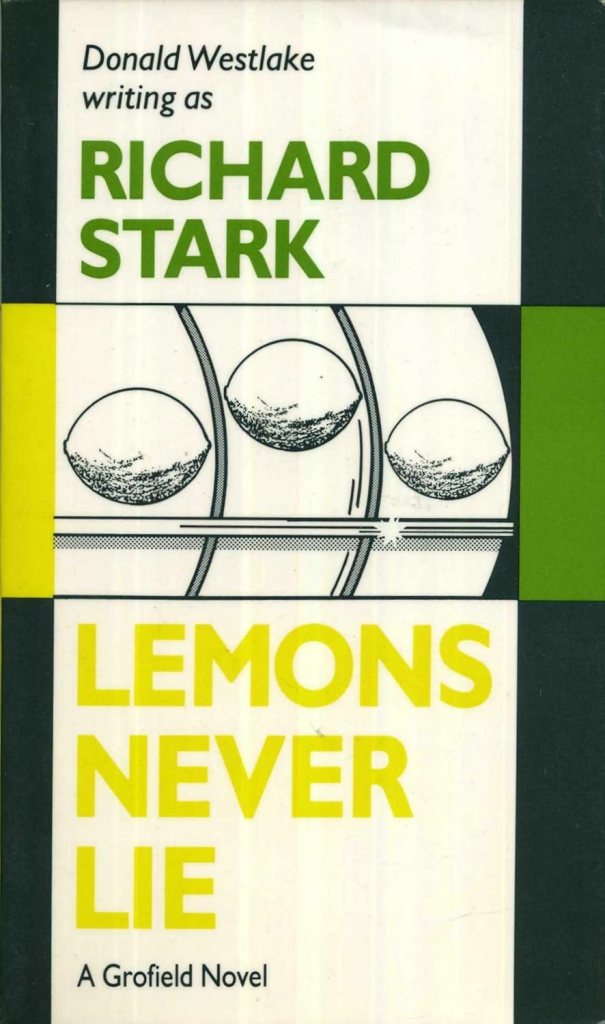
Hard Case Crime has republished about a dozen books by Donald E. Westlake (1933–2008), a prolific author who wrote popular mysteries and crime capers under the pen name Richard Stark. Lemons Never Lie was originally attributed to Stark in 1971, and it has remained one of Westlake’s more popular titles. The Vermont-based Countryman Press put out an edition in 1990, and the University of Chicago Press, which has been doing a Westlake run, released its own ebook version in 2012. Hard Case Crime actually published Lemons Never Lie in 2006; it is now putting it back into circulation with a new cover by Utahn illustrator Paul Mann.
Writing as Stark, Westlake is perhaps best known for his Parker series, named after the violent, ruthless thief who serves as its ant-hero. Through this series, Westlake then introduced a character named Alan Grofield, who in turn enjoyed a mini-series of his own, of which Lemons Never Lie is the fourth and final title. Grofield is a career criminal with a serious artistic bent. An actor with Shakespearean chops, he and his wife run a summer-stock theater in Indiana. But the revenue is weak, so he props up his productions with professional thievery, taking the occasional weekend jaunt for some grand larceny.
Of course, sometimes, when a big score isn’t possible, he’ll drive down into Kentucky and pass some bad checks, an operation that requires “an actor’s talents and methods.” But Grofield, it turns out, is a purist who would prefer not to sully his art. Instead, he tries to keep his two worlds separate; as a criminal, he is no con man but rather a “heavy heister.”
Westlake’s style is straightforward and terse—the snub-nosed sentences one expects for the hardboiled genre.
Lemons Never Lie begins with the prospect of such a heavy heist, as Grofield flies into Las Vegas for a possible job. Superstitiously putting a nickel into a slot machine at the gate when he gets off the airplane, he pulls a bad omen: lemon, lemon, lemon. He won’t even take the 70¢ payout. His worries are confirmed when the proposed robbery turns out to be a dud, a much-too-violent plan hatched by an unprofessional sociopath. Grofield walks away from it—or at least he tries to.
This novel has two things going for it, elements which allow it to remain captivating for a twenty-first-century reader. First, the action sequence is a little odd, a bit more complicated than that of the typical genre title. As Westlake himself later remarked, “What pleases me most about Lemons Never Lie is that it was the only time I can think of where I invented a plot structure. That structure, which is not an arc but three bounces, each one higher, was new, I believe.” While not exactly revolutionary, the plot does keep Grofield on the move from one location to the next, and it shifts his character’s motivation. The novel essentially begins as a heist narrative, with a compelling account of a grocery store robbery outside of St. Louis. But it ends as a personal revenge story much more in the mode of a western. In short, it keeps the reader’s attention.
The other appealing element is Grofield himself, a theatrical thief who peruses a biography of eighteenth-century celebrity actor David Garrick while waiting for a phone call about a crime. While he may prefer to consider his acting apart from his stealing, the reader understands that they go hand in hand. As Margo Martindale has revealed, she and Wayne Knight briefly worked as private investigators in 1984 (when they were trying to make a living in the theatre). The firm liked to hire actors because they could get on the phone and convincingly pretend to be other characters in order to extract information from people. Something like this is going on with Grofield, who often has to be careful when communicating through public telephone lines; his acting skills allow him to switch into character, as it were, to avoid tipping off the authorities. “The circumlocutions were a pain in the ass sometimes,” Grofield thinks, “but with bugging rivaling solitaire as the nation’s favorite indoor one-man sport it was necessary never to be very precise about what you wanted to say.”
This is what’s especially cool about Lemons Never Lie. Westlake’s writing is straightforward and terse—the snub-nosed sentences one expects for the hardboiled genre. It is never florid or digressive (except when describing firearms—then, clearly, a tender spot has been touched, and the text can suddenly resemble a consumer report, carefully weighing the differences between the Ruger .357 Blackhawk, with its solid weight and heft, or the Colt Trooper with a six-inch barrel). The violence is bluntly delivered, as when one man uses a knife and a pitchfork to make another man “leak to death.” But Westlake’s punchy prose is balanced by Grofield’s professional need to be vague and circumlocutious. As the struggling actor well knows, it’s not always easy to turn lemons into lemonade.
 Las Vegas Review of Books