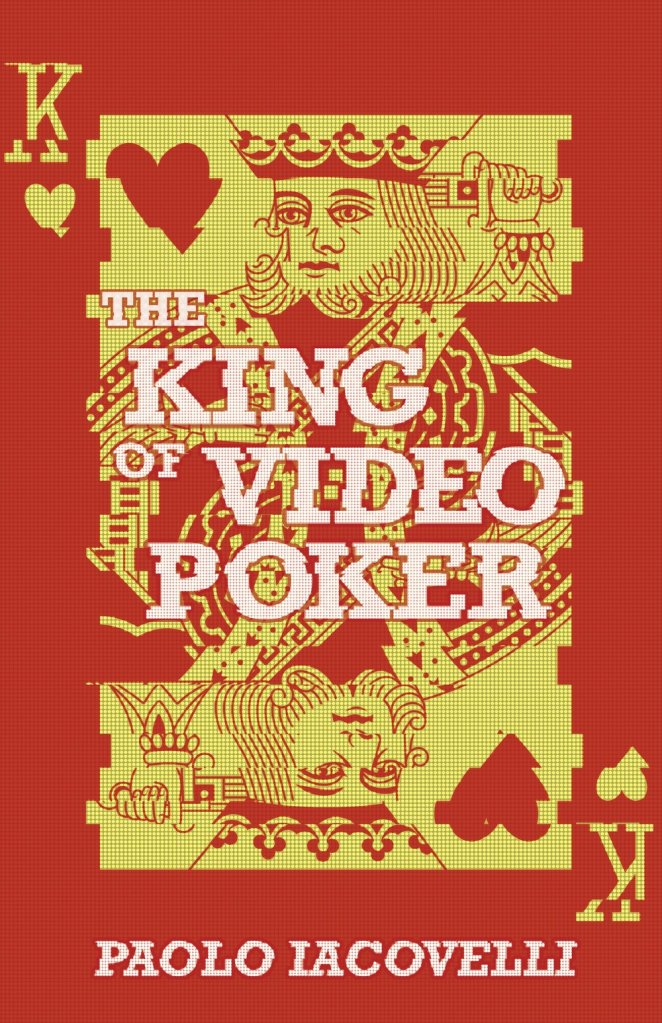
Paolo Iacovelli, The King of Video Poker (Clash Books), 186 pp. Paperback, $16.95.
The nameless narrator-protagonist of Paolo Iacovelli’s debut novel, The King of Video Poker, introduces himself as “a middle-aged white man who travels an hour and a half from Mesquite to Las Vegas five times a week to play high-stakes video poker and hasn’t won in fourteen days.” He also begins his narrative on a specific date, September 25, 2016, the day that Arnold Palmer died.
Is he a rabid golf fan? No, he doesn’t seem to care much about sports, but once when he was a boy his father pointed out Arnold Palmer to him at a country club and said, “That’s the King!” This obviously made an impression on the narrator, who is moved to tears when he learns of Palmer’s death. It also quickly becomes clear that the memory has more to do with his troubled relationship with his father, and of his own strained relationship with his teenage son, Tim, than it does with the game of golf.
The narrator’s game is video poker, upon which he regularly wages thousands of dollars. Perhaps he will be the Arnold Palmer of video poker! (Or at least the next Bob Dancer.) His regular casino is the Wynn; there, in a corner (“away from people, and next to an emergency exit”), he has a “Jacks or Better” machine he treats as his own. The chair is perfect: “The plumpness of the cold-cured foam gives a high resilience and the state-of-the-art ergonomic design ensures comfort for hours on end and I have sat in it to such length that it has been molded perfectly to my weight and size.” He adds, “I find it more comfortable than the chairs in my house in Mesquite.”
The novel’s momentum relies on a big last-act reveal regarding the narrator’s identity.
In short, the narrator has problems. He doesn’t seem to be in any dangerous debt, but his life has little meaning outside of video poker, and even the playing seems joyless. He’s on his second marriage, to a former casino hostess named Natalia, and he barely spends time with his wife or his son. He seems to be friendless—or, at least, he has had only “temporary friends who ended up becoming strangers.” His companions in the novel are the casino manager who comps him meals and rooms and a young prostitute (also comped) to whom he becomes attached.
The setup here is fairly interesting. While the narrator’s relative social isolation means that we’re largely given a rundown of his self-preoccupied observations, the character represents a fascinating type of Vegas local. Video poker in particular seems an apt twenty-first-century choice. Poker has the allure of the old wily cowboy, the big personality sitting down at the table, knowing when to hold ’em and when to fold ’em, a blusterer and a bluffer who wins by his mastery not of mathematics but of human nature. But the video poker player is a cold, expressionless calculator; there is nothing human about his game. He plays the odds of the possible permutations. He doesn’t talk to strangers, and he doesn’t seek attention beyond his complimentary cocktails. He wants to be alone with his machine.
And the narration here is often amusing, especially at the outset. When he gets excited, the narrator is given over to a ranting, run-on style not without a streak of dark humor. For example, after picking up some food at a Taco Bell drive-thru, he realizes that he’s thirsty:
I’m craving a glass of milk and I call the house phone to ask Natalia or Tim if we have any left but nobody answers and then I call Natalia’s cell but she doesn’t answer that either so I try the suicide hotline she works at and I ask for Natalia and I’m redirected to her line and when I tell her it’s me she doesn’t say anything for a moment and then she sounds embarrassed and whispers that she’s currently talking to someone who is threatening to throw themselves in front of traffic and I say how shitty of them to put that on someone else and then I ask Natalia if we have any milk at home and Natalia hangs up and I’m left alone in my car.
The irony, of course, is that the narrator, who doesn’t take the suicide hotline seriously, could himself use someone to talk to. But he solves his milk problem himself: “I end up stopping at the supermarket and answer my question by buying five gallons.”
The novel’s momentum relies on a big last-act reveal regarding the narrator’s identity. Unfortunately, Iacovelli completely gives it away with a telling detail halfway through the book. And, even beyond this, the reveal is gimmicky and unsatisfying; it doesn’t really flow from the rest of the narrative. Plus, the narration itself devolves into streams of facts and details that sap the voice of any of its initial charm. At the end of it all, the narrator just isn’t quite interesting enough to carry a novel on his own.
The King of Video Poker is often good on Vegas details, however, from the stingrays of the Mandalay Bay aquarium, to the madness of Fremont Street (“the Island of Misfit Toys for adults”), to the view from The Ogden: “I stare out the sliding glass doors, and with the low buildings scattered around and the Stratosphere erected against mountains near the horizon and the bleached sky, the view looks like artifice, a video game. And I’m expecting to witness a car chase or a building implode, something transgressive, a consequential product of the city without consequences.” It’s still the perspective of a visitor, but a visitor very familiar with the layout.
The end, though, is a disappointment. The King of Video Poker starts out well, with an interesting character and an amusing style. But it runs out of steam, even for a relatively short novel. By the time the surprise conclusion arrives, it feels neither surprising nor conclusive.
 Las Vegas Review of Books