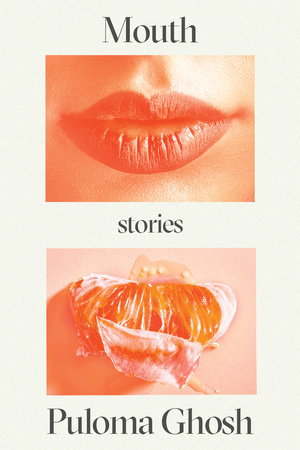
Puloma Ghosh, Mouth (Astra House), 224 pp. Hardback, $26.00.
Mouth opens with the following epigraph: “For my mother and grandmothers and the scary stories they told me at night.” In this collection of eleven short stories by Puloma Ghosh, the link between desire and memory is what draws humans forward—not necessarily toward each other but simply onward, in an endless search at times filled with monstrous longing that can be both subtle and blissfully violent. As the epigraph suggests, the relationship between the feminine and the surrounding world is mediated through these shared, generational memories—changed in the telling and adapted by each who receives them.
Ghosh’s language is vibrant—full of texture and physicality, capturing desire in all its visceral, guttural complexity. “I wanted to reach my little fingers into his mouth and feel his molars, tap his incisors with my fingernails,” says the narrator of the story “K.” Lines like this capture the discomfort of desire, describing the burgeoning sexuality of youth as well as the frequent inaccessibility of desire and its slipperiness or resistance to linguistic articulation. Desire, experiential and yet intangible, is made flesh—often quite literally—in this collection, where legendary creatures, cryptically unreliable narrators, clinical memories of past loves, and fantastical science-fiction tales of future worlds sketch out the sort of lifeforce that desire evokes.
This collection is a stunning debut, bitingly evocative and delightfully uncomfortable.
The thematic organization around mouths allows for a nuanced exploration of desire. Mouths consume, speak, taste, express, expunge, and remember. Ghosh imbues her pages with an intoxicating aroma of desire, one that crosses boundaries of culture, temporality, genre, and sentience. Rather than labeling herself as a science fiction or fantasy writer, Ghosh has stated that she has an obsession with the “uncanny.” She is interested in the ways that “fear and arousal have a similar, very physical effect on a person,” namely their impact on the body. This collection is arguably a meditation on the obsessions that consume her: sexuality, horror, food, mother-daughter relationships.
Mouth is bookended by two stories that explore these dynamics and are largely representative of the collection’s interest in the desire for both intimacy and death. In “Desiccation,” the delineations between living and dead blur as teenager Meghna’s proximity to death through her father’s morgue oddly leads to a sexual relationship with the distant and stoic Pritha, the figure skater with whom Meghna has competed for years. For undefined reasons, the men of this world were taken during her childhood and now, upon reaching adulthood, all boys are similarly removed from society. Meghna’s primary emotional connections are with her absent mother and the ghost-like holes left by the men and the boys who will become men, so much so that loneliness becomes a driving force of the narrative. In her youth, Meghna thought that her “aloneness was a choice, a badge of individuality, but my mother knew it was a consequence of her own choices, and that’s why it bothered her to see me stretch alone.” This aloneness, further propelled by the racial and cultural differences between Meghna’s South Asian heritage and the largely white community she lives in, is compounded by competition between herself and Pritha, her alarmingly pale and mysterious figure skating competitor and peer. In this story, mortal danger is both thrilling and consuming—Meghna’s attraction to Pritha lies in the fact that she “was just teeth and flesh and empty eyes, no different from a body on a slab.” The coldness of Meghna’s life, from dead bodies to the ice of the rink, to her absent mother, both propels her actions as she seeks individuality and limits her as she struggles to come to terms with her capacity to change her circumstances or be doomed to a predictable and inescapable trajectory.
“Persimmons” takes place on a future alien world sustained through the cyclical sacrifice of a woman of a singular lineage to a persimmon tree. Deprived of any fruit throughout her life to keep her pure, Uma is chosen by the persimmon tree for this sacrifice—a future her own mother escaped through bearing a female child. Uma “learned to tell ripeness from sound alone” of the fruit her mother consumed in front of her, a sensory signifier of the distance between them. While her mother’s response to their shared doom was to secure her own safety, Uma’s is more violent. Desperate to “leave something behind” after her sacrifice, like a lingering smell or residue, she wonders if “maybe that stickiness was a kind of love.” She has spent her life in search of love, being told by her mother that the maternal love she could have felt towards Uma was consumed by the fear of losing her to her sacrificial fate. The night before the ceremony, Uma welcomes her sometimes-lover, Moon, to her bed and hopes that “when the tree tore her apart” that “something inside Moon would tear too.” This stickiness, or longing for connection, bears down on her, and she secretly consumes the forbidden fruit just before her sacrifice. Her desire for connection leads to a destruction that breaks the cycle in which she is trapped, doomed to isolation, even as it means a violent end for her community. The tensions between mother and daughter in “Persimmons,” again magnified by societal ostracization, demonstrate a thematic interest in this collection about the nature of desire in the face of an inherited life.
Which is better? The destruction of the self in order to control desire or the dismantling of the system that limits and confines that desire? This collection offers no answers. Instead, it explores the nuances between these two opposite ends. Neither one is necessarily better; rather, they are part of a continuum informed by individual choice and shaped by external circumstances. The strength of this collection is in the juxtaposition of the fantastical with the mundane. The singular story that diverges from this strategy, “Natalya,” thus feels out of place. Presented in the style of an autopsy report, “Natalya” is a reflection on the narrator’s romantic relationship with the women on his autopsy table. “Desiccation” also offers a morgue as a site of sexual awakening, and “Leaving Things” features a wolf-man who consumes the body of his mother kept in a kitchen freezer—but “Natalya” sanitizes the physicality of dissecting a former lover in a cold and brutal way that feels discordant with the tones of the other stories in this collection.
The line in Mouth that resonates most appears in the story “In the Winter”: “There are no stories without loneliness.” Mouths, then, become not only thematically relevant (desire as all-consuming, a fascination with teeth or taste) but the means by which fear is made generative, as Ghosh has suggested in a recent essay. Women hear stories from their mothers and pass them on to their daughters, stories designed to protect and guide and direct through fear. Ghosh’s Mouth turns attention not to the outcome—whether or not the stories were successful in protecting—but toward the experience of hearing them, embracing them, questioning them. Mouth explores the complexity of being a woman or feminine person in a world that is often frightening and welcomes that danger and fear as though it is itself a desirable experience. Confusing, and sometimes contradictory, this desire urges us to question our own personal realities, and not to be afraid to create them for ourselves. This collection is a stunning debut, bitingly evocative and delightfully uncomfortable, worth returning to again and again with new eyes and new longings.
 Las Vegas Review of Books