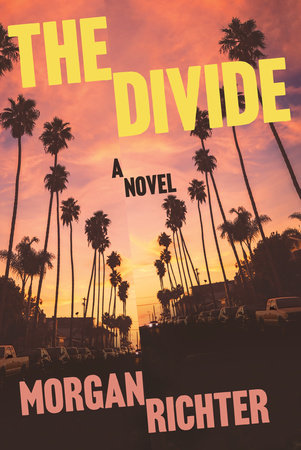
Morgan Richter, The Divide (Knopf), 304 pp. Hardback, $28.00.
Like the post-pandemic, present-day L.A. the novel takes as its setting, the truth first appears surface-level in Morgan Richter’s The Divide. Underneath the surface, however, every character has something to hide, an image to keep up, or an angle to play. For Richter, working in the genre of detective fiction, these superficial qualities have the most to reveal about people and their underlying motivations. Careful attention to how characters present themselves is the secret behind protagonist Jenny St. John’s “psychic” gift, which she readily characterizes as more of a benign fraud she plays into to pay the bills. But detectives, “at least the good ones,” she tells readers, “are psychic, whether or not they know it”—because they can know things by seeing how seemingly insignificant details fit into a bigger picture. Jenny’s powers of observation and interpretation anchor the narrative, which is less a “whodunit” than an exploration of identity in the land of fame and fortune.
Richter’s novel moves and reads quickly without feeling rushed, paced like a brisk ninety-minute film noir that focuses more on character than convoluted plots that finger the highest echelons of power and prestige. This emphasis on Jenny and her clients never distracts from the murder mystery of the novel, but it definitely signals Richter’s priorities of setting and character. The Divide has echoes of Raymond Chandler’s hard-boiled novels mixed with the humor and warmness of Psych—with a touch of Otto Preminger’s Laura to keep things interesting.
But its connections and references to other texts and genres always feel organic, never getting in the way of the story of failed ambitions and past lives at the center of Jenny’s investigation of the murder of famous Hollywood director Serge Grumet and the disappearance of his ex-wife, Gena Santos. Richter is self-referential in ways similar to her psychic, life-coach protagonist: she delivers for readers familiar with the genre without marshalling an array of weary tropes. Both Richter and Jenny excel at reading people, telling them what they want to hear and walking them through reflexive investigations into their lives—their anxieties and desires— without simply predicting things out of thin air for the quick buck. “Psychics are liars by definition,” a skeptical character says. But why should that bother anyone? They live in Los Angeles—and it’s “not like there’s a shortage of liars here,” Jenny replies.
Both Richter and Jenny are good liars. They lie without deceiving, giving their audiences something in return. The Divide offers an interesting mystery that’s easily navigable, while Jenny dispenses cheerful—if a little haphazard—advice that’s no less helpful for being based on educated guesses and tarot card readings. As a psychic detective and the novel’s first-person narrator, her strongest moments arrive when acting as more of a life coach than private eye to her clients, as when she encourages a dejected young actress into auditioning for a role without playing up her omniscient, otherworldly powers and guaranteeing her a part. For Jenny, being a psychic means acting like a trustworthy advisor rather than a clairvoyant.
The novel’s plot has a deceptively simple premise. As a young, aspiring actress, Jenny had starred in a film—The Divide—that was supposed to be her big breakthrough. But the production went bust, the theatrical release was scrapped, and her promising career faltered as the film went straight to DVD. Relegated to the periphery of the industry, she followed in her grandmother’s footsteps and opened a psychic clinic where she gave palm readings until, years later, a cop comes knocking on her door. The Divide’s director has been murdered, and Jenny is accused of living a double life as Gena—Serge’s ex-wife, who looks uncannily identical to Jenny.
Unlike the private-eye archetype of the hard-boiled gumshoe, Richter’s phony psychic detective is more at home in Hollywood’s social circles, where her occupation might make her the least ethically comprised person in the room.
While the novel plays with the motif of doubles and doppelgängers, it never falls into the stalemate of many a mystery thriller where the reader is constantly left guessing about the narrator’s reliability. The plot unravels through the protagonist and the reader’s mutual curiosity into the strange situation, unencumbered by a pressing need to clear one’s name in a homicide.
Unlike the private-eye archetype of the hard-boiled gumshoe, Richter’s phony psychic detective is more at home in Hollywood’s social circles, where her occupation might make her the least ethically comprised person in the room.
Richter eschews the intricacy and misdirection of a traditional private-eye novel to reflect on the down-and-out that make up the majority of Hollywood’s inhabitants. The lucky few who climb the ranks constitute an eccentric cast of characters (for example, a Gwyneth Paltrow-like actress/entrepreneur and a vapid social media influencer/ex-pop idol), who all stand to gain something from the murder and disappearance of someone in their social circle.
Rather than ramp up the thrills, the novel seeks to understand characters and their motivations, which is what interests Jenny the most as she takes it upon herself to find out what happened to Serge and Gena. Her biggest question, after all, concerns something relatively minor about Gena: why did this woman take credit for the leading role in The Divide, usurping Jenny’s one significant accomplishment in Hollywood? “She already had everything I lacked,” Jenny says: “widespread acclaim, financial stability, close friends who were boldfaced names.” Jenny’s “only accomplishment in life was The Divide, and everyone believed that was hers as well.” The desire to know why Gena would lie about starring in this unknown movie obsesses Jenny, spurring some major reflection about where it all went wrong—and where it all went so right for her double.
Jenny’s tone in these moments is reminiscent of Brando’s mesmerizing performance at the end of On the Waterfront. We get the sense that Jenny could have been a contender, the successful painter that Gena became, if she had only pushed through one early rejection. Or maybe she would have been more at peace with her decisions if she pursued—and failed—to achieve her real aspirations and passions. While Gena is never more than a spectral, unknowable figure in the novel, her value lies in providing a foil to Jenny, allowing the protagonist to see how different choices in life—like the decision to pick acting instead of applying to art school—could take identical people down different paths. The Divide is a soul-searching novel, using its “whodunit” plot to probe about the “what-ifs” in life that define a person’s trajectory.
 Las Vegas Review of Books