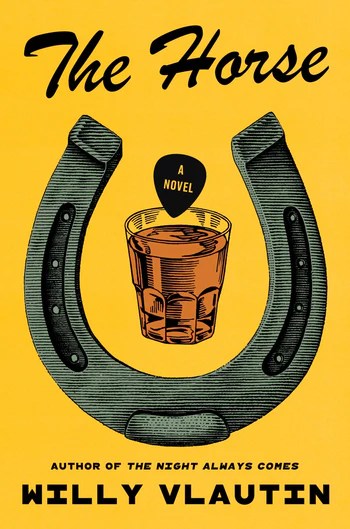
Willy Vlautin, The Horse (Harper), 208 pp. Hardback, $25.99.
The reader is introduced to Al Ward, the 67-year-old protagonist of Willy Vlautin’s latest novel, The Horse, in a state of morbid avolition. Shacked up in a dilapidated building on a “derelict mining claim” fifty miles outside of Tonopah, Nevada (a small town a little over 200 miles from Las Vegas), the failed country songwriter shuffles through his days noodling on his guitar, eating condensed soup, and reading old issues of National Geographic and Sports Illustrated. It quickly becomes clear that Al has given up on life. That is, until a scarred and battered horse appears in front of his home in the middle of winter. Lacking the supplies or the know-how to care for the animal, Al determines to hike out for his friend Lonnie—an old ranch hand who lives thirty miles away—for help.
The titular horse is the narrative engine for Al’s journey of reflection and redemption, but it plays a minor role in the novel, serving primarily as a (perhaps heavy-handed) symbolic parallel to Al. Rather, The Horse centers on Al’s confrontations with his past. Through flashbacks, and the songs they elicit, the reader is transported to episodes in Al’s history as a journeyman musician on the casino lounge circuit. Most of these episodes are quite painful. Suffering is Al’s profession, and his propensity to write about pain, those daggers of emotion that cut him the deepest, means that most of the stories retold are tragic. Alcoholism, divorce, death. Al embodies a well of sorrow. As one character says of him, “you write with a broken heart.” Formally, these temporal shifts provide Vlautin spaces through which to explore Al’s past, providing the necessary building blocks to understand how he ended up on the mining claim; metaphorically, they express his self-perception. The memories that he latches onto the hardest are usually the lowest moments of his life. Vlautin thus uses the form of the novel to evoke Al’s psychic distress and to materialize the sorrow of a man struggling to overcome his innate melancholy.
The novel relies solely on Al for the reader’s attention. Since Al is a depressive, that can make for a challenging read. This is The Horse’s central weakness: it can feel too beholden to clichéd tropes of the tragic musician. It is easy to picture Al Ward as Bradley Cooper’s Jackson Maine from A Star is Born (2018) or Jeff Bridges’s Bad Blake from Crazy Heart (2008). Vlautin himself is an accomplished and seemingly well-adjusted musician, and his accounts may be drawn quite accurately from his own experience or from those he knows well. But the peaks and valleys of Al’s life can feel predictable. Any success or happiness is sure to be met with failure or sorrow. The routinization of tragedy feels too methodical. However, Vlautin does well to subvert these tropes when able, especially in his characterization of Al, who is not the kind of rough-and-tumble dude one might expect from the novel’s premise and setting. Rather, one of Al’s defining characteristics is that “he could be too sentimental and cry too easily.”
Al’s emotionality is the strongest element of the novel, providing an avenue for Vlautin to explore his twin addictions: alcohol and songwriting. Alcohol is Al’s narcotic of choice, what he binges upon to smother his feelings. It is a numbing agent used to self-medicate. The sensitivity with which Vlautin depicts Al’s addiction results in a complicated and empathetic depiction of a man struggling with his demons. Beyond the patent grotesqueries of binge-drinking oneself into annihilation—there is a scene in which Al shits his pants in front of the Tonopah Clown Motel—Vlautin also captures the humanity of addiction and the ebbs and flows of dependency.
In a particularly powerful scene in which Al debates killing the horse out of mercy, he turns to alcohol to stiffen his nerves for the job. The deliberateness of Al’s drinking here shows the neurosis of his alcoholism:
An old casino highball glass sat on the table. Al drew a horizontal line halfway up it with a black marker. He opened the bottle and poured tequila to the line. A windup kitchen timer sat on the counter by the sink. He set it for an hour. One drink per hour. … He tried his best not to look at the timer, but he couldn’t help himself. Fifteen minutes left. If he had the drink now, he could refill the glass and have another drink in just fifteen minutes. He’d have to wait an hour after that, but he’d worry about that then.
This is a man who has long wrestled with his addiction and lost.
As a novel about a musician, The Horse illuminates the inner struggles of creation.
Vlautin parallels Al’s alcohol dependency with his desire to create art. It is impossible to say whether or not Al is a gifted artist, but he is obviously a passionate one. Al’s hovel on the mining claim is packed with spiral-bound notebooks full of songs he has written over the years. Vlautin includes numerous lists of songs that Al wrote during a given period of time, often including them like codas to a flashback, providing readers with insight into how Al internalized and articulated his lived experiences. As a novel about a musician, or an artist broadly, The Horse illuminates the inner struggles of creation. Through Al, Vlautin captures the paradox of creative work, a passion that at once evokes the pleasure of “working on a puzzle . . . chasing the thing, which is a good song,” and the horrible misery of intellectual consternation:
No matter what he did or how hard he tried, his songs were good but never great. How many notebooks had he filled with half-good songs, songs that were almost? How many hours and months and years had he toiled and tinkered? And Jesus, how many hours had he spent learning cover songs he hated? And why did people always request such horrible songs? And why were the tunes he loved most never popular?
The tension between artistic elation and angst resonates throughout the novel, sounding an acute expression of something that can often feel painfully ephemeral. Vlautin does well to articulate the creative’s struggle to create, and this aspect of the novel proves its most engaging. Al is a likeable and pitiable character, and one worth cheering for. Regardless of the clichés, his journey makes for an engrossing and pleasurable read.
 Las Vegas Review of Books