Joaquina Ballard Howles, No More Giants (Boiler House Press), 264 pp. Paperback, $24.99.
Joaquina Ballard Howles’s first novel, No More Giants, now appearing in a new edition from Boiler House Press, was originally published in England, by the Hutchinson firm, in 1966. Howles—now ninety-three years old and living in an assisted living facility—was then thirty-six and living in London with her husband, Jeffrey, an Oxford-educated banker. Howles herself had grown up on a ranch near Winnemucca, Nevada, and then attended Mills College in California, graduating with a degree in English literature in 1952. She met Jeffrey on her way to pursue graduate work at the University of London. Aside from a second, self-published novel, Brighter Later, which appeared on Amazon in 2020 (when she was ninety), Howles doesn’t seem to have authored anything other than No More Giants.

It seems almost mysterious because No More Giants is very good. Boiler House Press is releasing it now as part of their “Recovered Books” series, and recovered books are, let’s face it, often duds. They were generally forgotten for a reason. But Howles’s debut is definitely worth a read. It tells the story of fifteen-year-old Jenny, who lives with her father (Jerry), her mother (Ruth), her aunt (Lila), and her twelve-year-old brother (Brian) on the family cattle ranch in northern Nevada. They are twenty miles from the nearest town and a long bus ride from Reno.
An older Jenny narrates, but her recollection sticks to the year she was fifteen and “achingly not a boy.” The phrase connotes the two different desires pulling her apart. On the one hand, she wishes she could be a boy—could be the firstborn son her father so obviously wishes she had been. She loves the ranch and feels the sting of the gendered divide that would remove her from its action and keep her in the kitchen instead. “To my father, life ran in straight lines, and though they might run deep, they remained parallel, crossing only in the chaos of some unrecognized infinity.”
On the other hand, she is insistently not a boy; she is a young woman who keenly feels the isolation and limitations of ranch life—feelings her mother, Ruth, who loathes the ranch, often expresses loudly. Ruth, who craves sophistication and was raised to expect more, resents the rural “hellhole” to which her marriage has consigned her, and she gives up on the rough and rowdy daughter acculturated to it. “That was one thing about Mama, she always felt so sorry for herself that there wasn’t really room for anyone else to pity her.”
The family drama escalates during the haying season, when Jeffrey hires the dashing, blond, twenty-year-old Basque farmhand Justo—a “golden boy,” even a “sun-god,” in Jenny’s eyes. Nothing so exciting has ever arrived at the ranch before. And it’s not long before Jenny starts meeting Justo out by the willows at night, ostensibly to help him improve his English.
Howles’s book is indeed a lost gem—a Nevada novel that gets everything right.
The novel begins to unroll slowly, but the pace picks up quite a bit in the second half. Readers who continue with it will be rewarded in the later chapters. Howles is very good at conveying the experience of pain without resorting to descriptions of hatred or despair. A certain threshold for pain is a simple feature of the ranch, where chores include sawing the horns off cattle and performing “crude surgery” on a mother cow whose “uterus hung out from under her tail like a great bloody bubble.” “Pain is its own world with no boundaries of sense or time,” writes Howles. “Pain is omnipotent, greater than man; pain is God, there is no man, no woman who cannot be made to bow to it; there is nothing we own, have built, or have made which cannot be swept away by pain.”
But Jenny is no martyr. She has a sense of humor, and she uses it to navigate the path between her father’s sense of the valor of ranching life (cattle-ranching, that is—sheep-ranching is a “lost cause”) and her mother’s sense that everyone around is trash. In one chapter, as a nice trick, the narrating Jenny can no longer remember the name of a particular woman: “It was something beginning with B, something like, though not quite, Blair, Miss Blair.” Over the next twenty pages, instead of referring to her as Miss Blair, Jenny simply uses a new name each time the woman appears: Miss Baird, Bear, Burr, Briar, Brown, Brawn, Burns, Black, Blake, Block, Brake, Brook, Blum, Bly, Bloom, Brand, Band, Ban, Bond, Bland, Bell, and Bar. One of those names must be the right one.
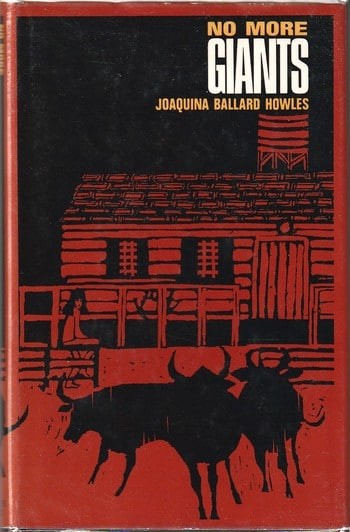
It’s worth wondering why No More Giants didn’t find success, a topic Nancy Cook takes up in her Afterword to this edition. Comparing the novel to Jean Stafford’s The Mountain Lion (1947) and Edna Ferber’s Giant (1952), and then, ultimately, to Howles’s Mills College classmate and friend Jane Rule’s Desert of the Heart (1964), Cook suggests that the chief disadvantage for No More Giants was its London publication. Had it appeared with a major American trade press, it might have received the attention needed to vault Howles into a professional career. In his “Neglected Books” blog post, which revived interest in the novel, Brad Bigelow suggests a favorable resemblance to Joan Didion’s debut novel, Run, River (1963), but also notes that Howles’s title was unfortunately never published in the United States.
Of course, this new edition is also being published out of England; Boiler House Press is run through the University of East Anglia. But American readers can easily obtain a copy of No More Giants through Asterism Books, Boiler House’s U.S. distributor. And they should! Howles’s book is indeed a lost gem—a Nevada novel that gets everything right.
 Las Vegas Review of Books