Robert Plunket, My Search for Warren Harding (New Directions), 256 pp. Paperback, $18.95.
In his 1888 novella The Aspern Papers, Henry James wrote about a scholar on the hunt for an American poet’s letters, thought to be held by his aging mistress in Venice. Posing as an ordinary boarder, the narrator catches the eye of the old lady’s niece and tries to get access to those private papers, potentially valuable as archival materials. As James remarks, his scholar is the victim of “that most fatal of human follies, our not having known when to stop.”
A young Robert Plunket read The Aspern Papers and became convinced that James’s narrator was, while not consciously gay, nevertheless “a man who was just not heterosexual at his core.” Plunket then wrote his own modernized version of The Aspern Papers, featuring just such a narrator, published by Knopf in 1983 under the title My Search for Warren Harding. Plunket’s narrator, Elliot Weiner, teaches college history courses in New York City and has a scholarly specialty in the career of the 29th President of the United States. When he learns that Harding’s octogenarian reclusive ex-mistress Rebekah Kinney (a character based on the real-life Nan Britton, who wrote an infamous 1923 tell-all book about her affair and love child with Harding, recently confirmed by DNA testing) is alive and well and living in the Hollywood Hills, he flies out to the West Coast and poses as a grad student looking to sublet her pool house. Finding that the old lady hordes a stash of Harding’s love letters in a chest next to her bed, Elliot strikes up a flirtation with her overweight granddaughter, Jonica, in the hopes of obtaining and publishing that presidential correspondence to scholarly acclaim.
In short, Elliot doesn’t know when to stop. Hijinks ensue.
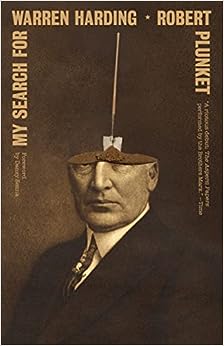
Plunket’s humorous novel found some readers in the 1980s, but it wasn’t a smash hit, and the author never became a star. (He wrote one other novel, Love Junkie, in 1992. Madonna supposedly bought the film rights to it.) Fiction writer Victoria Patterson helped to bring renewed attention to My Search for Warren Harding when she wrote about it for the “Lost and Found” section of an issue of Tin House in 2014. “Eventually My Search will make it back into print and receive the recognition it deserves,” she prophetically declared.
Patterson had been recommended the book by her friend Michael Leone, who then tracked down Robert Plunket in a Florida trailer park and interviewed him for the Los Angeles Review of Books a few months later. It’s quite an interview. Speaking of his career origins, Plunket remarks, “I honed my skills in the nitty-gritty world of small town supermarket handouts.” He also claims that his “new best friend” is Clifford Irving, a man who was imprisoned for writing a hoax “autobiography” of Howard Hughes in the 1970s.
When speaking of My Search, Plunket explains that one of its biggest fans was Larry David. “It was his favorite book,” Plunket claims. “He even asked me to write for Seinfeld—and I’m flabbergasted by the stuff he’s stolen from it. Elaine’s dancing, for instance, is a direct steal.”
This may seem unlikely—Julia Louis-Dreyfus’s visual performance stolen from an obscure novel? But when we read Plunket’s narrator, Elliot, describe the “truly egregious spectacle” his girlfriend presents on the dance floor, it’s easy to draw the connection. “She is one of those people who ‘abandon’ themselves to the beat,” Elliot explains. “The things she does—I can only describe them as Martha Graham routines. Her arms fly out into space, she makes sudden turns, then she half-squats, her head flung back in ecstasy.”
In her Introduction to the 40th anniversary reprinting of My Search for Warren Harding, by New Directions, Danzy Senna (who had been given a copy of the novel by Victoria Patterson) emphasizes the Seinfeld connection, reporting a rumor that Larry David told the show’s writers to read Plunket’s book and “imitate the tone.” Whether or not this rumor is true, fans of Seinfeld’s tone will likely enjoy My Search.
Elliot, the narrator, is a meticulous master of the mundane and occasionally pontificates upon his well-thought-out approaches to life. “My God, the care, the preparation, the skill with which I usually discard pornography,” he exclaims at one point. “The people who design nuclear power plants could get pointers from me. Backup system after backup system. Nothing left to chance.” (He combines the dirty magazines with innocuous periodicals and shreds them into confetti, then disposes of the debris one handful at a time across multiple public wastebins.) His casual observations often harmonize with the normal banter of Jerry and George. Elliot registers amused disgust, for instance, for the way a woman finishes a sandwich: “she held it up over her head and lowered it down to her mouth, like she was eating a bunch of grapes at a Roman orgy.” And his description of a “loudmouth family” sounds applicable to the Costanzas: “Dinner with them was like attending a labor negotiating session.”
The narrator is a meticulous master of the mundane and occasionally pontificates upon his well-thought-out approaches to life.
In order to like the book, you have to like Elliot’s voice. But it’s hard to like him as a person; he’s selfish, snobbish, mean, and unkind. Alexandra Alter, writing in the New York Times, notes that Elliot “uses homophobic slurs, describes Puerto Ricans and Mexicans with crude stereotypes and constantly fat-shames his girlfriend.” Twenty-first-century readers may be put off by such language. (They may also have to google some of the dated celebrity references: Sonny Bono, Liv Ullman, Alex Haley, Dr. Joyce Brothers.)
The appeal of Elliot’s narration comes, in large part, from the fact that he so clearly doesn’t need the reader’s empathy. He’s a type rarely privileged in today’s novels but nevertheless rife for mockery: the know-it-all. Having grown up among “the Pittsburgh haute bourgeoisie,” Elliot eventually obtained a Ph.D. in history from Columbia University—an institution he holds in disdain as a “School for Dorks,” where his doctoral classmates were “just plain stupid” and “pathetically easy to impress.” He’s equally dismissive of an afternoon spent on a Texas millionaire’s yacht: “I’ve had more fun waiting for a subway train.”
Early on, Elliot reveals that his chief hobby is Morris dancing, which says a lot not only about his character but about what New Directions publisher Barbara Epler calls the “lunatic energy” of the novel generally. The high point of the narrative comes not at the end but rather in the middle of the book, in the ninth chapter, when Elliot goes to see a play by Jonica’s friend at the “LA Women’s Theatre”: All My Sisters Slept in Dirt: A Choral Poem. The experience is disappointing from the get-go (“the only seating was what I feared, folding wooden chairs”), though Elliot is briefly intrigued when the actresses descend from the stage for some audience interaction. Each addresses a group of half a dozen and vividly relates a personal sexual experience. In a moment that could easily be a Seinfeld scene, Elliot becomes bored with his actress’s story (a passport photographer exposed himself to her) and becomes jealous of the group two rows in front, who seem to be getting a graphic account of “group sex in a coed prison.”
While it’s never explicitly declared in the novel that Elliot is queer—he has physical relationships with women and claims to be straight—the staunchness of his heterosexuality is suspect. (At one point, a woman calls him a “fairy.”) Plunket himself has been insistent that his narrator should be understood as a closeted gay man. “It’s a gay novel,” he repeatedly told The New Yorker’s Casey Cep.
And as Cep observes in return, the fun of My Search lies not only in the odd style and mannerisms of its narrator but also in the fact that its main subject matter is “a sex scandal from so long ago that it has ceased to be either sexy or scandalous.” That also sounds like a description of most Henry James novels. And perhaps Plunket’s book will now begin to be received in such company.
 Las Vegas Review of Books