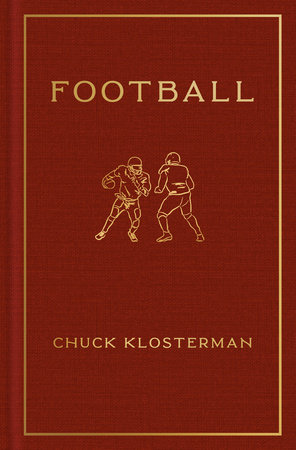
Chuck Klosterman, Football (Penguin), 304pp. Hardback, $32.00.
The intended reader of the cultural critic Chuck Klosterman’s latest essay collection, we are told, is less the football fan of 2026 than the American citizen of 2076. Klosterman purportedly targets someone 50 years or so in the future who might witness the near-total decay of football from the American cultural landscape; the author hopes to pre-empt any pat or trite explanations for this inevitable future decline by writing about it now. Football is “an expository obituary, published before the subject has died, delivered by someone who wants to explain why the victim mattered so much to so many, despite so much evidence to the contrary.” This objective is not entirely achieved, but the book itself is a thought-provoking and entertaining meditation on the state of America’s most popular sport.
While Klosterman’s writing output throughout his career has been wide-ranging, his recent essay collections have each centered around a single theme: I Wear the Black Hat (2013) is an investigation into the causes of cultural villainy, But What If We’re Wrong (2016) is a set of predictions about the future’s reception of the present, and The Nineties (2022) is an analysis of the “meaning” of the 1990s in America. These collections were successful when they focused on close readings of popular culture, but Klosterman has always seemed a little out of his depth talking about politics and cutting-edge science, let alone Foucauldian power/knowledge. Although Noam Chomsky and the sociologist-activist Harry Edwards do appear in this volume, Football mainly avoids overambitious theorizing despite the early emphasis on its provocative premise. In that regard it resembles Fargo Rock City (2001), his witty debut collection, which claimed that hair metal deserved serious critical analysis but made the argument through a series of perceptive and memorable autobiographical anecdotes about growing up in rural North Dakota in the ’80s. Klosterman insists in his introduction that Football is not intended as a memoir—which is too bad, because the best parts are his personal reminiscences: childhood devastation after witnessing The Catch on TV in 1981; a haunting comment by the author’s father after Doug Flutie’s 1984 Hail Mary; recollections of his youth pigskin career (presented simultaneously as proof of his authority and a defense against any ulterior motives).
“Football” is a thought-provoking and entertaining meditation on the state of America’s most popular sport.
The football field is not new turf; Klosterman has previously published essays on the sport. From 2009’s Eating the Dinosaur, “Football” argues that the gridiron’s cultural conservatism belies an intellectual radicalism that rewards boundary-transgressing thought. And “Sudden Death Over Time,” from But What If We’re Wrong (2016), imagined four possible futures for the demise of professional football. A fifth appears throughout this book: polite society will increasingly find the violence and authoritarianism inherent to football to be disreputable, and the remoteness of these experiences from most people’s normal lives (combined with fewer kids playing in high school) will make the game seem like an arcane ritual. Professional sports like basketball and golf, he argues, are not that far removed from casual backyard versions of the same, but the brutality of football and its requirement for elaborate, well-rehearsed play-calling make it an outlier: “the game itself is so complicated and overorganized that there’s no reasonable way to replicate it recreationally.” This fact, along with the growing financial insanity of paying to stage games and air them on television, will eventually lead to the sport’s ruin. The game will die out but never completely disappear, “in the same way you can still hear jazz on NPR and you can still smoke Lucky Strikes inside a casino.” A late chapter comparing football to horse racing (which one review praised as “an instructive precedent”) neatly ties the argument back to the introductory chapters: as equestrian knowledge receded from typical American life just before horse racing collapsed as a major sport in America, so too will the disappearance of football’s essential aspects foreshadow its demise.
But the book is not simply a prophecy of football’s unhappy future; Klosterman also tries to explain how the sport grew in popularity and came to occupy such a central position in current American culture. One reason is that the structure of the sport itself coincidentally happened to be perfect for the cognitive profile of the modern television viewer: “the fact that the game incessantly starts and stops provides incremental rushes of dopamine, augmented by fleeting bursts of introspection” (not to mention built-in commercial breaks).
Klosterman emphasizes the importance of viewing the televised version of a football game over sitting in a stadium; a recurring claim is that “football is a purely mediated experience, even when there is no media involved.” He insists that even a live spectator at a game will “automatically reframe what she saw into the way it would appear on television,” recalling her own eyewitness memories in the form of the traditional line-of-scrimmage camera angle familiar from TV. Anticipating resistance to this controversial claim, one unfortunately without any substantive evidence, Klosterman can only quote an imaginary reader hostile to the thesis and does not make much of a defense. (The notion seems to borrow material from Jerry Mander’s 1978 book Four Arguments for the Elimination of Television, a book Klosterman engaged with closely in “FAIL,” the concluding essay of Eating the Dinosaur, where he grappled seriously with ideas from the Unabomber Manifesto.)
Not all the essays in this collection are compelling. A meandering exploration of Canadian football’s alternative rules and an excursus on the apparent irrationality of the sport being called “football” only in America (despite kicking being a small fraction of the game) add little to the larger project. Klosterman offers a tepid defense of football’s violence despite our knowledge of CTE, and his analysis of the Colin Kaepernick controversy concludes indecisively that the situation was complicated. (A recent review in the Washington Post found these two chapters especially disappointing.) The book’s main flaw is an unwillingness to commit to its own beliefs. When Klosterman debates whether anyone should be allowed to play such an inherently dangerous sport at all (and risk brain damage), he insists that the issue must be handled in a disinterested and depersonalized fashion, without emotional appeals to the broken bodies of former players at both the professional and youth levels. This is challenging but tenable, and he ultimately resolves that people should be allowed to pursue dangerous activities. But later in the chapter, after recounting a concussion he thinks he received in seventh grade football, he concedes that had he suffered more serious medical consequences from this hit, he would feel differently, essentially invalidating his entire approach to the issue. After describing the on-field cardiac arrest of Damar Hamlin in 2023, Klosterman concludes by implying that the debate itself will not be dealt with rationally and that his own contribution to the discussion is pointless. This refusal to commit to a serious conclusion, while shrugging off all real-world behavior regarding the issue, comes across as a frustratingly wishy-washy (and uncharacteristic, for Klosterman) capitulation.
More convincing is an essay arguing that we should consider Jim Thorpe to be the greatest football player of all time. Thorpe is Klosterman’s nominee because, he argues, analyzing athletic (and artistic) mastery requires identifying “the earliest incarnation of greatness still intimately related to all subsequent examples of greatness following in its aftermath.” The argument thus provides an avenue for fans to resist granting GOAT status to Tom Brady, a player with whom Klosterman had an awkward interview experience after the quarterback’s Deflategate controversy. This piece doesn’t really advance any overarching thesis about football, but it artfully illuminates both the history of the sport and the evolution of how the game has remembered its own superstars.
Football will make an odd time capsule if the game no longer dominates American culture by the time of the national tricentennial. And many fans will finish the book feeling a little guiltier about their love for football, even though the collection was not meant to be a polemic or an exposé. But Klosterman has once again written a thoughtful argument in favor of treating mass culture as a site for serious ideological contestation.

