Rosebud Baker, Fully Baked: A Messy Memoir (Gallery Books), 256 pp. Hardback, $29.00.
A strong current of “Before-and-After” runs through stand-up comic Rosebud Baker’s work. She achieved widespread recognition with her 2025 one-hour Netflix special, The Mother Lode—half of which was filmed when she was eight months pregnant, the other half filmed after she gave birth to her daughter, Minnow. Those halves were then spliced together so that the special repeatedly toggles back and forth between her pregnant and postpartum selves. It was an unusual choice that made the humor seem a little edgier, a brilliant strategic move to acknowledge the significance of the pregnancy for Baker while also rendering it potentially ancillary to her professional act onstage.
Baker’s new “messy memoir,” Fully Baked, adopts a similar structure. Chapters often begin with her developing pregnancy, offering a story of her impending motherhood, then jump back in time to tell a longer story about her own childhood and her journey down the path leading to eventual success as a comic. The memoir is indeed “messy,” cobbled together from many genres: childhood trauma plot, alcoholic memoir, show biz success story, and motherhood narrative.
The memoir is indeed “messy,” cobbled together from many genres: childhood trauma plot, alcoholic memoir, show biz success story, and motherhood narrative.
This journey is a bumpy one, and the story is often dark. Shortly after Baker graduated high school, her younger sister Graeme died in a freak accident, drowning in a Jacuzzi at a summer party. “There was Before,” Baker explains. “And there was After.” The trauma of this loss never really dissipated. More immediately, it contributed to reckless behavior during Baker’s college years. Eventually, though, in her mid-twenties, she realized that she was an alcoholic and gave up drinking. But she still struggled with difficult relationships and slowly started to build a career in comedy. In the memoir, the birth of her daughter appears to be salvific. The now-sober Baker sees in her baby, Minnow, an eerie-yet-comforting resemblance to her lost sister, Graeme—the “two little girls” to whom her book is dedicated.
As Baker notes in her acknowledgments, the impetus for this writing project was her 2021 appearance on Marc Maron’s WTF podcast, during which she offered her personal story about trauma, alcohol, sobriety, and comedy. After the interview aired, an editor, Max Meltzer at Gallery Books, contacted her about writing the memoir.
(Gallery Books, which specializes in celebrity memoirs, also published titles such as Amy Schumer’s 2017 The Girl with the Lower Back Tattoo, Britney Spears’s 2023 The Woman in Me, and Real Housewife Heather Gay’s Good Time Girl—each of which, like Baker’s, features a PG-rated topless photo of the author on the cover. Jill Biden remained clothed for her own Gallery Books-published memoir this year.)
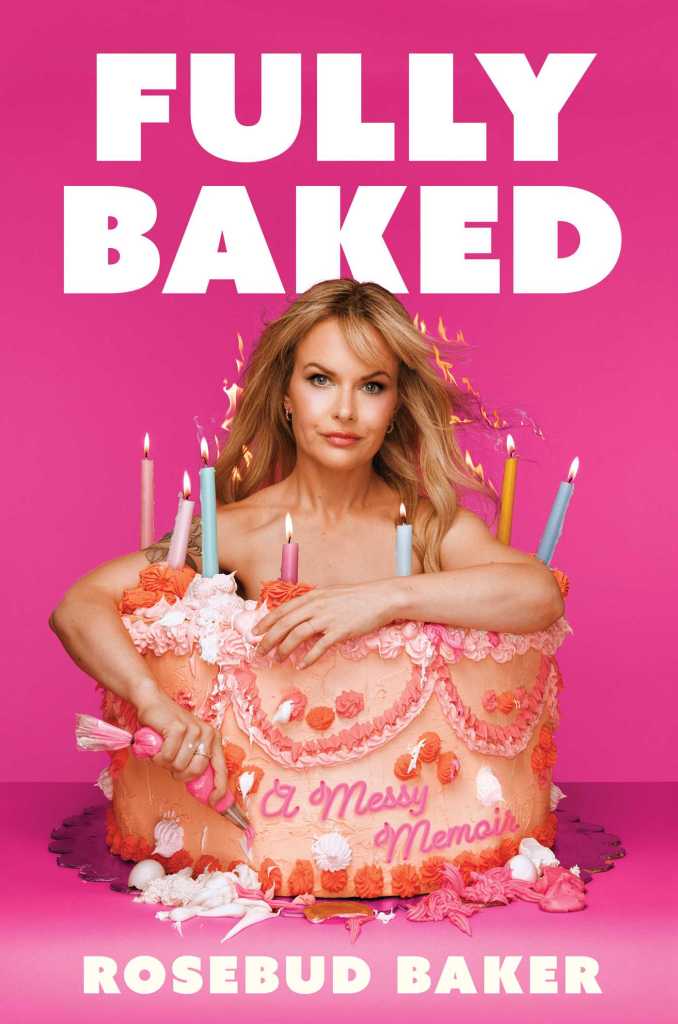
Those familiar with Maron’s podcast will probably recognize a basic structure—a sense that family trauma indirectly led both to substance abuse and stand-up comedy, and that the work toward sobriety has improved the work onstage. Here we get the kinds of ups and downs that might be expected—piss and vomit, blackouts and breakthroughs, punches and punchlines.
Yet Baker has quite a lot of additional material to work with. Her grandfather is James A. Baker III, who served as White House chief of staff under Ronald Reagan and as Secretary of State under George H. W. Bush. As might be expected, Rosebud Baker’s childhood was quite privileged. She grew up in northern Virginia and would sometimes go and play with President Bush’s granddaughters. More recently, she worked for three and a half years as a writer at Saturday Night Live, eventually working specifically for the “Weekend Update” segments. She left the iconic show shortly after the release of her Netflix special.
These elements are quite interesting, though they receive curiously little treatment in the book, each the subject of one chapter. Baker claims to know relatively little of her (still-living) grandfather, painting him chiefly as an embodiment of the WASPish virtue of emotionlessness. She primarily dwells upon her own discovery—gleaned through reading a 2020 biography of the man—that her grandfather had hidden his wife’s breast cancer diagnosis from her in the 1960s. Perhaps in contrast, the chapter on SNL, the last in the book, is relatively devoid of drama—or details, for that matter: no accounts of celebrities behaving badly, or zany office pranks, or edgy bits cut after dress rehearsal. Working at 30 Rock seems a little stressful, but mostly fine. In focusing so much of her book on booze and boyfriends, Baker may have underestimated what has made her own life so strange and interesting.
As a memoir, Fully Baked is messy in part because it’s difficult to structure a life-and-career retrospective when the subject is in her early forties. Does the conclusion imply that Baker has achieved the professional success and personal goals she’s always wanted? That she can now live happily ever after?
In addition to promoting the book, Baker is now back on the road working out new material in her “Paper Bag Princess” tour, and she performed at Wiseguys in Vegas’s Town Square Mall in July. And it turns out that a major element of her new material is the fact that she is divorcing her husband, comedian Andy Haynes. Marital problems are not part of the memoir; Andy comes across as a standup guy, a great husband and father, and Baker suggests that he’s the love of her life—that they’ll be together forever. In her new act, she’s not so keen on him. This doesn’t really negate the narrative of the memoir, but it certainly twists the takeaway if you read the book with the knowledge that her marriage is doomed.
This is all to say that the title of the memoir is an oxymoron. A “messy” cake typically isn’t fully baked but, rather, half baked. And Baker’s own development as a person and as a performer obviously isn’t complete. She’s still moving onto new stages. (She acknowledges this in the text as well, saying that she wishes she could arrive “at a nice, clean moment I could hold up like a photograph, witness my fully baked self, and say, ‘There she is! All done! She figured it out!’ But I know it doesn’t happen that way.”)
At one point during one of her sets at Wiseguys, Baker remarked to the crowd that Las Vegas locals are like a community of American expats who just couldn’t manage to actually leave the country. (Everyone seems to be from somewhere else, and many have cut ties with their homes to live new lives in Vegas.) She clearly didn’t mean this as an insult. If anything, she seemed to utter this observation with a dose of envy (while also acknowledging that she couldn’t tolerate Southern Nevada’s summer heat). Baker may belong here more than she thinks. What her “messy memoir” makes clear is that she herself is a work in progress, a half-published story awaiting its next chapter. And Vegas has more self-reinvention per square mile than anywhere else in America.
Baker is a very funny comic, and, despite its occasionally heavy material, Fully Baked evokes plenty of chuckles. The best passages tend to be about her work in stand-up, which she describes as “a solo sport for the unathletic, performed largely in rooms that smell like microwaved burritos.” The best chapter, titled “Bring Back Chad,” is all about the road work that comics have to do at comedy clubs across the country in order to hone their material before recording a special. Unless you can sell out a stadium, it’s often unglamorous. For Baker, the road work can be frustratingly literal; as she explains, sometimes you can be completely and demoralizingly upstaged by a local opener who simply complains about metropolitan traffic problems but thereby gets the audience passionately on his side.
But perhaps most appealing in Fully Baked are the especially self-aware moments in which Baker recognizes that what she most wants to say isn’t always very entertaining. “None of my growth is funny per se,” she admits, and “deep down, this has felt like a problem for me. I knew that choosing to be sober, and then choosing to be a mom, wouldn’t exactly fit the structure of a comedy. And I still battle with that.” Comics often work on bits for months or even years because they know there’s something there, even if they haven’t found it yet. This spirit of discovery is what really animates Baker’s work.

