Lindsay Schakenbach Regele, Flowers, Guns, and Money: Joel Roberts Poinsett and the Paradoxes of American Patriotism (University of Chicago Press), 264 pp. Paperback, $26.00.
Joel Roberts Poinsett is known for one thing: the Christmas flower that bears his name. He introduced it to the United States in 1828, while he was serving as the first U.S. Minister to Mexico, a position he held from 1825 to 1829, during the John Quincy Adams administration. The poinsettia (Euphorbia pulcherrima), native to Mexico, was a big hit, “unsurpassed in general effect by the most gorgeous coloring,” according to an 1837 newspaper article in Washington, D.C. “When well cultivated, this is truly the most magnificent of all the tropical plants we have ever seen,” wrote the florist Robert Buist in his 1839 American Flower Garden Directory.
In her new biography of Poinsett, published just in time for Christmas, Lindsay Schakenbach Regele, a history professor at Miami University of Ohio, begins by gesturing to “the world’s most economically important potted plant.” But her Zevonian title is a bit misleading; while her account certainly focuses on guns and money, flowers get short shrift. Those hoping for a story about the origins of the poinsettia will be disappointed.
Regele’s goal here is to shift the focus. While she acknowledges that Poinsett is known today chiefly for the plant he began mailing to influential friends in the 1820s, Regele insists that, “when we look at a poinsettia today, the vivid flower should call to mind more than December decorations: thanks to Poinsett, it should remind us of the blazingly selfish, confident statecraft that he helped pioneer.” This version of statecraft Regele labels “martial capitalism.” Poinsett’s agenda, she says elsewhere, “was based on political pragmatism, economic expansion, white supremacy, and state power.”
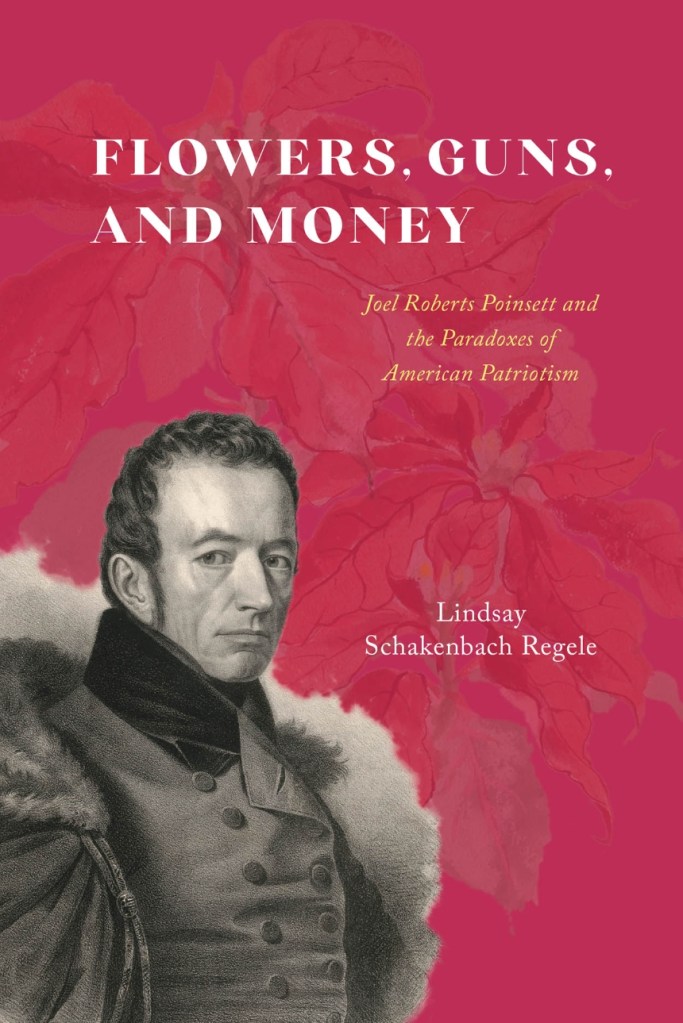
Regele’s argument is that Poinsett’s politics were “paradoxical,” not slotting easily into preconceived political ideologies, certainly not according to what our left-right expectations might be for nineteenth-century Southerners. Poinsett was a South Carolinian slaveholder. But he was also a unionist who opposed secession, and he was generally uninterested in defending the institution of slavery. As a diplomat, he promoted U.S. military forces, but as the former U.S. Secretary of War (under Van Buren, from 1837 to 1841), he opposed the Annexation of Texas (1845) and the resulting Mexican–American War (1846–1848). His colleagues praised him for his patriotism, but his philosophy seems to have boiled down to the idea that what was good for Poinsett was good for America.
The “paradox” tends to disappear upon closer inspection. Poinsett’s willingness to work with antislavery politicians had little to do with moral qualms about human rights and more to do with his dislike of Black people; he favored a whites-only future. Similarly, his opposition to the Mexican–American War had nothing to do with ethical objections to imperial land-grabbing; rather, he strongly suspected that the U.S. government had underestimated the Mexican military and would lose the war—or, at least, would end up in an expensive and embarrassing quagmire, as the Second Seminole War in Florida had become for him while serving as Secretary of War.
Regele, to her credit, doesn’t really try to turn Poinsett into a complicated hero. It’s clear that he’s primarily a bad guy here. In his most powerful position, as Secretary of War, he was largely responsible for the Cherokee Trail of Tears. “Although the forced removal of approximately fifty thousand individuals is usually associated with [Andrew] Jackson, the majority of it happened under Poinsett’s watch,” notes Regele. “He would oversee the forced migration of four-fifths of Native peoples beyond the Mississippi.” And his officers were apparently well aware of Poinsett’s personal opinion that the best policy for Native Americans was “extermination.”
What should we think of when we see a poinsettia today?
Nevertheless, Poinsett was an interesting figure. As a young man, he served in several small diplomatic posts in Latin America, briefly acting as a military adviser to the Chilean government. During a stint in Mexico in 1822, he kept a journal that he turned into an informative book—simply titled Notes on Mexico (1824)—which, for a U.S. audience largely unfamiliar with the country, established Poinsett as an authority. (The Notes aren’t a very appealing read today. While Poinsett found beauty in the landscape and smelled profits in mining opportunities, his observations reflect unsurprising prejudices, and he frequently describes Mexican people as dirty, lazy, and lascivious. He also complains about the taste of tortillas.)
Regele offers two elements of Poinsett’s life that could be good channels for further inquiry. First, his career was aided in significant ways by his role as a Freemason; he became a Royal Arch Mason in Charleston in 1818. For example, he arranged to have a secret child, born out of wedlock, raised by a Masonic brother. He also helped to establish a Masonic Lodge of the York Rite in Mexico City while he was serving as U.S. Minister there in the 1820s, securing a charter from Philadelphia—and the “Yorkinos” subsequently gained power in the Mexican legislature. Poinsett seems to have been able to use such international Masonic connections to his advantage as a diplomat. The role of Freemasonry in the history of U.S. foreign affairs and the consular service has been underexplored, and Poinsett might serve as a useful entry for such work.
Second, Regele points to Poinsett’s lifelong incorporation of botany into his government work. “Poinsett’s combination of determined diplomacy and national and international connections to scientific networks was unparalleled,” she notes. At the end of his career, he served as the president of a national scientific institute that was ultimately a forerunner of the Smithsonian Institution. Perhaps the introduction of the poinsettia to the United States wasn’t simply a whim, a gifting of pretty flowers as part of a larger scheme to extract wealth from Latin America. Regele’s book leaves us wondering: What should we think of when we see a poinsettia today?
 Las Vegas Review of Books